
Server-Side Template Injection Myths: What Developers Get Wrong
Server-side template injection allows attackers to execute code on your server by manipulating how data is rendered, not just by escaping output.
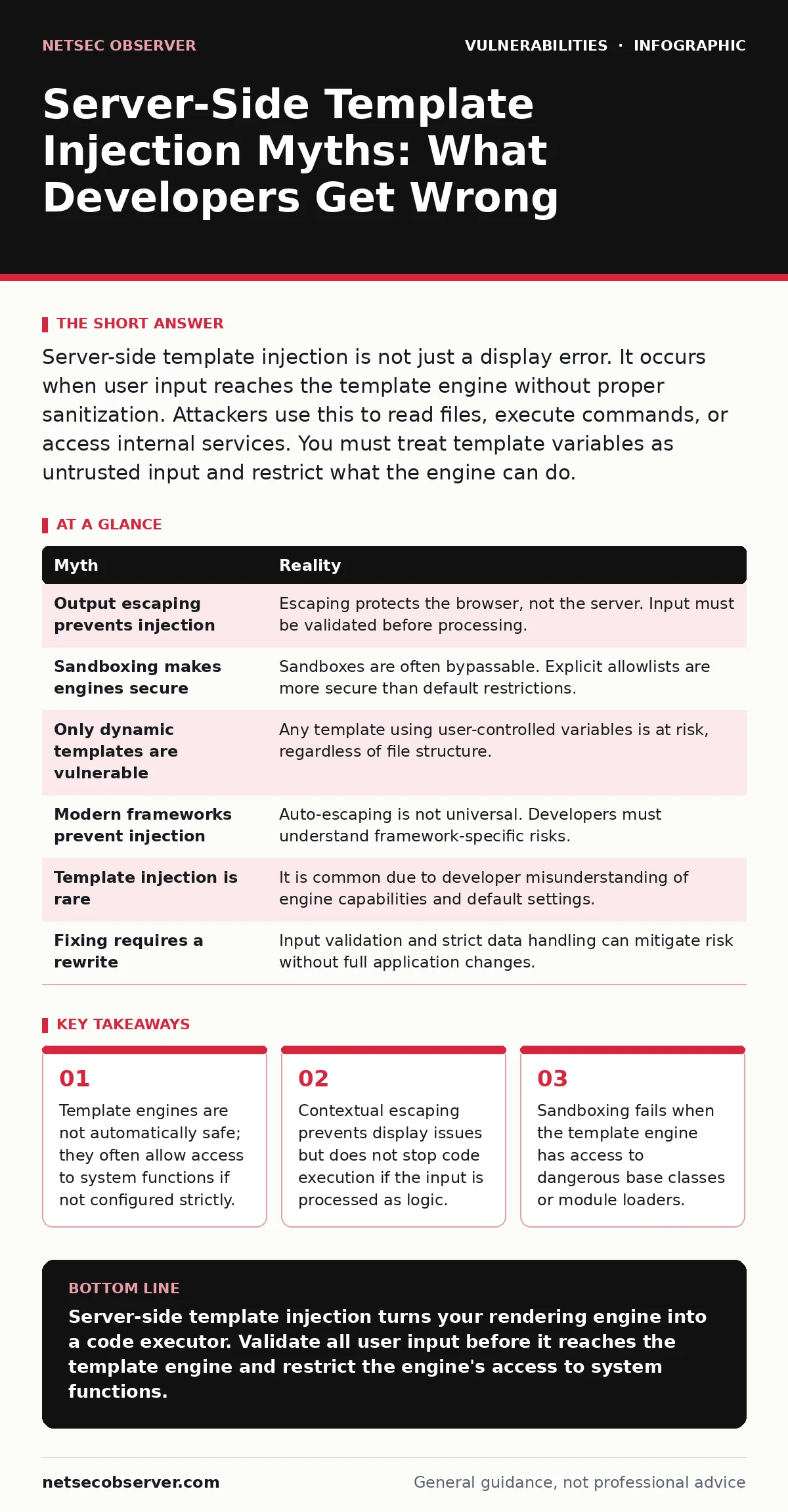
Server-side template injection is not just a display error. It occurs when user input reaches the template engine without proper sanitization. Attackers use this to read files, execute commands, or access internal services. You must treat template variables as untrusted input and restrict what the engine can do.
Myth: Output Escaping Prevents Server-Side Template Injection
Reality: Escaping special characters like angle brackets or quotes only stops the browser from interpreting injected HTML or JavaScript. It does nothing to stop the server from executing malicious logic within the template engine. When you escape output, you are protecting the user’s browser from cross-site scripting.
You are not protecting your server from server-side template injection. The template engine processes the input before the escaping happens. If the input contains template syntax, the engine executes it. The result might be escaped for display, but the damage to the server has already occurred. You must validate input at the point of entry, not just at the point of output.
Suppose you display a user’s name in a welcome message. If you escape the output, <script> tags become harmless text in the browser. However, if the template engine interprets {{7*7}} as a calculation, it runs that math on the server. The browser sees 49. The server has already executed code. This distinction is critical. Many developers assume that because the browser is safe, the server is safe. This assumption leads to severe vulnerabilities. You must treat the template engine as a code interpreter, not just a text formatter.
Myth: Sandboxing Template Engines Makes Them Secure
Reality: Sandboxing aims to restrict what a template engine can do, but these restrictions are often incomplete or bypassable. Most template engines provide a way to access underlying objects or modules. Attackers can traverse object properties to find dangerous functions. For example, they might access a base class that includes file reading capabilities. Sandboxes usually block direct access to known dangerous modules.
They do not block access to every possible path to those modules. An attacker can use the environment to load new modules or access system properties. The sandbox becomes a puzzle rather than a barrier. You cannot rely on the default sandbox configuration for security. You must explicitly allow only the specific functions you need. Deny everything else by default. This approach is difficult to maintain but necessary for true security.
Imagine a template engine that blocks access to the os module. An attacker might access __import__ to load a different module. Or they might use a configuration object that already has file handles open. The sandbox fails because it assumes the attacker can only use what is explicitly exposed. It does not account for the complex web of objects available in the runtime environment. You must audit the entire object graph accessible to the template. This is labor-intensive and error-prone. It is better to avoid using powerful template engines for untrusted input entirely.
Myth: Only Dynamic Templates Are Vulnerable to Injection
Reality: Static templates that include user-controlled variables are just as vulnerable as fully dynamic ones. The risk exists wherever user input influences the template structure or logic. Many developers believe that if the template file itself is fixed, it is safe. This is incorrect. If a variable in that fixed template comes from user input, the attacker can inject template syntax into that variable.
The engine processes the variable value as part of the template logic. The static nature of the file provides no protection. The vulnerability lies in the data flow, not the template structure. You must assume that any variable derived from external input is hostile. This includes query parameters, headers, and database values. Do not trust the source of the data. Trust only the validation and sanitization applied to it.
Myth: Modern Frameworks Automatically Prevent Template Injection
Reality: Modern web frameworks often include auto-escaping features, but these are not universal or foolproof. Auto-escaping usually applies to text output. It does not apply to control structures, filters, or methods called within the template. If a framework allows you to use a filter that executes code, auto-escaping will not stop it. Some frameworks also allow disabling auto-escaping for specific contexts. Developers often disable it for performance or convenience, creating vulnerabilities.
The framework provides tools, not guarantees. You must understand how your specific framework handles data. You must know which contexts are auto-escaped and which are not. Relying on the framework to be smart enough to protect you is a dangerous strategy. You must actively secure your templates. This means reviewing every place where user input enters the template. It means testing for injection with template-specific payloads.
Suppose you use a framework that auto-escapes HTML. You might think you are safe. But if you use a filter to format a date, and that filter accepts a format string from the user, you might enable injection. The framework does not know the format string is dangerous. It only knows it is text. You must validate the format string yourself. You must ensure it does not contain template syntax. This requires manual effort and constant vigilance. The framework helps, but it does not solve the problem.
Myth: Server-Side Template Injection Is Rare in Practice
Reality: Server-side template injection is common because many developers do not understand how template engines work. They assume that because the engine is designed for display, it is safe for data. This misunderstanding leads to widespread misuse. Many popular template engines are not secure by default. They are designed for flexibility, not security. Developers often enable features that allow code execution for convenience. This creates vulnerabilities that are easy to exploit.
The attack surface is large. Any application that uses a template engine and accepts user input is at risk. You should not assume your application is safe because it uses a modern stack. You must test for template injection specifically. Standard web application scanners often miss these vulnerabilities. You need specialized tests and manual review. The prevalence of this vulnerability is a testament to the gap between developer knowledge and engine capabilities.
Myth: Fixing Template Injection Requires Rewriting the Application
Reality: You can often mitigate server-side template injection without a full rewrite. The key is to separate data from logic. Use a template engine that does not allow code execution. If you must use a powerful engine, restrict its access to the environment. Do not pass user input directly into the template engine. Process and sanitize it first. Convert user input to a safe data type before it reaches the template.
For example, if you expect a string, ensure it is a string and contains no template syntax. You can use allowlists for expected values. If the input does not match the allowlist, reject it. This approach reduces the attack surface significantly. It does not require changing the entire application architecture. It requires changing how you handle input at the boundary. This is a manageable fix for most applications.
Imagine you have a legacy application with many templates. You cannot rewrite it all at once. You can add a validation layer before the template engine. This layer checks for template syntax in user input. If it finds any, it blocks the request. This stops most attacks. It is not a perfect solution, but it is a effective stopgap. You can then plan a longer-term migration to a safer engine or architecture. This incremental approach is practical and effective. It addresses the immediate risk while you work on a permanent solution.
| Myth | Reality |
|---|---|
| Output escaping prevents injection | Escaping protects the browser, not the server. Input must be validated before processing. |
| Sandboxing makes engines secure | Sandboxes are often bypassable. Explicit allowlists are more secure than default restrictions. |
| Only dynamic templates are vulnerable | Any template using user-controlled variables is at risk, regardless of file structure. |
| Modern frameworks prevent injection | Auto-escaping is not universal. Developers must understand framework-specific risks. |
| Template injection is rare | It is common due to developer misunderstanding of engine capabilities and default settings. |
| Fixing requires a rewrite | Input validation and strict data handling can mitigate risk without full application changes. |
Key takeaways
- Template engines are not automatically safe; they often allow access to system functions if not configured strictly.
- Contextual escaping prevents display issues but does not stop code execution if the input is processed as logic.
- Sandboxing fails when the template engine has access to dangerous base classes or module loaders.
Server-side template injection turns your rendering engine into a code executor. Validate all user input before it reaches the template engine and restrict the engine's access to system functions.
Frequently asked questions
How do I test for server-side template injection?
Use payloads that evaluate expressions, such as `{{7*7}}` or `{{config}}`. If the output changes or reveals internal data, you likely have an injection vulnerability.
Is server-side template injection related to cross-site scripting?
No. Cross-site scripting targets the user’s browser. Server-side template injection targets the server. They require different defenses and exploit different mechanisms.
Can I use a whitelist to prevent template injection?
Yes. Define exactly what input is allowed. Reject anything that does not match the expected format or content. This is more secure than trying to block bad input.
Does using a simple template engine help?
Yes. Engines that only support variable substitution and basic loops are safer. Avoid engines that allow direct code execution or access to the underlying programming language.
How this guide was produced: written by the NetSec Observer editorial team with AI assistance, checked against the public references listed below, and reviewed when the facts change. See our editorial policy or report an error.