
Hardcoded Secrets in Source Code: How to Find, Fix and Prevent Them
Hardcoded secrets leak when developers commit credentials to version control, creating permanent exposure even after the code is deleted from the repository history.
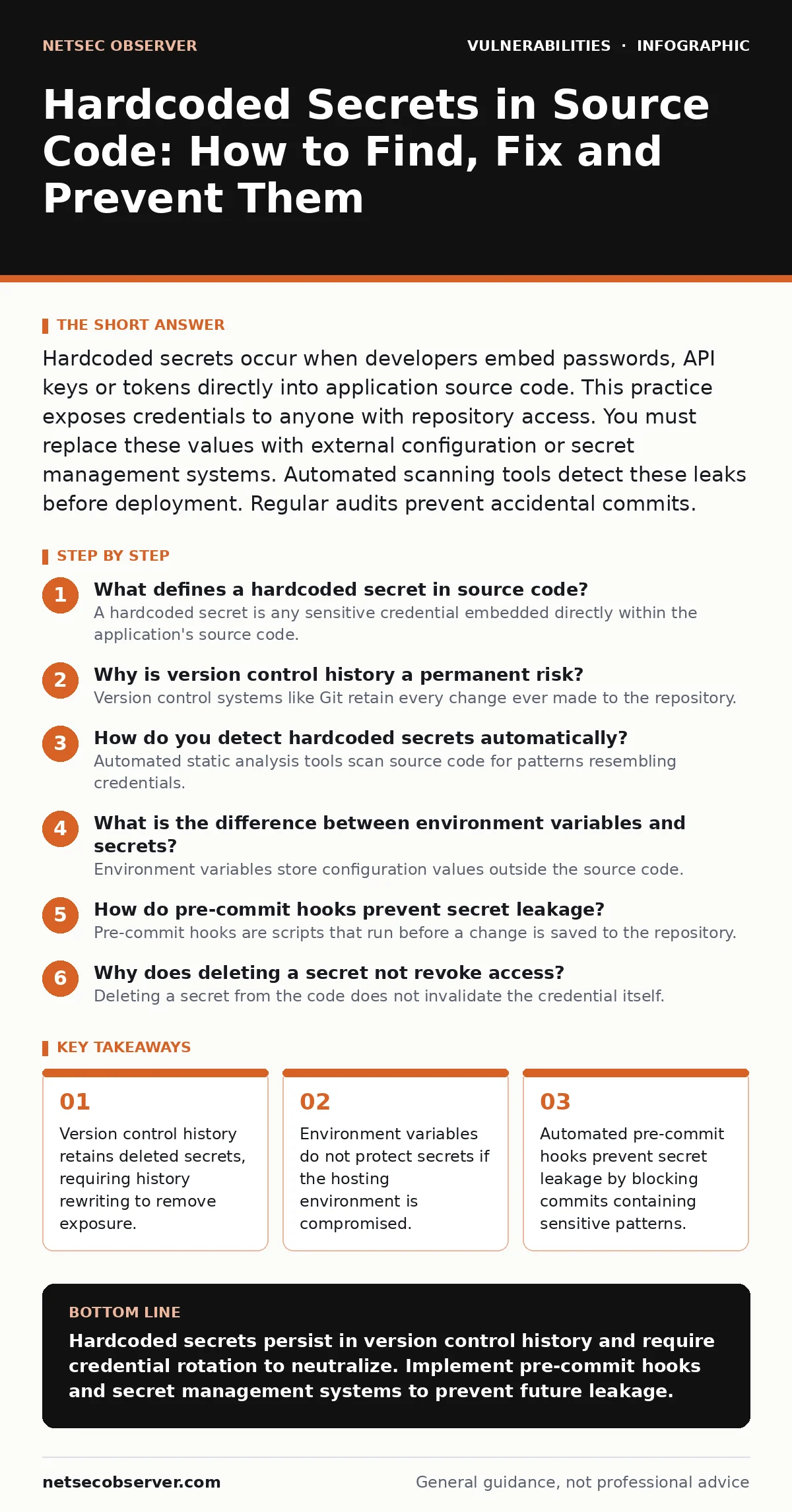
Hardcoded secrets occur when developers embed passwords, API keys or tokens directly into application source code. This practice exposes credentials to anyone with repository access. You must replace these values with external configuration or secret management systems. Automated scanning tools detect these leaks before deployment. Regular audits prevent accidental commits.
What defines a hardcoded secret in source code?
A hardcoded secret is any sensitive credential embedded directly within the application's source code. This includes passwords, API keys, encryption keys, database connection strings and digital certificates. Developers often insert these values for convenience during local testing. The code then moves to production without removal. This practice treats sensitive data as static code. Static code is visible to anyone who can read the repository. It bypasses standard access controls for configuration management. The credential becomes part of the software binary. This makes extraction trivial for attackers.
Why is version control history a permanent risk?
Version control systems like Git retain every change ever made to the repository. Deleting a file containing a secret removes it from the current codebase. It does not remove it from the history. Attackers can clone the repository and inspect past commits. They can reconstruct the secret from historical data. This means simply removing the secret from the latest version is insufficient. The credential remains accessible indefinitely. Rewriting the entire history is required to erase the trace. This process is complex and risky for large projects.
How do you detect hardcoded secrets automatically?
Automated static analysis tools scan source code for patterns resembling credentials. These tools use regular expressions and machine learning models. They identify strings that match known formats for AWS keys, SSH tokens or API identifiers. Integration into the continuous integration pipeline ensures every commit is checked. This provides immediate feedback to developers. Manual code reviews are insufficient for detecting subtle secrets. Humans miss patterns in large codebases. Automated scanning scales with the project size. It catches errors before they reach production.
| Detection Method | Scope | Accuracy | Maintenance Effort |
|---|---|---|---|
| Manual Code Review | Limited | Low | High |
| Regex Scanning | Broad | Medium | Medium |
| ML-Based Analysis | Contextual | High | Low |
| Pre-Commit Hooks | Immediate | High | Low |
What is the difference between environment variables and secrets?
Environment variables store configuration values outside the source code. They are accessible to the application at runtime. They are not hardcoded in the files. However, they are not inherently secure. Environment variables are visible to processes running on the same host. They can be dumped from memory or process listings. They are often logged in application output. True secrets require encryption at rest and in transit. They require strict access controls. Environment variables are a step up from hardcoded values. They are not a complete security solution.
How do pre-commit hooks prevent secret leakage?
Pre-commit hooks are scripts that run before a change is saved to the repository. They scan the staged files for sensitive patterns. If a match is found, the commit is blocked. The developer receives an error message. They must remove the secret before proceeding. This creates a safety net at the point of entry. It prevents accidental commits of credentials. It enforces security policies automatically. Developers do not need to remember to run scans. The hook integrates into their workflow. It reduces the cognitive load on the team.
Why does deleting a secret not revoke access?
Deleting a secret from the code does not invalidate the credential itself. The password or key remains valid until the issuing system revokes it. Attackers who found the secret in history can still use it. You must rotate the credential immediately. Rotation involves generating a new secret and disabling the old one. This ensures previous exposure is neutralized. Failing to rotate leaves the system vulnerable. The old secret works indefinitely. This extends the window of opportunity for attackers. Rotation is mandatory after any leak.
What are the risks of using shared secrets?
Shared secrets are credentials used by multiple components or services. If one component is compromised, the secret is exposed. Attackers can then access all other services using that secret. This creates a single point of failure. Compromise spreads rapidly across the system. Unique secrets per service limit the blast radius. This is the principle of least privilege. Each component should have its own credentials. This isolates breaches. It prevents lateral movement. Shared secrets simplify management but increase risk. The trade-off favors unique credentials.
How do you handle secrets in containerized environments?
Containers package applications with their dependencies. Secrets should not be baked into the container image. Images are often stored in public registries. They are immutable and versioned. A secret in an image is exposed forever. Use external secret management systems instead. Inject secrets at runtime via environment variables or mounted volumes. These systems encrypt secrets at rest. They provide audit logs for access. They support automatic rotation. This keeps the container image clean. It separates configuration from code. It enhances overall security posture.
What is the role of secret management systems?
Secret management systems provide a centralized repository for credentials. They encrypt secrets at rest and in transit. They manage access controls and audit logs. They support automatic rotation of credentials. Applications retrieve secrets dynamically at runtime. This eliminates the need to store secrets in configuration files. It reduces the risk of accidental leakage. It simplifies compliance with security standards. It provides a single source of truth. It enables consistent security policies. It scales with organizational complexity.
How do you audit for hardcoded secrets effectively?
Auditing requires scanning both current code and historical data. Use specialized tools designed for deep history scanning. These tools analyze every commit in the repository. They identify secrets that were introduced and later removed. They generate reports of exposed credentials. This allows for comprehensive risk assessment. Regular audits ensure ongoing compliance. They catch secrets that bypassed initial checks. They provide visibility into past mistakes. They inform future security policies. They are part of a continuous improvement cycle.
Key takeaways
- Version control history retains deleted secrets, requiring history rewriting to remove exposure.
- Environment variables do not protect secrets if the hosting environment is compromised.
- Automated pre-commit hooks prevent secret leakage by blocking commits containing sensitive patterns.
Hardcoded secrets persist in version control history and require credential rotation to neutralize. Implement pre-commit hooks and secret management systems to prevent future leakage.
Frequently asked questions
Can I use a .gitignore file to hide secrets?
No, .gitignore only prevents new files from being tracked. It does not remove secrets already committed to the repository history.
Is it safe to use dummy credentials in production code?
Dummy credentials are safe if they are clearly marked as test data. They must never be used for actual authentication or authorization.
How do I rewrite Git history to remove a secret?
Use tools like BFG Repo-Cleaner or git filter-branch to rewrite history. Force push the changes and notify all collaborators to reclone the repository.
Do cloud providers store my environment variables securely?
Cloud providers encrypt data at rest, but environment variables are accessible to applications running on the same instance. Use dedicated secret managers for better protection.
How this guide was produced: written by the NetSec Observer editorial team with AI assistance, checked against the public references listed below, and reviewed when the facts change. See our editorial policy or report an error.