Industrial Control System Vulnerabilities Explained
Factory software often lacks modern security because speed and uptime matter more than encryption in these critical physical systems.
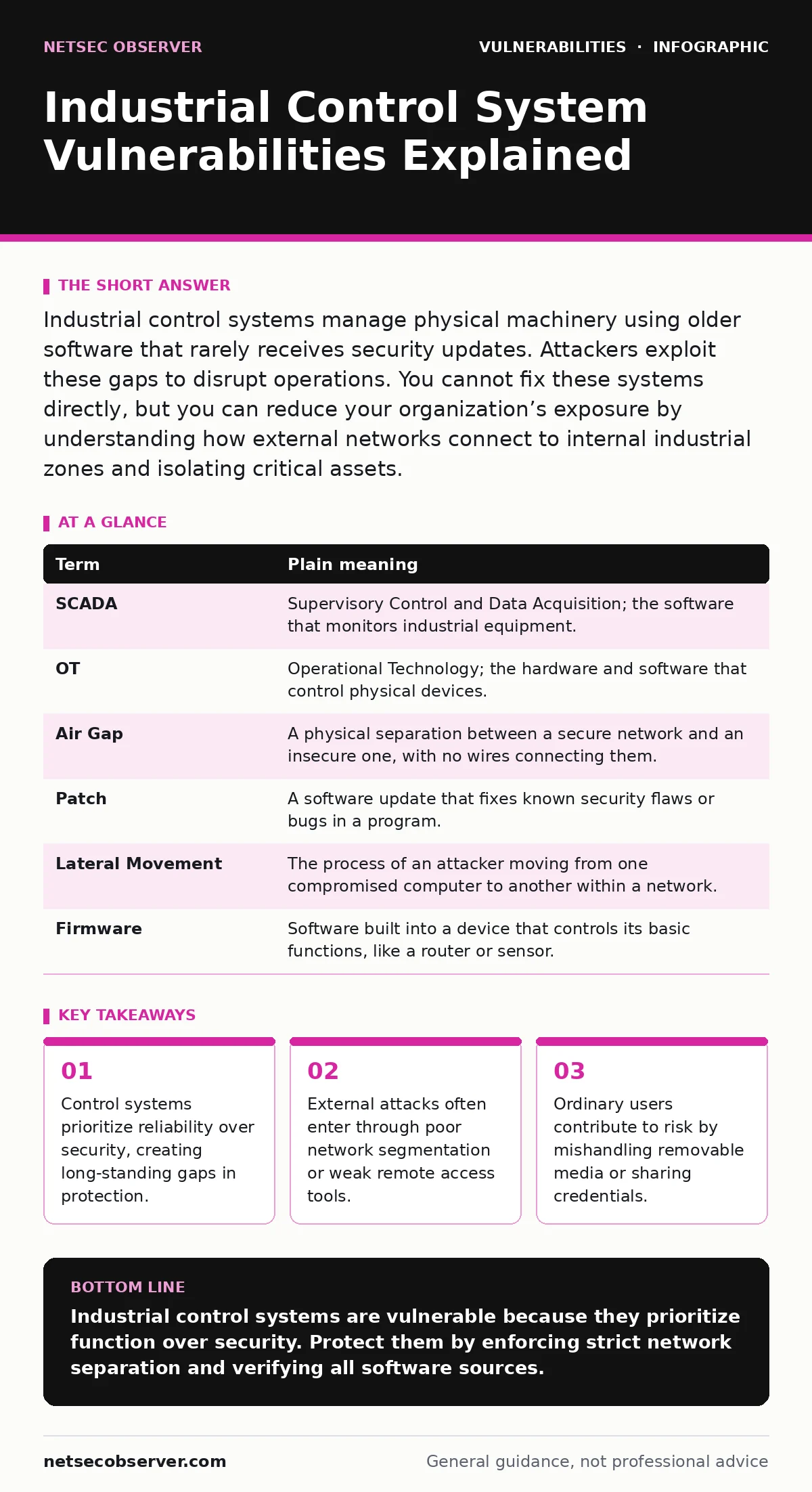
Industrial control systems manage physical machinery using older software that rarely receives security updates. Attackers exploit these gaps to disrupt operations. You cannot fix these systems directly, but you can reduce your organization’s exposure by understanding how external networks connect to internal industrial zones and isolating critical assets.
The Power Plant Analogy
Imagine a modern power plant. The control room is a secure office with high-speed internet, email, and web browsers. This is the corporate network. Downstairs, in a locked room, are the machines that generate electricity. These machines run on specialized software that only knows how to turn valves and monitor temperature. This is the industrial control system. The two areas are separated by a heavy door, but someone left a window open for maintenance. Attackers do not break down the main door. They slip through the open window, bypassing the office security entirely, to reach the machines that control physical processes.
Key Terms for Beginners
Security professionals use specific language that can obscure the real risks. Understanding these terms helps you see where the weaknesses lie.
| Term | Plain meaning |
|---|---|
| SCADA | Supervisory Control and Data Acquisition; the software that monitors industrial equipment. |
| OT | Operational Technology; the hardware and software that control physical devices. |
| Air Gap | A physical separation between a secure network and an insecure one, with no wires connecting them. |
| Patch | A software update that fixes known security flaws or bugs in a program. |
| Lateral Movement | The process of an attacker moving from one compromised computer to another within a network. |
| Firmware | Software built into a device that controls its basic functions, like a router or sensor. |
Why These Systems Are Fragile
Industrial systems were designed decades before the internet became a threat vector. The primary goal was always uptime and precision, not security. Engineers built these systems to run for years without interruption. Adding security checks slows down processes. In a factory, a millisecond delay can ruin a product. In a power grid, a delay can cause a blackout. Consequently, many industrial controllers lack basic security features like strong authentication or encryption. They often rely on hard-coded credentials that cannot be changed, leaving the door open for anyone who knows the default password.
The Path from Office to Factory
Attackers rarely target industrial systems directly from the internet. Instead, they target the corporate network first. Suppose an employee clicks a malicious link in an email. The attacker gains access to the office computer. From there, they look for a bridge to the industrial network. This bridge often exists because IT staff need to monitor industrial data or update software.
If the connection between the office and the factory is not properly segmented, the attacker moves laterally. They cross from the insecure office zone to the critical industrial zone. This is why external attack surface scanning is vital for identifying these hidden connections before an attacker does.
What This Means for You
You may not work in a factory, but your digital habits affect industrial security. If your company uses industrial systems, your personal actions can create entry points. Using the same password for your personal email and your work account gives attackers a shortcut. Connecting a personal USB drive to a work computer can transfer malware directly into the industrial network. Even simple mistakes, like leaving a remote access tool logged in, provide a foothold. The security of critical infrastructure depends on the discipline of every user in the organization.
Simple Safety Habits
You cannot rewrite the firmware of a factory controller, but you can reduce the risk of initial compromise. Follow these steps to protect your organization’s perimeter.
- Treat removable media as dangerous. Do not plug in unknown USB drives. Many industrial systems still use these for updates, making them a prime target for malware.
- Separate your networks. Ensure that your personal devices are on a guest network that cannot access internal corporate or industrial resources.
- Verify software sources. Only install software from trusted vendors. Unknown tools often contain hardcoded secrets in source code that attackers can exploit to gain unauthorized access.
Hidden Costs of Security
Adding security to industrial systems is not just about buying new software. It requires changing how work is done. Engineers must test every update in a safe environment before deploying it to live systems. This testing takes time and money. It also means that some vulnerabilities cannot be patched immediately. You must accept that some risk remains. The goal is not zero risk, but manageable risk. Understanding this trade-off helps you prioritize which defenses are most effective.
The Role of Awareness
Security is not just a technical problem. It is a human one. Attackers often use social engineering to trick employees into revealing information. They may pose as IT support or a vendor. If you receive an unexpected request for credentials or system access, verify it through a separate channel. Do not trust the email or phone call alone. This simple verification step stops many attacks before they begin. Awareness training is not a one-time event. It is a continuous practice that keeps your team sharp against evolving threats.
Key takeaways
- Control systems prioritize reliability over security, creating long-standing gaps in protection.
- External attacks often enter through poor network segmentation or weak remote access tools.
- Ordinary users contribute to risk by mishandling removable media or sharing credentials.
Industrial control systems are vulnerable because they prioritize function over security. Protect them by enforcing strict network separation and verifying all software sources.
Frequently asked questions
Can an attacker shut down a power grid from my home computer?
Directly, no. Attackers usually need to compromise a corporate network first to reach industrial systems. Your home computer is not a direct entry point to a power plant.
Why don't industrial systems use modern security software?
Modern security tools can slow down processes or cause crashes. Industrial systems require extreme stability, so operators often disable security features to prevent operational disruptions.
Is air-gapping enough to protect industrial systems?
No. Air gaps can be bridged by removable media, insider threats, or poor physical security. Attackers often find ways to introduce malware via USB drives or maintenance laptops.
How do I know if my company has industrial vulnerabilities?
You likely cannot know directly. Rely on your IT department to perform regular **external attack surface scanning** and consult the **CISA Known Exploited Vulnerabilities catalog** for known risks.
How this guide was produced: written by the NetSec Observer editorial team with AI assistance, checked against the public references listed below, and reviewed when the facts change. See our editorial policy or report an error.