
Multi-Region Failover: How to Keep Services Alive When Cloud Zones Drop
Multi-region failover moves traffic across physical borders to survive total data center outages, not just server crashes.
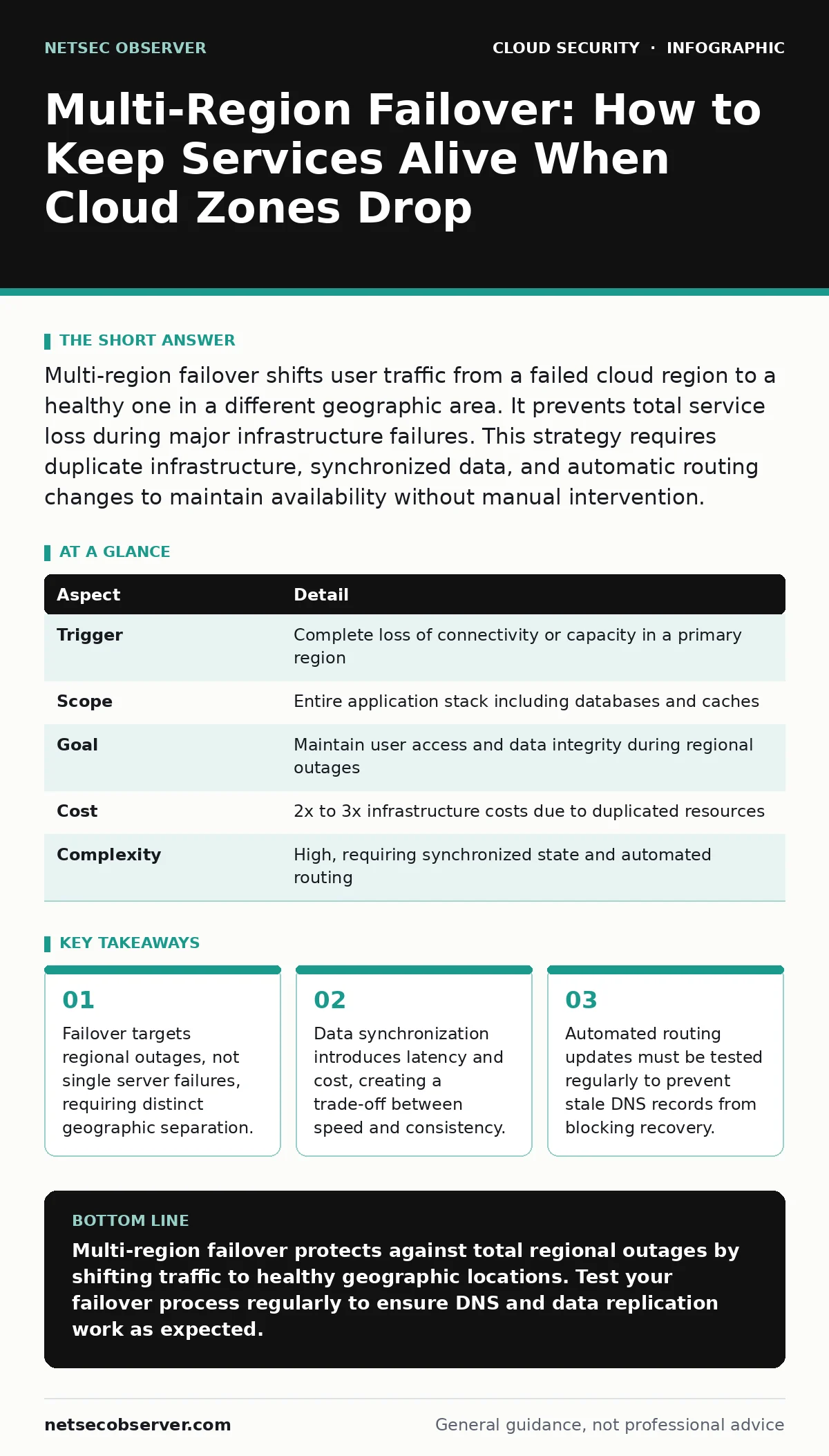
Multi-region failover shifts user traffic from a failed cloud region to a healthy one in a different geographic area. It prevents total service loss during major infrastructure failures. This strategy requires duplicate infrastructure, synchronized data, and automatic routing changes to maintain availability without manual intervention.
The Airport Runway Analogy
Imagine an airport with only one runway. If that runway closes for repairs, every flight on the ground must wait, and incoming flights must divert to distant cities. Now imagine an airport with three runways. If one closes, air traffic control simply directs planes to the other two. The planes do not stop. The passengers do not notice the closure. Multi-region failover works the same way for cloud infrastructure. You build identical services in separate geographic locations. When one location fails, traffic flows to the others.
What Multi-Region Failover Actually Does
Multi-region failover is a design pattern that distributes application components across two or more independent cloud regions. A region is a distinct geographic area containing multiple data centers. The purpose is to maintain service availability when an entire region becomes unreachable. This differs from high availability within a single region. Single-region high availability protects against server crashes or rack failures. Multi-region failover protects against natural disasters, power grid failures, or major provider outages.
| Aspect | Detail |
|---|---|
| Trigger | Complete loss of connectivity or capacity in a primary region |
| Scope | Entire application stack including databases and caches |
| Goal | Maintain user access and data integrity during regional outages |
| Cost | 2x to 3x infrastructure costs due to duplicated resources |
| Complexity | High, requiring synchronized state and automated routing |
The Problem It Solves
Cloud providers are reliable, but they are not infallible. Power grids fail. Fiber optic cables break. Software bugs cascade through massive infrastructure. When a whole region goes dark, your application stops working. Users see error pages. Transactions fail. Reputation suffers. Multi-region failover solves this by ensuring no single geographic point of failure controls your entire service. You accept higher costs to buy resilience against catastrophic events.
Core Components of the Architecture
You need four main parts for this to work. First, you need redundant infrastructure. This means running the same application code and database schemas in at least two regions. Second, you need data replication. Changes made in the primary region must copy to the secondary region. This can happen in real-time or with a slight delay. Third, you need a global load balancer. This service monitors the health of each region and directs user traffic. Fourth, you need an automation script. When the load balancer detects failure, it must update DNS records or routing tables to point users to the healthy region.
The Hidden Cost of Data Sync
Data replication is the hardest part of multi-region failover. You face a trade-off between consistency and availability. If you replicate data in real-time, writes are slow because the system must confirm the copy before acknowledging the user. If you replicate with a delay, you risk losing recent data if the primary region fails before the copy completes. This is known as eventual consistency. You must choose which data is critical. User passwords can tolerate slight delays. Financial transactions usually cannot.
See also: Debunking Secrets in Source Code: 6 Myths That Leave Systems Open
Where It Fits in Your Defense
Multi-region failover is an availability control, not a security control. It does not stop attackers. It keeps your service running when infrastructure fails. You must combine it with other practices. Use cloud key management services to protect encryption keys across regions. Ensure your infrastructure-as-code scanning checks for misconfigurations in every region. Do not assume that failover protects you from cloud ransomware. Attackers can encrypt data in the primary region, and if that encrypted data replicates, the secondary region also holds encrypted files. Failover restores access, but not necessarily clean data.
What People Usually Get Wrong
Many teams think they have multi-region failover because they deploy to two regions. They are wrong if they do not test the failover process. DNS records can cache for hours. If your failover script does not handle DNS Time-To-Live (TTL) settings, users will continue to try to connect to the dead region. Another common mistake is treating the secondary region as a backup. A backup is for recovery after a disaster. A failover region is for continuous operation. You must keep the secondary region active and updated.
Testing Your Failover Plan
You cannot trust a failover system you have not broken. Schedule regular chaos engineering tests. Intentionally shut down the primary region during low-traffic hours. Watch how the global load balancer reacts. Measure how long it takes for traffic to shift. Check if data is consistent. Look for errors in application logs. This process reveals hidden dependencies. You might find that a third-party API only works in the primary region. You might find that your monitoring alerts do not trigger fast enough. Fix these gaps before a real outage occurs.
Balancing Cost and Resilience
Running two full copies of your infrastructure is expensive. You pay for idle resources in the secondary region. You pay for data transfer between regions. You pay for increased complexity in your engineering team. You must decide how much downtime is acceptable. If your service is non-critical, you might accept a few minutes of downtime to save money. If your service handles life-critical data, you must invest in active-active architectures where both regions handle traffic simultaneously. This eliminates the switchover delay but doubles your operational complexity.
Key takeaways
- Failover targets regional outages, not single server failures, requiring distinct geographic separation.
- Data synchronization introduces latency and cost, creating a trade-off between speed and consistency.
- Automated routing updates must be tested regularly to prevent stale DNS records from blocking recovery.
- This mechanism complements application-level resilience but does not replace secure configuration practices.
Multi-region failover protects against total regional outages by shifting traffic to healthy geographic locations. Test your failover process regularly to ensure DNS and data replication work as expected.
Frequently asked questions
Does multi-region failover protect against DDoS attacks?
It helps absorb large attacks by distributing load, but you still need dedicated DDoS mitigation services to filter malicious traffic before it reaches your servers.
How long does a failover take?
It depends on your DNS TTL settings and automation. Well-configured systems can switch in seconds. Poorly configured ones may take minutes or hours due to cached records.
Can I use this for small projects?
Small projects often lack the budget for dual-region infrastructure. Start with single-region high availability. Move to multi-region only when your service grows and downtime becomes costly.
Is active-active better than active-passive?
Active-active handles traffic in both regions, offering better performance and no switchover delay. Active-passive is cheaper but requires a brief interruption while the secondary region takes over.
How this guide was produced: written by the NetSec Observer editorial team with AI assistance, checked against the public references listed below, and reviewed when the facts change. See our editorial policy or report an error.