
What Is Callback Phishing: How Attackers Use Phone Calls to Steal Access
Callback phishing bypasses email filters by moving the attack to a voice channel where technical defenses cannot inspect the content of the conversation.
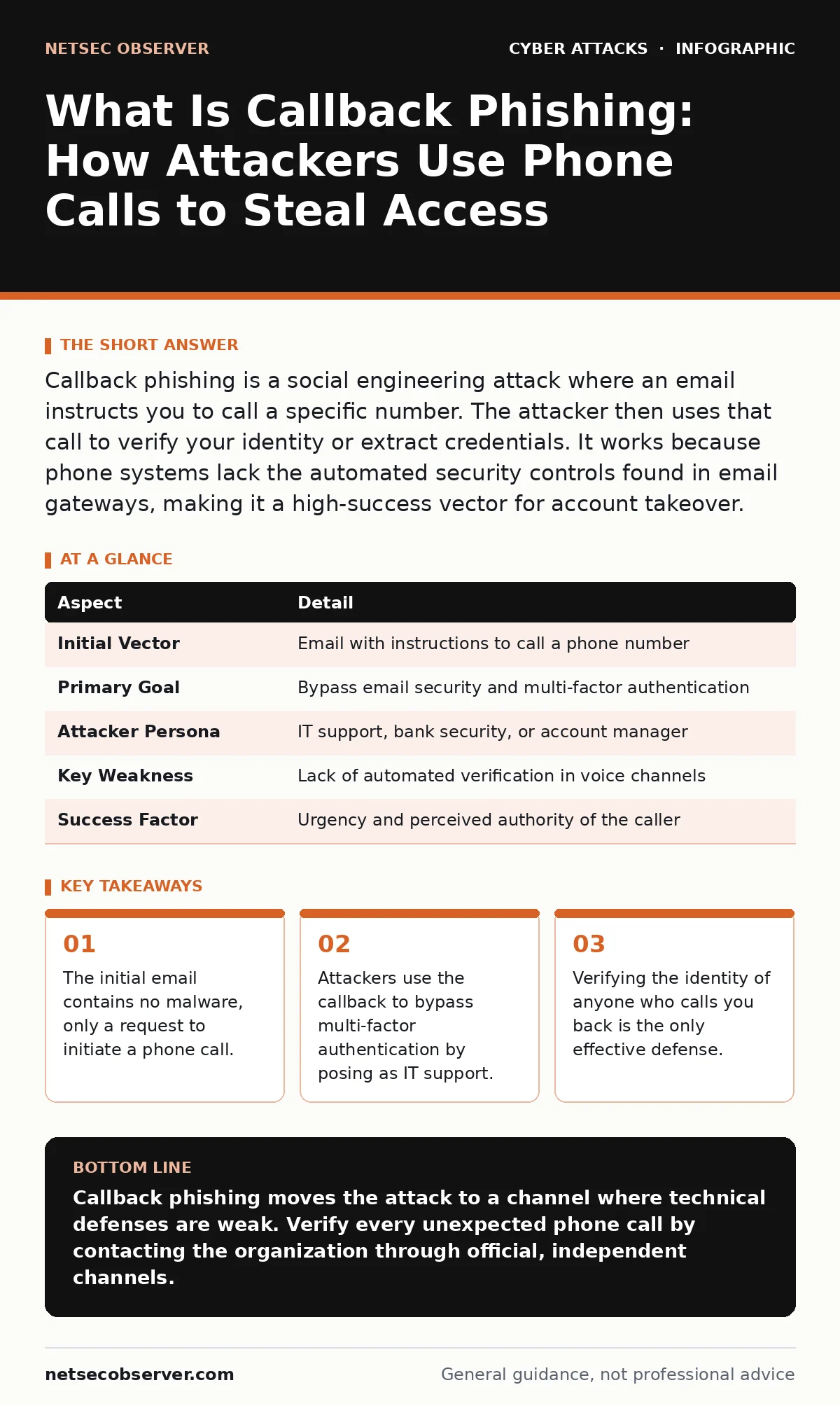
Callback phishing is a social engineering attack where an email instructs you to call a specific number. The attacker then uses that call to verify your identity or extract credentials. It works because phone systems lack the automated security controls found in email gateways, making it a high-success vector for account takeover.
The Mechanics of Callback Phishing
Imagine you receive a package that requires a signature. You do not open the box yourself. Instead, you call the courier service to arrange a time for delivery. The courier arrives, asks for your ID, and signs for the package on your behalf. In this scenario, the courier is not who they claim to be. They are an attacker who used your trust in the delivery process to gain access to your home.
Callback phishing follows this exact pattern. An attacker sends an email that appears to come from a trusted source, such as a bank, a cloud provider, or an internal IT department. The email does not contain a malicious link or an infected attachment. It contains a simple instruction: call the phone number listed below to resolve an urgent issue. The issue might be a suspended account, a billing discrepancy, or a security alert.
The recipient calls the number. The person on the other side is the attacker. They have already gathered some information about the victim from the initial email or from public records. They use this information to build rapport and establish authority. The goal is to get the victim to perform an action that grants the attacker access.
What Is Callback Phishing and Why It Works
What is callback phishing? It is a social engineering technique that shifts the attack vector from digital to analog. Traditional phishing relies on the victim clicking a link or downloading a file. These actions can be blocked by email security tools, web filters, and endpoint protection. Callback phishing removes these technical barriers.
The attack succeeds because human psychology remains consistent across channels. People are trained to follow instructions from authority figures. When an email from a "security team" tells you to call a number, you assume the number is safe. You assume the person on the other end is a colleague or a support agent. You lower your guard because you believe you are following protocol.
This method also exploits the lack of verification in voice communications. Email systems check sender addresses, domain authentication records, and content signatures. Phone systems generally do not verify the identity of the caller in real time. The attacker knows that once the call is connected, they are in a environment with minimal technical oversight.
| Aspect | Detail |
|---|---|
| Initial Vector | Email with instructions to call a phone number |
| Primary Goal | Bypass email security and multi-factor authentication |
| Attacker Persona | IT support, bank security, or account manager |
| Key Weakness | Lack of automated verification in voice channels |
| Success Factor | Urgency and perceived authority of the caller |
How the Attack Unfolds Step by Step
The attacker begins by researching the target. They may use public data to find names, job titles, and company structures. They craft an email that looks legitimate. The subject line creates urgency. It might mention a failed payment, a login attempt from a new device, or a compliance violation.
The body of the email explains the problem. It tells the recipient that they must call a specific number to verify their identity. The number is often spoofed to look like it comes from the legitimate organization. When the victim calls, the phone system displays the trusted number. This reinforces the illusion of safety.
The attacker answers the call. They introduce themselves using a name that sounds professional. They ask the victim to confirm personal details. These details might be found in public records or obtained through previous phishing attempts. The attacker uses this information to prove they are "real."
Once trust is established, the attacker asks for something more valuable. They might ask for a verification code sent to the victim's phone. They might ask the victim to change their password. They might ask the victim to approve a transaction. The victim complies because they believe they are helping the support agent resolve the issue.
Who Is Most Likely to Be Targeted
Callback phishing affects anyone with a phone and an email address. However, certain groups face higher risks. Employees in finance, human resources, and information technology are frequent targets. These roles often have access to sensitive data or financial systems. Attackers know that compromising these accounts yields high rewards.
Small businesses are also vulnerable. They may lack dedicated security teams to monitor for unusual activity. They may rely on standard email and phone services without advanced verification features. An attacker can exploit these gaps to gain initial access and move laterally through the network.
Individual users are not immune. Attackers target personal accounts to steal identities or access linked financial services. The initial email might appear to come from a utility company or a social media platform. The goal is to gain access to personal data that can be sold or used for further fraud.
What People Usually Get Wrong
Many people believe that callback phishing is rare. They focus their defenses on email links and attachments. They ignore the phone as a potential attack vector. This is a critical error. The phone is often the weakest link in the security chain.
Another common mistake is assuming that a displayed caller ID proves identity. Caller ID spoofing is easy and cheap. An attacker can make it appear that the call is coming from your bank or your IT department. You cannot trust the number on your screen. You must verify the identity of the caller through independent means.
People also fail to recognize that legitimate organizations rarely ask for sensitive information over the phone. A real support agent will not ask for your full password or your multi-factor authentication code. They will not ask you to download software or change settings based on a phone call. If someone asks for these things, hang up.
See also: Credit Freezes: What They Protect and Where They Fail
Defending Against Callback Phishing
Defense starts with awareness. You must understand that an email asking you to call is a red flag. Legitimate organizations have secure portals for account management. They do not rely on phone calls for verification. If you receive such an email, do not call the number.
Instead, verify the request through a different channel. Look up the official contact number for the organization on their website. Call that number. Ask if there is an issue with your account. This breaks the chain of deception. The attacker cannot intercept your call to their own number if you call the official line.
Implement internal policies that prohibit phone-based verification for sensitive actions. Require that password resets and account changes be done through secure web portals. Train employees to recognize the signs of account takeover attempts. Emphasize that urgency is a common tactic used by attackers to bypass critical thinking.
Advanced Techniques and Related Threats
Attackers often combine callback phishing with other techniques to increase their success rate. They may use brand impersonation to make the initial email look more authentic. They copy the logo, colors, and tone of the legitimate organization. This makes the email harder to distinguish from real communications.
They may also use typosquatting to register domain names that look similar to the target organization. The email might appear to come from a slightly misspelled domain. The phone number in the email is still the attacker's number. This adds another layer of deception.
In some cases, attackers use IP spoofing to make their emails appear to come from internal servers. This bypasses some basic email filters. The recipient sees an email from a familiar internal address and assumes it is safe. They do not realize that the email was forged.
Building a Culture of Verification
Technical controls alone cannot stop callback phishing. You need a culture of verification. Encourage employees to question unexpected requests. Create a process for verifying identity that does not rely on phone calls. Use multi-factor authentication that is tied to a physical device or a secure app.
Regular training helps. Simulate callback phishing attacks to test employee awareness. Provide feedback on how to respond correctly. Reinforce the message that urgency is a tactic, not a reality. Help employees understand that taking a moment to verify saves time and resources in the long run.
Remember that vendor email compromise often starts with a simple request. An attacker compromises a vendor account and sends emails to their customers. These emails might ask for payment changes or technical support. The callback element adds a personal touch that increases the likelihood of success. Stay vigilant against these combined threats.
Key takeaways
- The initial email contains no malware, only a request to initiate a phone call.
- Attackers use the callback to bypass multi-factor authentication by posing as IT support.
- Verifying the identity of anyone who calls you back is the only effective defense.
Callback phishing moves the attack to a channel where technical defenses are weak. Verify every unexpected phone call by contacting the organization through official, independent channels.
Frequently asked questions
Can I block callback phishing with an email filter?
No, because the email itself contains no malicious code or links. It only contains a phone number. Filters cannot assess the intent of a phone call.
Is caller ID spoofing illegal?
Laws vary by jurisdiction, but spoofing is widely used by attackers. Relying on caller ID for security is ineffective regardless of legality.
Should I ever call a number from an email?
Only if you have independently verified that the email is legitimate. Otherwise, look up the official contact number yourself and call that.
How do I report a callback phishing attempt?
Report it to your internal security team. Provide the email and the phone number. This helps them track trends and update training materials.
How this guide was produced: written by the NetSec Observer editorial team with AI assistance, checked against the public references listed below, and reviewed when the facts change. See our editorial policy or report an error.