
Credit Freezes: What They Protect and Where They Fail
Credit freezes block new account openings but do not prevent thieves from using existing accounts or stealing your identity for non-financial crimes.
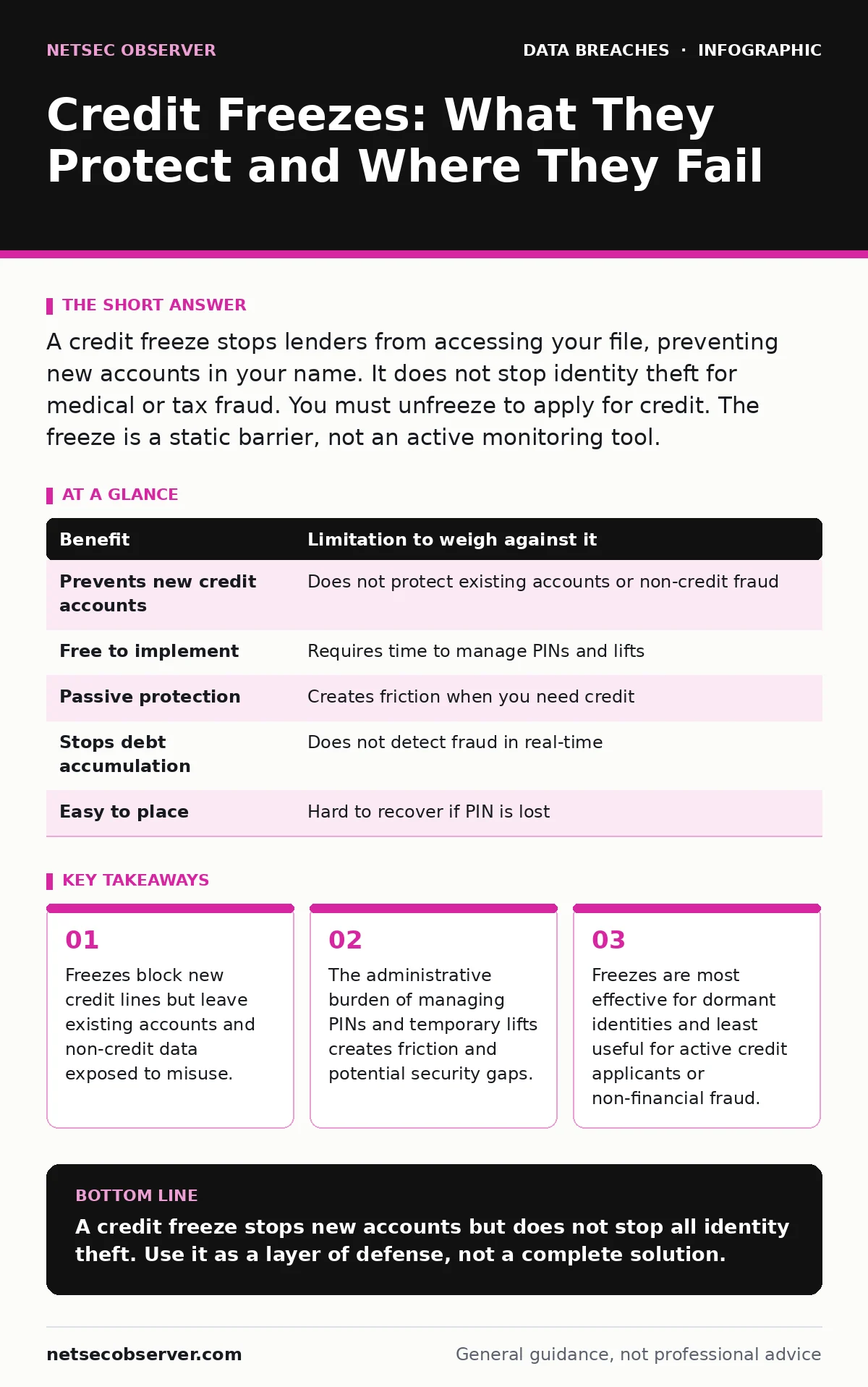
A credit freeze stops lenders from accessing your file, preventing new accounts in your name. It does not stop identity theft for medical or tax fraud. You must unfreeze to apply for credit. The freeze is a static barrier, not an active monitoring tool.
The Mechanics of a Credit Freeze
A credit freeze, also known as a security freeze, restricts access to your credit report. When you place a freeze, the three major credit bureaus lock your file. Lenders cannot pull your report without your explicit permission. This prevents a fraudster from opening a new credit card, loan, or utility account in your name.
The mechanism is simple. The bureau checks for a freeze flag before releasing data. If the flag is present, the request is denied. You control the flag using a personal identification number, or PIN. You must lift the freeze temporarily or permanently to allow a lender to see your history.
This is different from a fraud alert. A fraud alert asks lenders to verify your identity before approving credit. A freeze stops the verification process entirely. The lender cannot even see if you exist to verify anything.
Concrete Benefits of Blocking Access
The primary benefit is prevention. You stop the creation of new debt before it happens. If a thief has your Social Security number and date of birth, they can often open a credit card. A freeze makes that impossible. The application fails at the first step.
This protection is passive. You do not need to monitor your accounts constantly. The freeze works while you sleep. It requires no active participation once set up. This is useful for people who do not apply for credit frequently.
Another benefit is the low barrier to entry. In most jurisdictions, placing and removing a freeze is free for consumers. You do not need to pay a monthly subscription. The service is mandated by law, not sold as a product.
Honest Limitations of the Freeze
A freeze only protects against new credit applications. It does not protect existing accounts. If a thief steals your credit card number, they can charge your existing card. The freeze does not stop this. Your existing creditors already have access to your history. They do not need to pull a new report to process a transaction.
Identity theft is not just about credit. A thief can use your identity to file false tax returns. They can open a bank account using only your name and ID, without a credit check. They can seek medical care or enroll in insurance plans. A credit freeze does not stop these actions.
The administrative cost is high. You must manage PINs for each bureau. If you lose the PIN, you must go through a recovery process that requires sending documents by mail. This takes time. If you need credit quickly, the delay can be costly.
When It Is Worth It
A freeze is worth it if you have a dormant financial identity. This includes students who have never applied for credit. It includes people who do not plan to buy a house or car soon. For these groups, the risk of unauthorized account opening is high, and the need to access credit is low.
It is also worth it if you have previously been a victim of fraud. If your data has been exposed in a breach, the likelihood of misuse increases. A freeze adds a layer of defense that makes it harder for criminals to exploit your information.
Imagine you receive a letter about an account you never opened. You realize your data was compromised. Placing a freeze immediately stops further damage. You can then investigate the specific account without worrying about new ones appearing.
When It Is Not Worth It
A freeze is not worth it if you apply for credit frequently. If you are house hunting, you will need to lift the freeze multiple times. Each lift requires time and effort. The friction of managing the freeze can become a burden.
It is not worth it if you rely solely on it for security. You must still monitor your accounts. You must still respond to suspicious activity. A freeze is a lock on the door, not an alarm system. It does not tell you if someone is trying to break in.
Suppose you need a loan for a small business. You must lift the freeze, apply, and then refreeze. If you forget to refreeze, you leave yourself exposed. The mental overhead of managing this cycle can lead to errors.
See also: Personally Identifiable Information: Small Business Protection Strategies · Data Scraping: How It Works and How to Stop It
The Hidden Cost of Convenience
The biggest hidden cost is the false sense of security. People believe a freeze makes them invulnerable. This leads to neglecting other security measures. They stop checking bank statements. They ignore phishing emails. They do not update passwords.
This complacency is dangerous. A freeze does not protect your email account. It does not protect your social media profiles. It does not protect your banking login credentials. Hackers target these accounts to steal money directly, not to open new credit lines.
You must treat the freeze as one tool in a larger set. It is not a replacement for good hygiene. It is not a replacement for monitoring. It is a specific countermeasure against a specific type of fraud.
Weighing Benefits Against Limitations
| Benefit | Limitation to weigh against it |
|---|---|
| Prevents new credit accounts | Does not protect existing accounts or non-credit fraud |
| Free to implement | Requires time to manage PINs and lifts |
| Passive protection | Creates friction when you need credit |
| Stops debt accumulation | Does not detect fraud in real-time |
| Easy to place | Hard to recover if PIN is lost |
This table shows the trade-offs. You gain prevention but lose convenience. You gain security but lose simplicity. You must decide if the risk of new accounts is higher than the hassle of managing the freeze.
Integrating with Other Defenses
A freeze works best when combined with other measures. You should also use multi-factor authentication on your financial accounts. This adds a second layer of verification for logins. It protects against credential theft.
You should also monitor your credit reports regularly. Many services offer free weekly reports. This allows you to spot unauthorized inquiries or changes. A freeze prevents new accounts, but monitoring detects them if the freeze fails.
Consider dark web monitoring to know if your credentials are exposed. If your email and password are for sale, you should change them immediately. A freeze does not help if your bank login is compromised.
Review your breach notification laws to understand your rights. Some regions require companies to notify you if your data is exposed. This information helps you decide when to place a freeze.
Check your third-party risk assessments if you work in security. Vendors with access to your data can be a weak link. A freeze protects your personal data, but not your professional reputation if a vendor is breached.
Ensure your incident communication plans include steps for identity theft. If you are targeted, you need a clear path to freeze credit, contact banks, and report fraud. Preparation reduces stress during an attack.
Understand privacy impact assessments to know how organizations handle your data. If a company has poor privacy practices, your data is more likely to be exposed. This increases the value of a credit freeze.
Protect against database exposure by using unique passwords. If a database is leaked, unique passwords prevent attackers from accessing other accounts. This reduces the chance of credential stuffing attacks.
Manage encryption key management for your digital files. If you store sensitive documents, encryption protects them if your device is stolen. This complements the freeze by protecting data at rest.
Prepare for accidental data disclosure by being cautious with sharing. Do not post sensitive information on social media. This reduces the surface area for attackers to gather information for social engineering.
Key takeaways
- Freezes block new credit lines but leave existing accounts and non-credit data exposed to misuse.
- The administrative burden of managing PINs and temporary lifts creates friction and potential security gaps.
- Freezes are most effective for dormant identities and least useful for active credit applicants or non-financial fraud.
A credit freeze stops new accounts but does not stop all identity theft. Use it as a layer of defense, not a complete solution.
Frequently asked questions
Does a credit freeze affect my credit score?
No. A freeze does not affect your score because it does not prevent you from making payments or checking your own credit. It only blocks external lenders from accessing your report.
How long does it take to lift a freeze?
It varies by bureau. Some lifts are immediate online. Others take up to one business day. Plan ahead if you need credit quickly.
Can I lift a freeze for a specific lender?
Yes. You can authorize a specific lender to access your report for a set time. This is called a temporary lift. It is more secure than a full lift.
How this guide was produced: written by the NetSec Observer editorial team with AI assistance, checked against the public references listed below, and reviewed when the facts change. See our editorial policy or report an error.