
Breach Notification Laws: 10 FAQs Answered for Compliance
Notification timelines depend on data type and jurisdiction, not just the breach size, creating a complex matrix of legal obligations for organizations.
Breach notification laws require organizations to inform affected individuals and regulators when protected data is compromised. Timelines vary by jurisdiction and data sensitivity. Failure to report accurately can result in severe legal penalties and loss of trust.
What exactly counts as a data breach under the law?
A data breach occurs when unauthorized individuals access, acquire, or use protected information without permission. Most laws focus on personal identifiable information, which includes names, addresses, social security numbers, and financial account details. It is not just about stolen data; the mere potential for misuse often triggers legal requirements. You must determine if the data was encrypted or masked, as this can change the legal classification of the event.
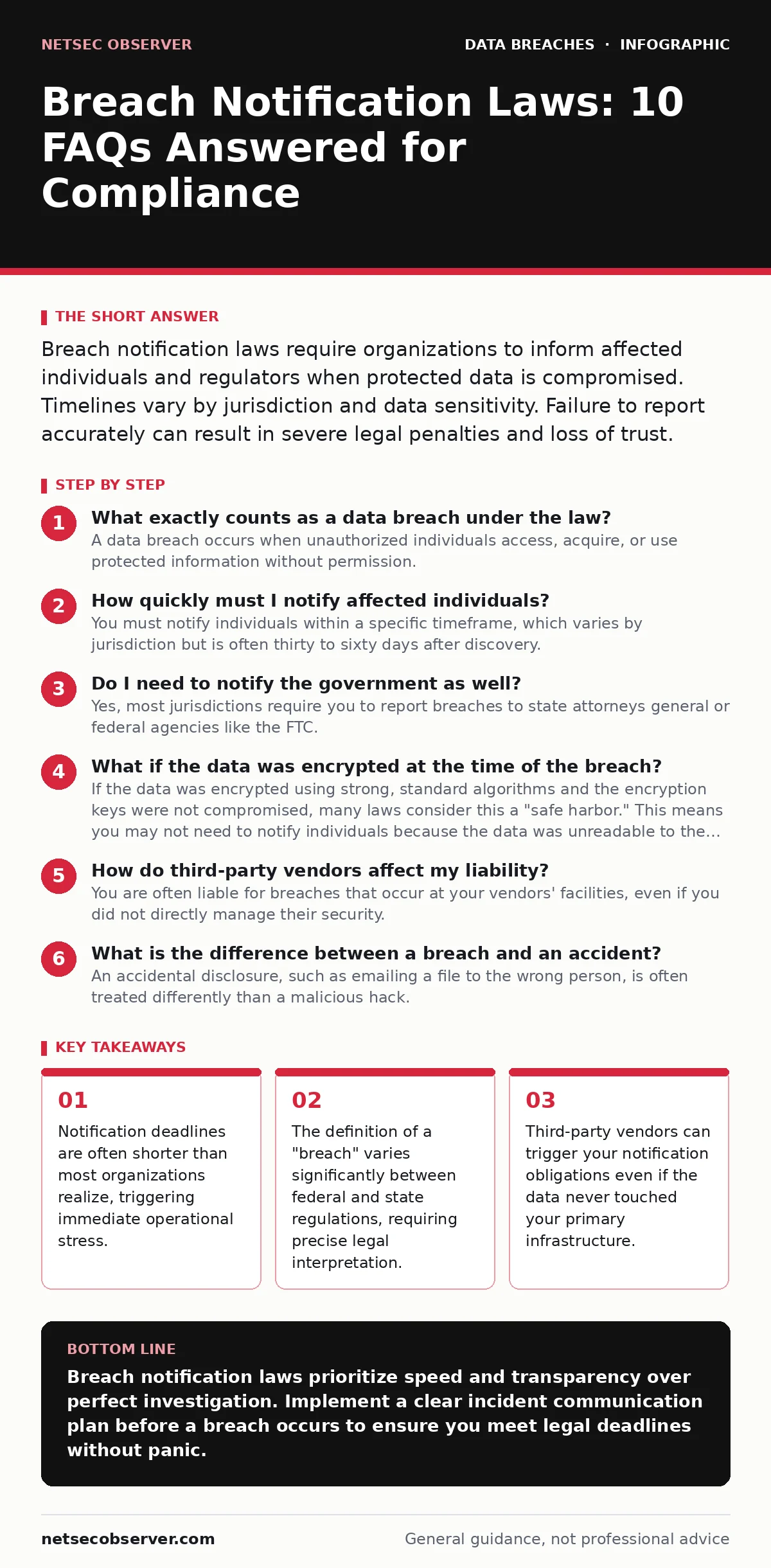
How quickly must I notify affected individuals?
You must notify individuals within a specific timeframe, which varies by jurisdiction but is often thirty to sixty days after discovery. Some regions require notification "without unreasonable delay," which legal teams interpret as immediate action. Waiting to investigate fully before notifying can violate these timelines, even if the investigation is ongoing. You should have a pre-approved template ready to send initial notifications while you continue your forensic analysis.
Do I need to notify the government as well?
Yes, most jurisdictions require you to report breaches to state attorneys general or federal agencies like the FTC. The threshold for government notification is often lower than for individual notification, sometimes requiring reports for breaches affecting fewer than a hundred people. You must also notify credit reporting agencies if financial data is compromised, which triggers additional monitoring services for victims. This dual reporting requirement doubles your administrative burden during a crisis.
What if the data was encrypted at the time of the breach?
If the data was encrypted using strong, standard algorithms and the encryption keys were not compromised, many laws consider this a "safe harbor." This means you may not need to notify individuals because the data was unreadable to the attacker. However, you must prove that the encryption was active and effective at the moment of the breach. If the keys were stored insecurely or shared improperly, the safe harbor protection likely does not apply.
How do third-party vendors affect my liability?
You are often liable for breaches that occur at your vendors' facilities, even if you did not directly manage their security. If a contractor holds your customer data and suffers a breach, you are usually the entity required to notify your customers. This makes third-party risk assessments a critical part of your pre-breach preparation. You cannot outsource your legal responsibility by outsourcing your data storage or processing.
See also: Data Scraping: How It Works and How to Stop It · Build an Incident Communication Plan That Prevents Panic
What is the difference between a breach and an accident?
An accidental disclosure, such as emailing a file to the wrong person, is often treated differently than a malicious hack. Some laws provide exemptions if the data was not actually accessed or viewed by an unauthorized party. However, proving that no one viewed the data is difficult and requires rigorous audit logs. If you cannot prove the data remained secure, you must treat it as a breach and follow notification protocols.
How do I handle cross-border or multi-state breaches?
If your customers live in multiple states or countries, you must comply with the laws of each jurisdiction where the affected individuals reside. This creates a complex matrix of deadlines, content requirements, and reporting channels. You may need to send different notifications to customers in California versus those in New York, as their laws differ in specificity. Centralizing your notification process helps manage this complexity, but local legal review is often necessary.
What should the notification letter actually say?
The letter must clearly state what happened, what data was involved, and what steps you are taking to mitigate the risk. You must provide contact information for questions and resources for identity protection, such as credit freezes or monitoring services. Avoid using technical jargon or legal disclaimers that obscure the severity of the incident. Clear, plain language reduces confusion and limits the volume of inbound calls to your support team.
Can I avoid notification if I detect the breach quickly?
Some laws allow you to avoid notification if you detect and remediate the breach before any data is actually exfiltrated or viewed. This is known as a "good faith" exception, but it requires immediate and thorough internal investigation. You must document every step of the detection and remediation process to prove the data was never compromised. Relying on this exception without solid evidence is a high-risk legal strategy.
What are the penalties for failing to notify?
Penalties for non-compliance can include significant fines, lawsuits from affected individuals, and regulatory audits. The cost of failing to notify often exceeds the cost of the notification process itself, including legal fees and reputational damage. Regulators look for patterns of negligence, so a single missed deadline can trigger broader scrutiny of your security practices. Transparency is the best defense against regulatory escalation.
| Factor | Individual Notification | Government Notification | Credit Bureau Notification |
|---|---|---|---|
| Trigger | PII compromised | Threshold met (e.g., 500+ records) | Financial data compromised |
| Timeline | 30-60 days typically | Varies by state/federal law | Immediate or within specific window |
| Content | What happened, what data, steps taken | Detailed incident report, root cause | Specific financial data types affected |
| Safe Harbor | Encrypted data may exempt | Rarely exempted | Rarely exempted |
Key takeaways
- Notification deadlines are often shorter than most organizations realize, triggering immediate operational stress.
- The definition of a "breach" varies significantly between federal and state regulations, requiring precise legal interpretation.
- Third-party vendors can trigger your notification obligations even if the data never touched your primary infrastructure.
Breach notification laws prioritize speed and transparency over perfect investigation. Implement a clear incident communication plan before a breach occurs to ensure you meet legal deadlines without panic.
Frequently asked questions
Does dark web monitoring help with breach notification?
Dark web monitoring can alert you to leaked credentials, but it does not replace the legal requirement to investigate and notify based on confirmed exposure of protected data.
Do I need to notify if only internal data is lost?
If the internal data contains personal information about employees or customers, you generally must notify those individuals, regardless of whether the data left your network.
How this guide was produced: written by the NetSec Observer editorial team with AI assistance, checked against the public references listed below, and reviewed when the facts change. See our editorial policy or report an error.