Build an Incident Communication Plan That Prevents Panic
Most breaches fail because teams argue over who speaks, not because the data was stolen. A pre-approved message hierarchy stops that chaos before it starts.
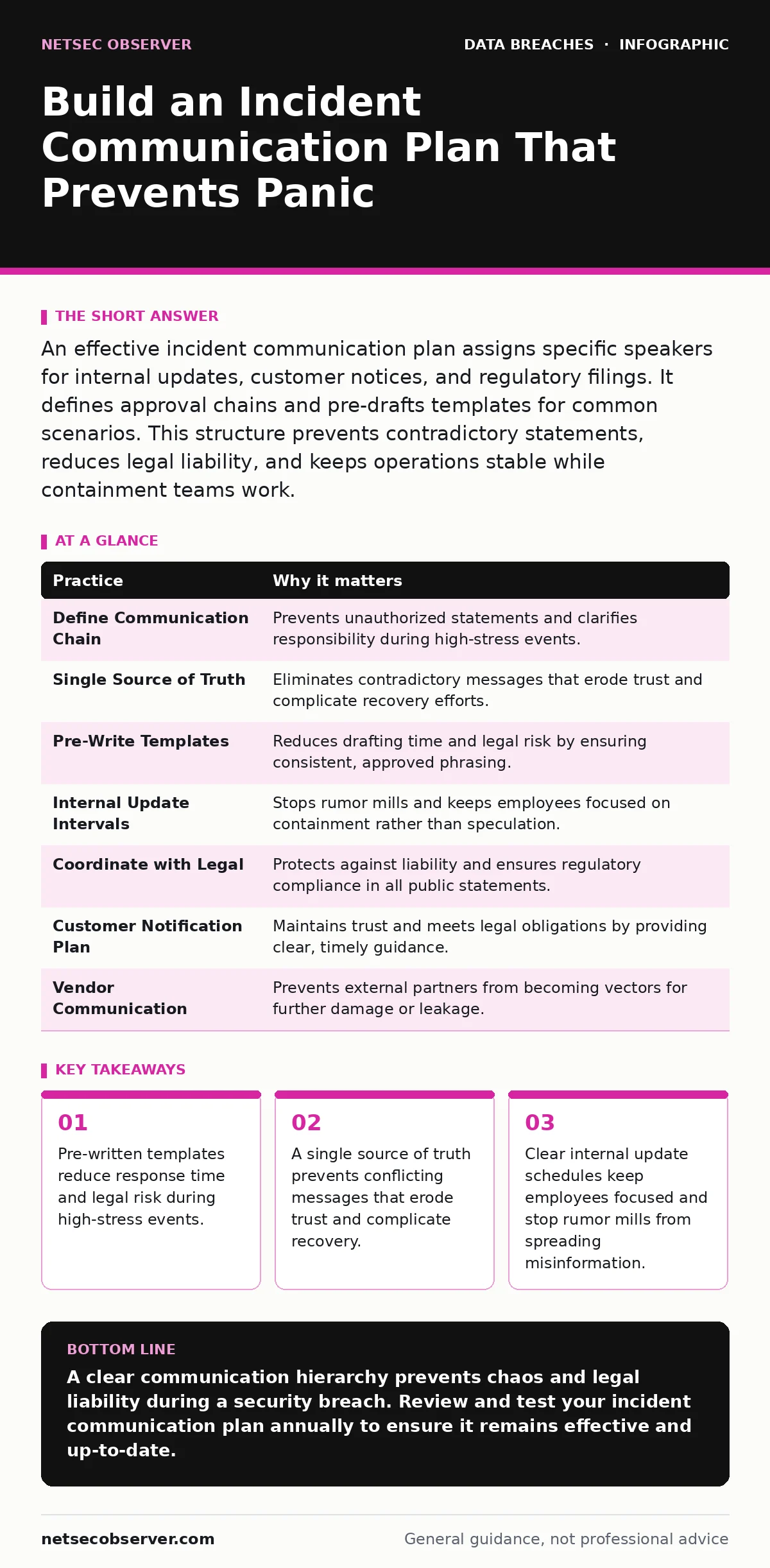
An effective incident communication plan assigns specific speakers for internal updates, customer notices, and regulatory filings. It defines approval chains and pre-drafts templates for common scenarios. This structure prevents contradictory statements, reduces legal liability, and keeps operations stable while containment teams work.
Define the Communication Chain Before the Crisis
An incident communication plan must name exactly who speaks to which audience. You cannot decide this during a breach. Stress impairs decision-making, leading to unauthorized statements or silence. The plan assigns roles for technical leaders, legal counsel, public relations, and executive sponsors. Each role has a defined scope. The technical lead explains what happened. Legal reviews liability. Public relations manages external perception. This separation prevents technical jargon from confusing customers and legal warnings from alarming employees.
Tip: Create a RACI matrix that lists Responsible, Accountable, Consulted, and Informed parties for every communication type. Review this matrix quarterly to account for staff turnover.
Establish a Single Source of Truth
Contradictory messages destroy credibility faster than the breach itself. If IT says the system is down and Marketing says services are normal, customers panic. You need one official channel for verified updates. This could be an internal wiki page, a dedicated Slack channel, or a secure portal. All staff must be directed to this source. Other channels become read-only. This prevents rumors from circulating via email or instant messaging. It ensures everyone operates with the same facts.
Tip: Assign one person to update the single source of truth every hour. This person must have direct access to the containment team to verify status changes before posting.
Pre-Write Templates for Common Scenarios
Drafting messages under pressure leads to errors. You should have templates ready for various breach types. These include data leaks, ransomware attacks, and service outages. The templates contain placeholders for specific details. They also include standard legal disclaimers and empathy statements. Having these drafts ready allows you to focus on accuracy rather than phrasing. It speeds up the release of critical information to affected parties. This aligns with requirements in breach notification laws that mandate timely disclosure.
Tip: Store templates in a secure, offline-accessible location. Ensure the legal team reviews and approves them annually to reflect current regulatory standards.
Set Internal Update Intervals
Silence breeds speculation among employees. Your staff will notice unusual activity or system changes. Without official updates, they will guess what is happening. These guesses often spread to social media or personal contacts. You must commit to a strict update schedule. For example, provide a status check every 4 hours. If there is no new information, state that clearly. This maintains order and keeps employees productive. It also reduces the risk of accidental data disclosure by curious staff trying to help.
Tip: Use a predefined status code system like Green, Yellow, and Red to convey severity quickly without detailed explanations in early stages.
Coordinate External Messaging with Legal
External communications carry significant legal weight. Every word can be used in litigation or regulatory inquiries. You must involve legal counsel before releasing any public statement. The plan should define the approval process. This might require sign-off from two executives. It ensures consistency and protects the organization from admitting fault prematurely. This coordination is vital when dealing with sensitive personally identifiable information. It also helps manage the narrative around third-party risk assessments if vendors are involved.
Tip: Create a checklist for legal review that includes specific questions about liability, regulatory triggers, and customer impact. This speeds up the approval process.
See also: Cybersecurity Incident Response Team: How It Works and Why It Matters · WordPress Page Builder Breach: Response and Recovery Steps
Plan for Customer Notification
Customers deserve timely, clear information about how their data is affected. Delays can lead to lawsuits and loss of trust. Your plan must include criteria for when to notify customers. This depends on the type of data compromised and the potential harm. The notification should explain what happened, what data was involved, and what steps the organization is taking. It must also offer guidance on protective measures. Referencing resources on credit freezes can help customers secure their financial identities.
Tip: Segment customers based on the data they hold. Send specific, relevant information to each group rather than a generic blast. This reduces confusion and support ticket volume.
Manage Vendor and Partner Communications
Breaches often involve third parties. If a vendor’s system was compromised, you must communicate with them. Conversely, if your system affected their operations, they need to know. Your plan should include a list of critical vendors and their emergency contacts. Communication with vendors should focus on containment and recovery coordination. This is part of effective vendor risk management. It ensures that external partners do not become unwitting vectors for further damage or information leakage.
Tip: Include a clause in vendor contracts that specifies communication protocols during security incidents. This sets expectations before a crisis occurs.
Conduct Regular Tabletop Exercises
A plan is useless if no one knows how to use it. You must test your incident communication plan regularly. Tabletop exercises simulate a breach without actual impact. Participants role-play their responsibilities. They practice sending messages, getting approvals, and updating the single source of truth. This reveals gaps in the process. It also builds muscle memory for the team. You should rotate participants to ensure broad familiarity. This preparation is as important as technical defenses like dark web monitoring.
Tip: Record the exercise and review it afterward. Identify delays in communication or confusion about roles. Update the plan to address these findings.
| Practice | Why it matters |
|---|---|
| Define Communication Chain | Prevents unauthorized statements and clarifies responsibility during high-stress events. |
| Single Source of Truth | Eliminates contradictory messages that erode trust and complicate recovery efforts. |
| Pre-Write Templates | Reduces drafting time and legal risk by ensuring consistent, approved phrasing. |
| Internal Update Intervals | Stops rumor mills and keeps employees focused on containment rather than speculation. |
| Coordinate with Legal | Protects against liability and ensures regulatory compliance in all public statements. |
| Customer Notification Plan | Maintains trust and meets legal obligations by providing clear, timely guidance. |
| Vendor Communication | Prevents external partners from becoming vectors for further damage or leakage. |
| Tabletop Exercises | Reveals process gaps and builds team familiarity before a real incident occurs. |
Handle Post-Incident Review
Communication does not end when the breach is contained. You must analyze how well the communication plan worked. Did messages reach the right people? Were approvals too slow? Were templates accurate? This review informs future improvements. It also provides closure for the team. Documenting lessons learned ensures that the next incident is handled better. This continuous improvement cycle is key to building resilience. It transforms a negative event into a learning opportunity for the entire organization.
Tip: Hold a blameless post-mortem focused on process, not people. Identify systemic issues in the communication flow rather than individual errors.
Key takeaways
- Pre-written templates reduce response time and legal risk during high-stress events.
- A single source of truth prevents conflicting messages that erode trust and complicate recovery.
- Clear internal update schedules keep employees focused and stop rumor mills from spreading misinformation.
A clear communication hierarchy prevents chaos and legal liability during a security breach. Review and test your incident communication plan annually to ensure it remains effective and up-to-date.
Frequently asked questions
How often should I update my incident communication plan?
Review the plan annually and after every significant incident or organizational change. Update contact lists and templates regularly to reflect current staff and regulatory requirements.
Who should be included in the communication team?
Include technical leads, legal counsel, public relations, executive sponsors, and HR. Each role provides specific expertise needed for accurate, compliant, and empathetic messaging.
What if I don’t know all the facts yet?
Issue a holding statement acknowledging the incident and promising more information. Avoid speculation. Focus on what you are doing to investigate and protect users. Update as facts emerge.
How do I communicate with employees without causing panic?
Provide regular, factual updates through a single source of truth. Reassure them that the situation is being managed. Give clear instructions on what they should do or avoid doing.
How this guide was produced: written by the NetSec Observer editorial team with AI assistance, checked against the public references listed below, and reviewed when the facts change. See our editorial policy or report an error.