
Accidental Data Disclosure: Response and Recovery Steps
Deleting a leaked file rarely stops the spread because search engines and caches preserve copies independently of the source server.
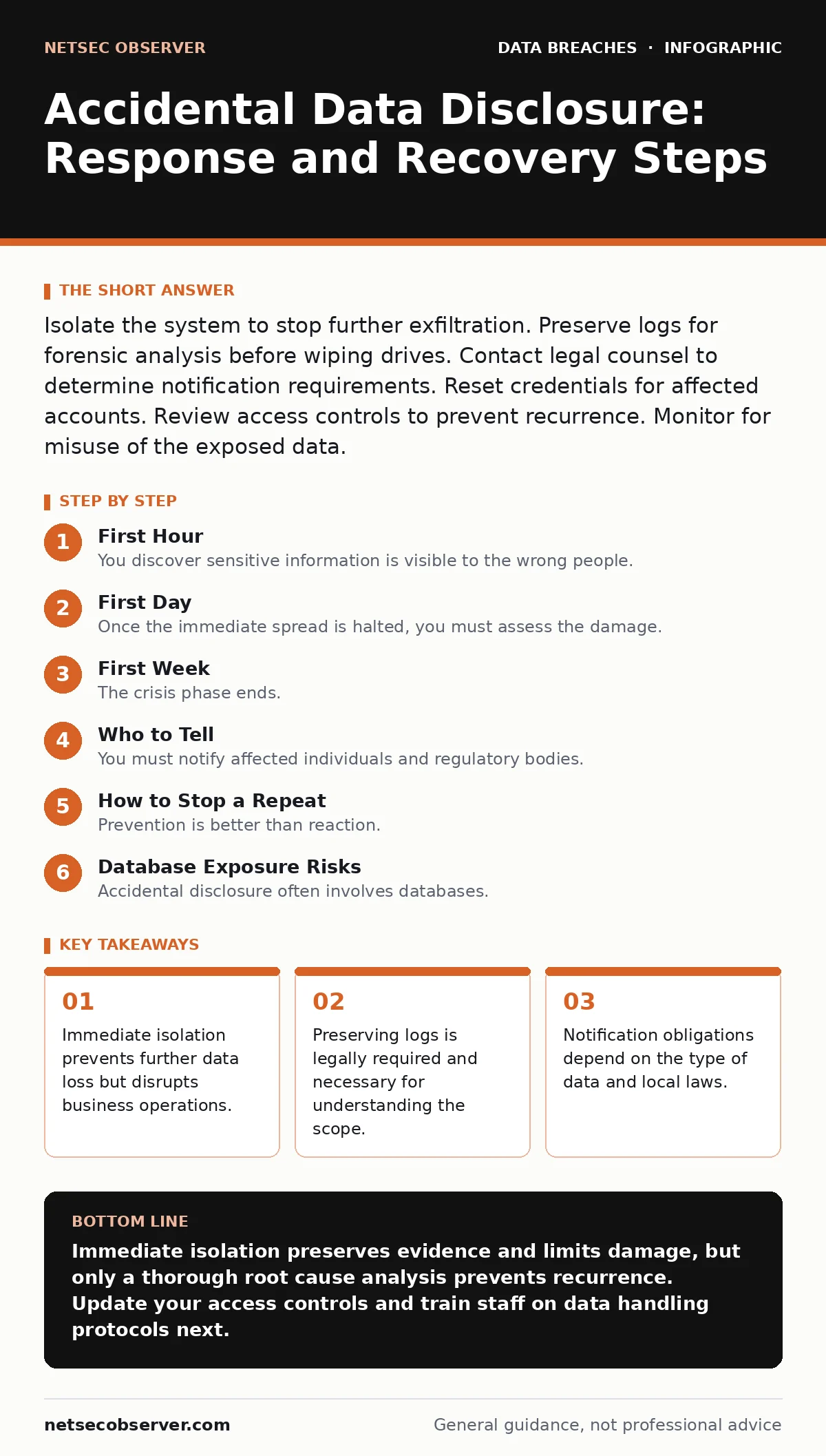
Isolate the system to stop further exfiltration. Preserve logs for forensic analysis before wiping drives. Contact legal counsel to determine notification requirements. Reset credentials for affected accounts. Review access controls to prevent recurrence. Monitor for misuse of the exposed data.
First Hour
You discover sensitive information is visible to the wrong people. Panic sets in. The instinct is to delete the file or shut down the server immediately. Do not do this. Deleting the evidence destroys the chain of custody and makes it impossible to determine how the breach happened.
Your first task is containment. You must stop the bleeding without destroying the scene. If the data is on a web server, take the specific page offline. If it is in a cloud storage bucket, change the permissions to private. You are not fixing the problem yet. You are limiting the exposure window.
- Isolate the affected system from the network.
- Change access credentials for the compromised account.
- Capture a snapshot of the current system state.
- Document the exact time and discovery method.
Do not unplug the machine if it is a server. Many logs reside in volatile memory. A hard shutdown loses that data. Instead, use a network switch to cut the connection. This keeps the system running but stops external traffic.
First Day
Once the immediate spread is halted, you must assess the damage. You need to know what data was exposed and who could see it. This is not a technical exercise alone. It is a legal and business risk assessment.
Identify the data type. Was it personal identifiers, health records, or intellectual property? The classification determines your next steps. Personal data triggers notification requirements under privacy impact assessments. Intellectual property loss may require legal injunctions.
Review the access logs. Who viewed the data? When did they view it? Use the snapshot you took earlier. If you did not take a snapshot, you are working blind. You must estimate the scope based on server logs and application records.
Check for secondary effects. Did the leaked data contain credentials? If so, those credentials are now compromised. You must assume an attacker has them. Rotate all secrets associated with that account. This includes API keys, database passwords, and session tokens.
Consult your incident communication plans. You need a single source of truth. Conflicting messages from different departments create confusion and erode trust. Designate one spokesperson. All updates go through that person.
First Week
The crisis phase ends. The recovery phase begins. You must restore services and verify that the vulnerability is closed. This is not just about turning the server back on. It is about ensuring the same mistake cannot happen again.
Analyze the root cause. Why was the data exposed? Was it a misconfigured storage bucket? A developer who pushed secrets to a public repository? A lack of encryption? The answer dictates the fix. If it was a configuration error, you need automated checks. If it was a human error, you need training and process changes.
Implement technical controls. Enable encryption at rest and in transit. Use encryption key management to control who can decrypt the data. This does not prevent accidental exposure, but it limits the damage. If the data is encrypted and the key is not exposed, the leak is less severe.
Review your third-party risk assessments. Did a vendor cause the leak? If so, you need to renegotiate contracts and security requirements. Vendors often have weaker security postures. You must hold them to your standards.
Update your access policies. Apply the principle of least privilege. Users should only have access to the data they need to do their job. Excessive access increases the risk of accidental disclosure. Regular audits ensure that permissions remain appropriate.
Who to Tell
You must notify affected individuals and regulatory bodies. This is not optional. Breach notification laws require timely disclosure. Delaying notification can result in fines and legal action.
Start with your legal counsel. They will determine the specific requirements based on jurisdiction and data type. They will also help draft the notification letter. The letter must be clear, concise, and honest. Avoid legal jargon. Explain what happened, what data was involved, and what steps you are taking.
Notify the individuals affected. Provide them with clear instructions. If credit card numbers were exposed, suggest credit freezes. If passwords were leaked, demand immediate changes. Provide support resources. This reduces the burden on the victim and demonstrates responsibility.
Inform your board and senior leadership. They need to understand the business impact. They may need to make strategic decisions. Transparency builds trust. Hiding the truth destroys it.
How to Stop a Repeat
Prevention is better than reaction. You must build a culture of security. This starts with training. Employees must understand the risks of accidental disclosure. They must know how to handle sensitive data.
Implement technical safeguards. Use data loss prevention tools to monitor outbound traffic. Block uploads of sensitive file types. Encrypt sensitive data by default. Use dark web monitoring to detect leaked credentials early. These tools do not stop all leaks, but they reduce the likelihood.
Conduct regular audits. Review configurations and access logs. Look for anomalies. Automated tools can help, but human review is still necessary. You need to catch misconfigurations before they become breaches.
Test your response. Run tabletop exercises. Simulate a breach. See how your team reacts. Identify gaps in your process. Fix them before a real incident occurs. Practice makes perfect.
See also: Cybersecurity Incident Response Team: How It Works and Why It Matters · WordPress Page Builder Breach: Response and Recovery Steps
Database Exposure Risks
Accidental disclosure often involves databases. A misconfigured database can expose millions of records. This is a common failure mode. You must secure your databases.
Use strong authentication. Require multi-factor authentication for database access. Limit remote access. Only allow connections from trusted IP addresses. Encrypt the data at rest. This ensures that even if the database files are stolen, the data is unreadable without the key.
Regularly patch your database software. Vulnerabilities in database servers are common. Attackers exploit them to gain access. Keeping your software up to date reduces this risk.
Encryption Key Management
Encryption is only as strong as your key management. If you lose the key, you lose the data. If you expose the key, you expose the data. You must manage keys carefully.
Use a dedicated key management service. Do not store keys in code or configuration files. Rotate keys regularly. Revoke access immediately when employees leave. This minimizes the risk of key compromise.
Final Checks
Before you declare the incident over, perform a final review. Ensure all affected systems are patched. Verify that all credentials have been rotated. Confirm that all notifications have been sent. Document the lessons learned. Update your security policies. This closes the loop.
You have contained the breach. You have recovered the systems. You have notified the stakeholders. Now you must improve. Security is not a destination. It is a continuous process.
Key takeaways
- Immediate isolation prevents further data loss but disrupts business operations.
- Preserving logs is legally required and necessary for understanding the scope.
- Notification obligations depend on the type of data and local laws.
- Recovery requires changing secrets and verifying that the leak source is closed.
Immediate isolation preserves evidence and limits damage, but only a thorough root cause analysis prevents recurrence. Update your access controls and train staff on data handling protocols next.
Frequently asked questions
Do I need to notify users if no personal data was leaked?
Check local laws. Some jurisdictions require notification for any breach of confidentiality, even if no personal data was involved.
How long should I keep forensic logs?
Keep them for the duration of any legal proceedings and as required by your industry regulations. This is often several years.
Can I use automated tools to detect accidental leaks?
Yes. Data loss prevention and cloud security posture management tools can identify misconfigurations and sensitive data exposure.
What if the data was leaked by a third-party vendor?
You are still responsible for your data. Notify your vendor, but also notify your users and regulators as required by law.
How this guide was produced: written by the NetSec Observer editorial team with AI assistance, checked against the public references listed below, and reviewed when the facts change. See our editorial policy or report an error.