
Cybersecurity Incident Response Team: How It Works and Why It Matters
A dedicated cybersecurity incident response team reduces recovery time by having pre-approved authority to isolate systems during a crisis.
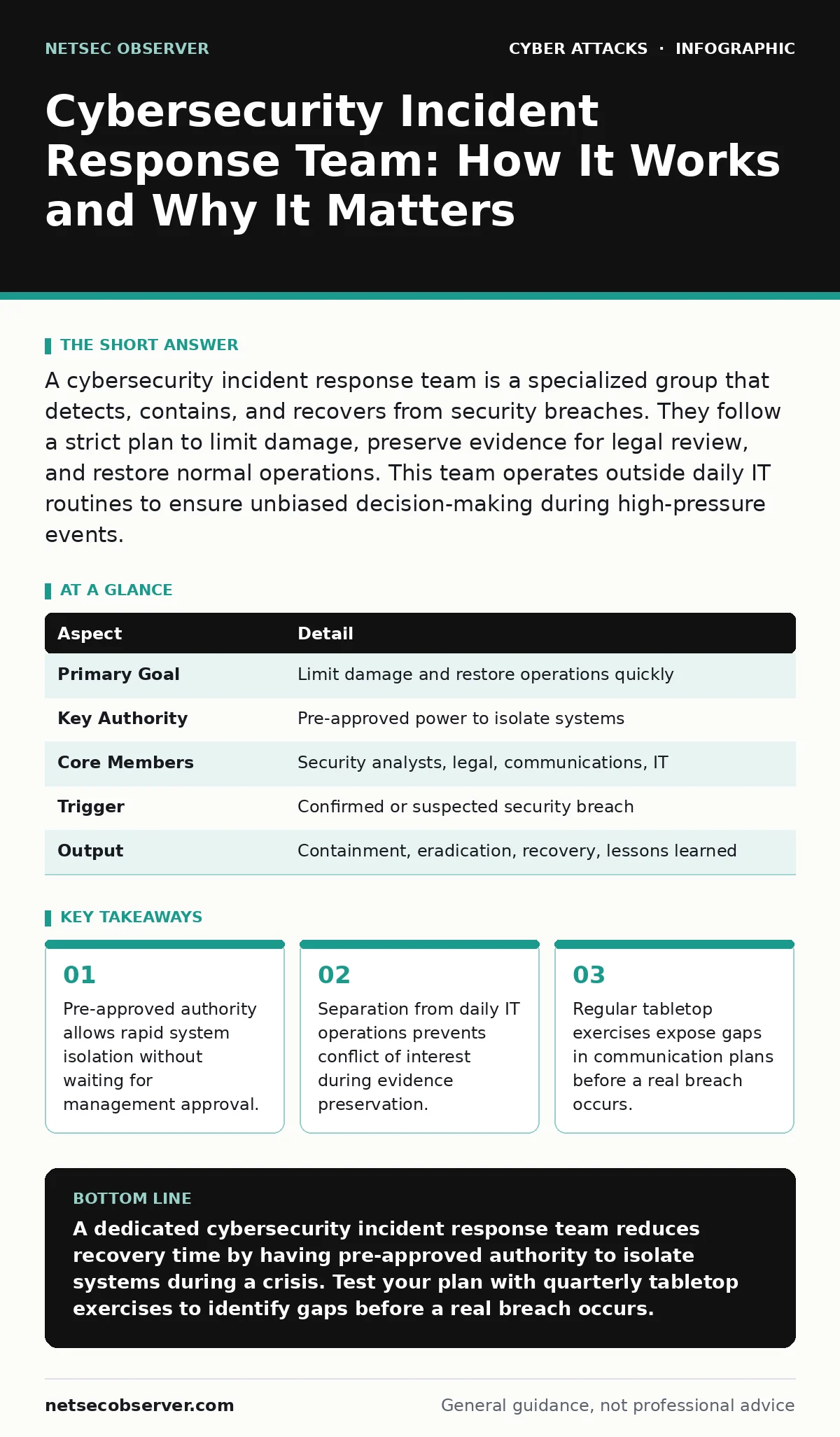
A cybersecurity incident response team is a specialized group that detects, contains, and recovers from security breaches. They follow a strict plan to limit damage, preserve evidence for legal review, and restore normal operations. This team operates outside daily IT routines to ensure unbiased decision-making during high-pressure events.
What Is a Cybersecurity Incident Response Team?
A cybersecurity incident response team handles the detection, containment, and recovery phases of a security breach. This group operates under a predefined plan to limit damage and restore normal operations. Think of them as a specialized medical response unit. When a patient arrives with unknown symptoms, the triage team does not guess. They follow a protocol to stabilize the patient, identify the threat, and prevent spread. The team members include security analysts, legal counsel, communications staff, and technical experts. Each role has a specific function. The analyst investigates the technical scope. Legal ensures compliance with data protection laws. Communications manages internal and external messaging. This structure prevents chaos.
Without clear roles, teams duplicate work or miss critical steps. The team exists to convert a chaotic event into a managed process. They do not prevent the attack. They manage the aftermath. Their primary goal is to reduce the duration of the incident. Time is the most valuable resource during a breach. Every minute a threat actor remains in the network increases the potential for data loss. The team’s speed directly correlates with the final cost of the incident. They operate under a charter that defines their authority. This charter allows them to take drastic actions, such as shutting down servers, without seeking permission from department heads. This pre-approval is the key difference between a successful response and a prolonged crisis.
| Aspect | Detail |
|---|---|
| Primary Goal | Limit damage and restore operations quickly |
| Key Authority | Pre-approved power to isolate systems |
| Core Members | Security analysts, legal, communications, IT |
| Trigger | Confirmed or suspected security breach |
| Output | Containment, eradication, recovery, lessons learned |
How the Team Operates During a Crisis
The team follows a lifecycle of phases. Preparation happens before any incident. Detection and analysis identify the scope. Containment stops the spread. Eradication removes the threat. Recovery restores systems. Post-incident activity reviews what happened. You cannot skip steps. Skipping containment to speed up recovery often leads to reinfection. The team uses a playbook. This document lists exact steps for common scenarios. It removes the need for decision-making under stress. When a ransomware alert fires, the team does not debate. They execute the playbook. They isolate the affected network segment. They disable compromised accounts. They preserve logs for forensic analysis.
The team communicates through a dedicated channel. This channel is separate from regular business communication. It ensures that sensitive details do not leak to unauthorized staff. The team leader coordinates actions. They assign tasks based on skill sets. They track progress against a timeline. The goal is to return to normal operations as fast as possible without leaving residual threats. The team must balance speed with accuracy. Rushing containment can destroy evidence. Moving too slowly allows the attacker to escalate privileges. The team leader judges this balance. They rely on training and previous exercises. This experience allows them to act decisively when seconds count.
Who Is Affected by the Response Process
The incident response team affects multiple groups within an organization. Employees experience disruptions to their tools. They may lose access to email or file shares. This causes frustration and reduces productivity. Management faces pressure to maintain business continuity. They need clear updates on the situation. They cannot afford vague answers. The legal department must assess liability. They need to know if customer data was exposed. They must prepare for potential regulatory fines. Customers may be notified if their data is at risk. This damages trust. The communications team manages this narrative. They provide honest, timely updates.
The IT department supports the response. They provide technical access and infrastructure changes. They do not lead the investigation. This separation prevents bias. IT staff might want to restore systems quickly to resume work. The security team must prioritize thorough eradication. This tension is normal. The team manages it through clear roles. Everyone understands their part. This clarity reduces confusion. It ensures that business needs and security needs are both addressed. No single group holds all the power. The team acts as a bridge. They translate technical findings into business impacts. This translation helps leadership make informed decisions.
What People Usually Get Wrong
Many organizations misunderstand the role of the cybersecurity incident response team. They assume the team prevents attacks. This is incorrect. Prevention is the job of security controls. The response team handles failures. Another common mistake is using the same staff for daily IT support. This creates a conflict of interest. IT staff may hide mistakes to avoid blame. The response team must be independent. They need objectivity to investigate thoroughly. Organizations often skip tabletop exercises. They assume the plan works on paper.
Real incidents reveal gaps. People forget passwords. Tools fail. Communication channels are blocked. Exercises expose these issues. They allow the team to practice under pressure. Without practice, the plan is just a document. Another error is ignoring the legal aspect. Technical fixes are not enough. Legal requirements dictate how evidence is handled. Mishandling evidence can void insurance claims. It can lead to lawsuits. The team must include legal counsel from the start. They ensure compliance with data protection laws. This prevents secondary legal disasters.
Building Effective Response Capabilities
You build capability through structure and practice. Define clear roles. Assign specific responsibilities to each team member. Ensure backup personnel are trained. Avoid single points of failure. If the team leader is unavailable, the response stalls. Develop detailed playbooks. Cover common scenarios. Include contact lists. Verify these lists regularly. People change jobs. Numbers change. Outdated contacts delay response. Invest in tools. Automation speeds up detection. It reduces manual effort. Security information and event management systems aggregate logs.
They provide a central view of activity. Use these tools to monitor for anomalies. Train staff regularly. Conduct tabletop exercises quarterly. Simulate different attack types. Test communication plans. Measure response times. Identify bottlenecks. Fix them. Continuous improvement is key. The team must learn from every exercise. They must update playbooks based on lessons learned. This iterative process builds resilience. It ensures the team is ready for any event. Preparation reduces panic. It allows for calm, calculated actions.
See also: WordPress Page Builder Breach: Response and Recovery Steps · Dark Web Monitoring Mistakes That Waste Your Budget
Related Security Measures
The response team works alongside other security controls. Prevention reduces the number of incidents. Detection speeds up the response. Recovery minimizes downtime. You should integrate response planning with these areas. For example, understanding malicious email attachments helps the team recognize phishing campaigns. These emails often start the incident. The team needs to know how to trace them. Knowledge of IP spoofing aids in traffic analysis. Attackers use spoofed addresses to hide their origin. The team must filter out false leads. Awareness of spear phishing tactics helps in initial triage. These targeted attacks are harder to detect. The team must look for subtle indicators.
Vendor email compromise requires careful verification. The team must confirm requests with vendors through separate channels. HTML smuggling techniques bypass some filters. The team must analyze decoded content. Brand impersonation attacks confuse users. The team must educate users on verification. Slowloris attacks exhaust server resources. The team must identify and block slow connections. Password managers reduce credential theft. This limits the attacker’s access. The team should promote their use. These measures support the response effort. They provide context and tools. They make the team’s job easier. Integration is key. Silos hinder response. Collaboration strengthens it.
What To Do About It
Start by assessing your current readiness. Do you have a plan? Is it tested? Who is on the team? Are roles clear? Identify gaps. Fill them. Create a plan if one does not exist. Define the scope. Identify critical assets. Determine the impact of their loss. Assign roles. Train staff. Conduct exercises. Improve continuously. Do not wait for an incident. It will happen.
Preparation is the only control. You cannot predict the exact attack. You can prepare for the response. This reduces uncertainty. It builds confidence. It protects the organization. The cybersecurity incident response team is your last line of defense. Make it strong. Make it ready. Make it effective. This ensures survival. It ensures recovery. It ensures trust.
Key takeaways
- Pre-approved authority allows rapid system isolation without waiting for management approval.
- Separation from daily IT operations prevents conflict of interest during evidence preservation.
- Regular tabletop exercises expose gaps in communication plans before a real breach occurs.
A dedicated cybersecurity incident response team reduces recovery time by having pre-approved authority to isolate systems during a crisis. Test your plan with quarterly tabletop exercises to identify gaps before a real breach occurs.
Frequently asked questions
Does every company need a full-time incident response team?
Small companies can use a third-party provider or a part-time consultant. The key is having a defined plan and clear contacts, not necessarily full-time staff.
How often should the incident response plan be updated?
Update the plan after every major change in infrastructure, staff, or regulations. At minimum, review it annually.
Who leads the incident response team?
The team leader is usually a senior security analyst or manager. They have the technical knowledge and authority to make rapid decisions.
Can the IT department handle incident response?
IT can support the response, but they should not lead the investigation. Independence ensures objectivity and prevents conflict of interest.
How this guide was produced: written by the NetSec Observer editorial team with AI assistance, checked against the public references listed below, and reviewed when the facts change. See our editorial policy or report an error.