How IP Spoofing Works: Step-by-Step Mechanism and Defenses
IP spoofing fails when network devices verify the source address before accepting the packet, turning a complex attack into a simple routing error.
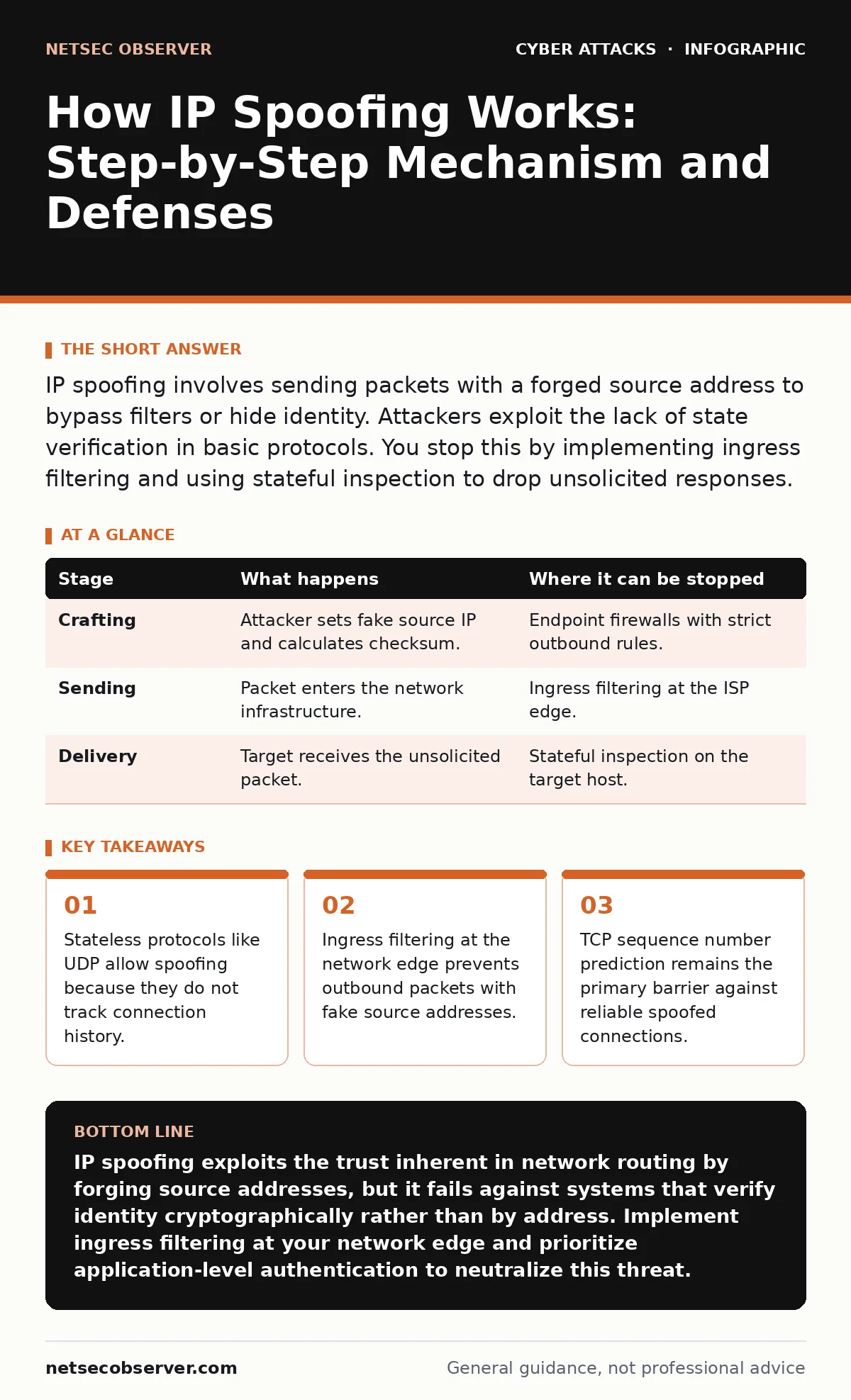
IP spoofing involves sending packets with a forged source address to bypass filters or hide identity. Attackers exploit the lack of state verification in basic protocols. You stop this by implementing ingress filtering and using stateful inspection to drop unsolicited responses.
The Mechanics of Source Address Forgery
IP spoofing occurs when an attacker creates internet packets with a false source Internet Protocol address. This false address masks the attacker’s true location and identity. The technique relies on the fundamental design of the Internet Protocol, which prioritizes delivery over verification. The protocol assumes the sender is who they claim to be.
This assumption creates a vulnerability. The network infrastructure routes traffic based on destination addresses, not source legitimacy. An attacker can craft packets that appear to come from a trusted server. The target system receives the packet and processes it without checking the origin. This initial step is purely about crafting the data correctly.
Stage 1: Crafting the Packet Header
The attacker begins by constructing a network packet. They modify the header section to include a spoofed source address. This address usually belongs to a trusted entity or a random host. The goal is to make the packet look legitimate to the first line of defense.
The attacker must also calculate the header checksum correctly. The checksum is a mathematical value used to verify data integrity. If the checksum is wrong, the receiving system discards the packet immediately. Modern tools automate this calculation, allowing the attacker to focus on the payload. This step ensures the packet survives basic protocol validation checks.
| Stage | What happens | Where it can be stopped |
|---|---|---|
| Crafting | Attacker sets fake source IP and calculates checksum. | Endpoint firewalls with strict outbound rules. |
| Sending | Packet enters the network infrastructure. | Ingress filtering at the ISP edge. |
| Delivery | Target receives the unsolicited packet. | Stateful inspection on the target host. |
Stage 2: Network Transit and Routing
The forged packet enters the network. Routers examine the destination address to determine the next hop. They do not inspect the source address for validity during standard transit. This lack of verification allows the packet to travel across multiple networks.
The packet follows the standard routing paths. It may traverse several autonomous systems before reaching the target. Each router forwards the packet based on its routing table. None of these intermediate devices question the origin. This transparency is a feature of the Internet architecture, not a bug. It enables global connectivity but facilitates spoofing attacks.
Stage 3: Target Reception and Processing
The target system receives the packet. The operating system network stack processes the header. If the protocol is stateless, such as User Datagram Protocol, the system accepts the data immediately. UDP does not require a handshake or prior connection. This makes it ideal for spoofing attacks like DNS amplification.
If the protocol is stateful, such as Transmission Control Protocol, the system expects a prior handshake. The attacker must predict the sequence number. This is a complex task. The target may drop the packet if it does not fit the expected state. The attacker relies on the target responding or processing the payload without strict verification. This stage determines whether the attack succeeds or fails.
Stage 4: Exploitation or Reflection
The attacker exploits the received packet. In a denial-of-service attack, the goal is to overwhelm the target. The spoofed source address directs the response traffic elsewhere. This reflects the attack traffic toward a victim. The victim receives traffic they did not request.
In a direct exploitation scenario, the attacker sends a command. The target executes the command because the source address is trusted. This bypasses access controls that rely on IP whitelists. The attacker gains unauthorized access or triggers a vulnerability. The success depends on the target’s reliance on IP-based trust rather than cryptographic verification.
See also: Respond to Attacker Reconnaissance: Stop the Scan Before Breach · BGP Hijacking: How Route Manipulation Steals Internet Traffic
Interrupting the Attack Chain
You can interrupt IP spoofing at multiple points. The most effective defense is ingress filtering. This practice involves configuring edge routers to drop packets with invalid source addresses. If a packet claims to come from an internal network but arrives from the internet, the router discards it. This stops the attack at the source.
Network operators must implement this filtering. It requires coordination across internet service providers. Without universal adoption, spoofed packets can still enter the network. Individual sites can also use egress filtering. This prevents their own networks from being used as sources for spoofed traffic. Both measures reduce the attack surface significantly.
Limitations and Hidden Costs
IP spoofing has inherent limitations. It works best with connectionless protocols. Establishing a reliable TCP connection with a spoofed address is difficult. The attacker cannot receive the response packets. These responses go to the innocent owner of the spoofed address. This blind spot limits the types of attacks possible.
The hidden cost of spoofing defenses is complexity. Implementing strict filtering requires accurate routing tables. Misconfiguration can block legitimate traffic. Organizations must balance security with connectivity. Overly aggressive filtering may disrupt business operations. Understanding these trade-offs helps you design effective defenses without causing outages.
Protocol-Specific Vulnerabilities
Different protocols handle spoofing differently. Hypertext Transfer Protocol runs on TCP. Spoofing HTTP requests is nearly impossible due to the handshake requirement. However, attackers can spoof UDP-based services. Domain Name System queries are a common target. DNS servers respond to any query, regardless of source.
This behavior allows amplification attacks. The attacker sends a small spoofed request. The DNS server sends a large response. The ratio of request to response size amplifies the attack traffic. The victim is overwhelmed by the volume. Mitigating this requires response rate limiting and source validation extensions. These measures add overhead but protect against reflection attacks.
Verification and Cryptographic Alternatives
Relying on IP addresses for trust is flawed. You should use cryptographic methods instead. Transport Layer Security encrypts the connection and verifies the server’s identity. This prevents man-in-the-middle attacks even if the IP is spoofed. The client validates the certificate, not the address.
Application-level authentication adds another layer. Tokens and signatures verify the user’s identity. These methods do not depend on the network address. They remain effective even if the source IP is forged. Moving trust from the network layer to the application layer reduces the impact of spoofing. This shift is critical for modern security architectures.
Key takeaways
- Stateless protocols like UDP allow spoofing because they do not track connection history.
- Ingress filtering at the network edge prevents outbound packets with fake source addresses.
- TCP sequence number prediction remains the primary barrier against reliable spoofed connections.
IP spoofing exploits the trust inherent in network routing by forging source addresses, but it fails against systems that verify identity cryptographically rather than by address. Implement ingress filtering at your network edge and prioritize application-level authentication to neutralize this threat.
Frequently asked questions
Can IP spoofing bypass a firewall?
Basic firewalls that only check source IPs can be bypassed by spoofed packets if they are configured to trust specific addresses. Stateful firewalls that track connections will drop unsolicited spoofed packets, making the attack ineffective.
Does using a VPN prevent IP spoofing?
A VPN encrypts your traffic but does not prevent you from sending spoofed packets. However, it hides your true IP from the destination. Network operators can still detect and block spoofed traffic at the routing level, regardless of encryption.
How do I know if my server is under a spoofing attack?
Look for sudden spikes in traffic from diverse source IPs that do not match your user base. Monitor for unsolicited responses or DNS query floods. Intrusion detection systems can flag traffic patterns consistent with reflection or amplification attacks.
Is IP spoofing legal?
IP spoofing itself is a technique. Using it to cause harm, disrupt services, or gain unauthorized access is illegal in most jurisdictions. Legitimate uses include privacy protection and testing, but these must be conducted within authorized boundaries and network policies.
How this guide was produced: written by the NetSec Observer editorial team with AI assistance, checked against the public references listed below, and reviewed when the facts change. See our editorial policy or report an error.