BGP Hijacking: How Route Manipulation Steals Internet Traffic
BGP hijacking redirects global internet traffic to unauthorized servers, allowing attackers to intercept data without breaking any encryption keys on your local network.
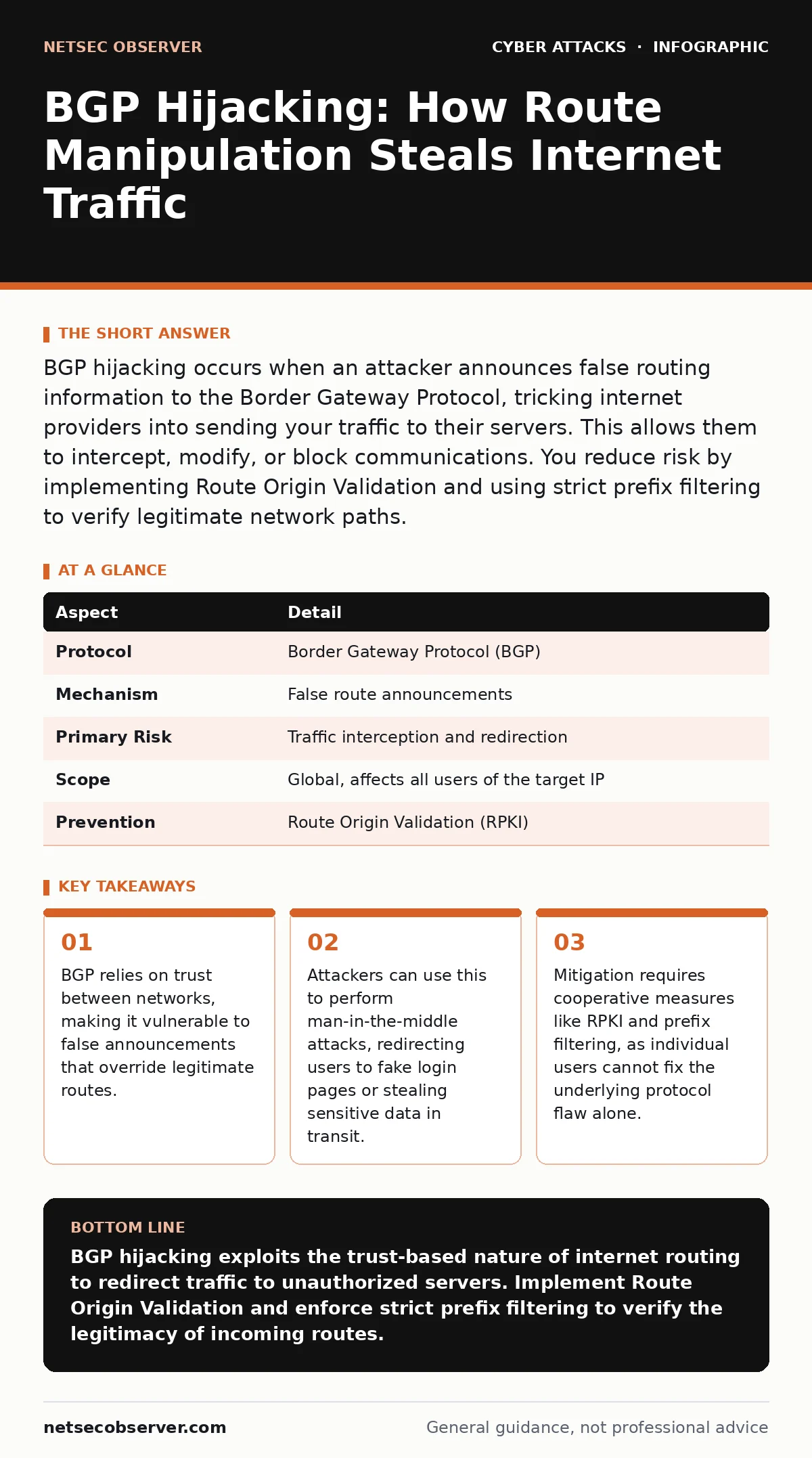
BGP hijacking occurs when an attacker announces false routing information to the Border Gateway Protocol, tricking internet providers into sending your traffic to their servers. This allows them to intercept, modify, or block communications. You reduce risk by implementing Route Origin Validation and using strict prefix filtering to verify legitimate network paths.
The Postal System of the Internet
Imagine you send a package to a specific address. The postal service reads the label and decides which truck, which city, and which final carrier will deliver it. This system works because every postal office trusts the next one to follow the map. The internet works similarly, but instead of trucks, it uses routers, and instead of a central map, it uses a distributed database of routes. This database is managed by the Border Gateway Protocol, or BGP. BGP is the set of rules that tells routers how to forward packets of data across different networks. It is the backbone of global connectivity.
BGP was designed in an era when the internet was small and operators knew each other personally. It assumed that network administrators would be honest about where their networks were located. This assumption of trust is the core vulnerability. When an operator lies about their location or the paths available, the entire routing table can shift. Traffic that should go straight to its destination takes a detour through the liar’s network. This is the foundation of BGP hijacking.
How Route Announcements Fail
BGP does not verify if an announcement is true; it only verifies if the announcement is reachable. If two networks announce they can reach a specific destination, the internet generally prefers the shorter path. An attacker can exploit this by announcing a more specific or shorter path to a target IP address range. Routers around the world see this new, "better" route and update their tables. Traffic intended for the victim now flows to the attacker.
This process happens automatically and globally. Once a false route is announced, it propagates through the internet in minutes. The attacker does not need to hack the victim’s server. They do not need to break into the victim’s computer. They simply need to convince the routing infrastructure that they are the correct next hop. The victim’s systems continue to operate normally, unaware that their incoming and outgoing traffic is now passing through an unauthorized intermediary.
| Aspect | Detail |
|---|---|
| Protocol | Border Gateway Protocol (BGP) |
| Mechanism | False route announcements |
| Primary Risk | Traffic interception and redirection |
| Scope | Global, affects all users of the target IP |
| Prevention | Route Origin Validation (RPKI) |
Common Forms of Hijacking
Attackers usually pursue one of three goals when hijacking BGP routes. The first is interception. By placing themselves in the middle of the communication path, they can read unencrypted data. This is particularly dangerous for users who rely on HTTP instead of HTTPS. Even with encryption, the attacker can perform a man-in-the-middle attack if they can trick the user’s browser into trusting a fake certificate.
The second goal is denial of service. An attacker can announce a route to a black hole, a network interface that discards all incoming traffic. This effectively makes the target website or service disappear from the internet. This is distinct from traditional DDoS attacks because it targets the routing layer rather than overwhelming the server with requests. The server is fine, but no one can reach it.
The third goal is data theft or modification. The attacker can copy the traffic for analysis, looking for credentials, financial data, or intellectual property. They can also modify the content. For example, they could inject malware into software updates or change the text of news articles. This form of attack is subtle and difficult to detect because the service appears to be working, just slightly altered.
Who Gets Affected and Why
BGP hijacking affects anyone connected to the internet, but the impact varies by scale. Small networks with few connections are less likely to be targeted because the reward is lower. Large organizations, such as banks, cloud providers, and social media platforms, are prime targets. They hold valuable data and have high traffic volumes.
Individual users are often collateral damage. When a major service is hijacked, millions of users may experience outages or be exposed to phishing attempts. The user cannot tell that the route has changed. The website loads, the logo is correct, and the interface is familiar. The only difference is that the connection is no longer private. This is why relying solely on visual cues for security is insufficient.
The risk is not limited to large corporations. Any organization with a public IP address can be hijacked. If your company’s DNS servers or email gateways are redirected, your entire communication infrastructure is compromised. The attacker does not need to target you specifically; they can target the upstream provider that carries your traffic. This indirect targeting makes defense more complex.
What People Usually Get Wrong
A common misconception is that encryption solves BGP hijacking. While HTTPS protects the content of your messages from being read, it does not protect the routing path. If an attacker redirects your traffic, they can still block the connection entirely. They can also degrade the performance of the connection, making it slow and unreliable. Encryption assumes the path is secure; BGP hijacking proves the path is not.
Another mistake is assuming that BGP hijacking is rare. It happens frequently, often due to configuration errors rather than malicious intent. A network administrator might mistype a prefix length, accidentally announcing a larger range of IP addresses than they own. This creates a route that captures traffic for other organizations. These accidents are just as damaging as intentional attacks because they redirect traffic away from legitimate owners.
Many also believe that firewalls can stop BGP hijacking. Firewalls inspect packets at the edge of a network. They cannot see the path the packet took to get there. If the packet arrives at the firewall, the hijacking has already succeeded. The traffic is already inside the attacker’s network or on its way to the wrong destination. Defense must happen at the routing level, before the traffic enters the network.
See also: 7 SSRF Mistakes That Expose Internal Networks to Attack · Respond to Attacker Reconnaissance: Stop the Scan Before Breach
Reducing Risk Through Validation
The most effective defense is Route Origin Validation, or RPKI. This system allows network owners to digitally sign their IP address blocks. Routers can check these signatures to verify that the entity announcing a route actually owns the IP addresses. If a router sees an announcement from an unauthorized source, it rejects the route. This stops many hijacking attempts before they propagate.
Network operators should also use prefix filtering. This involves only accepting route announcements that are expected. If a provider only announces routes for its own customers, it should reject any announcements from others. This limits the spread of false routes. While this does not prevent a hijack from originating, it prevents it from spreading globally.
Individual users can take steps to mitigate the impact. Always use HTTPS and check for valid certificates. If a certificate warning appears, do not ignore it. This may indicate that traffic is being intercepted. Use DNS over HTTPS or DNS over TLS to protect your DNS queries from being redirected. These protocols encrypt the DNS lookup process, making it harder for an attacker to redirect you to a fake server.
The Hidden Cost of Trust
The underlying issue with BGP is that it is a trust-based protocol. There is no central authority that verifies every route. This decentralization is what makes the internet scalable and resilient. It is also what makes it vulnerable. Fixing BGP requires global cooperation and significant changes to how networks interact.
Until then, organizations must assume that their traffic can be redirected. Security strategies should include monitoring for unusual routing changes. Tools exist that alert administrators when their IP prefixes are announced by unauthorized entities. Early detection allows for quicker response, limiting the time the hijack is active.
Key takeaways
- BGP relies on trust between networks, making it vulnerable to false announcements that override legitimate routes.
- Attackers can use this to perform man-in-the-middle attacks, redirecting users to fake login pages or stealing sensitive data in transit.
- Mitigation requires cooperative measures like RPKI and prefix filtering, as individual users cannot fix the underlying protocol flaw alone.
BGP hijacking exploits the trust-based nature of internet routing to redirect traffic to unauthorized servers. Implement Route Origin Validation and enforce strict prefix filtering to verify the legitimacy of incoming routes.
Frequently asked questions
Can BGP hijacking affect my home internet connection?
Yes, if an attacker hijacks the route to your ISP or a popular service you use. You may experience outages or be redirected to malicious sites.
Does using a VPN prevent BGP hijacking?
A VPN encrypts your traffic, but if the route to the VPN server is hijacked, your connection will fail. It does not prevent the routing manipulation itself.
How long does a BGP hijack typically last?
It can last from minutes to days, depending on how quickly the network operators detect and correct the false route announcements.
Is BGP hijacking legal?
No, it is unauthorized access and manipulation of network infrastructure. It violates computer fraud and abuse laws in many jurisdictions.
How this guide was produced: written by the NetSec Observer editorial team with AI assistance, checked against the public references listed below, and reviewed when the facts change. See our editorial policy or report an error.