
Difference Between Cyber Espionage and Cyber Terrorism
Espionage seeks long-term access for stealing data, while terrorism uses digital attacks to cause immediate fear or physical damage.
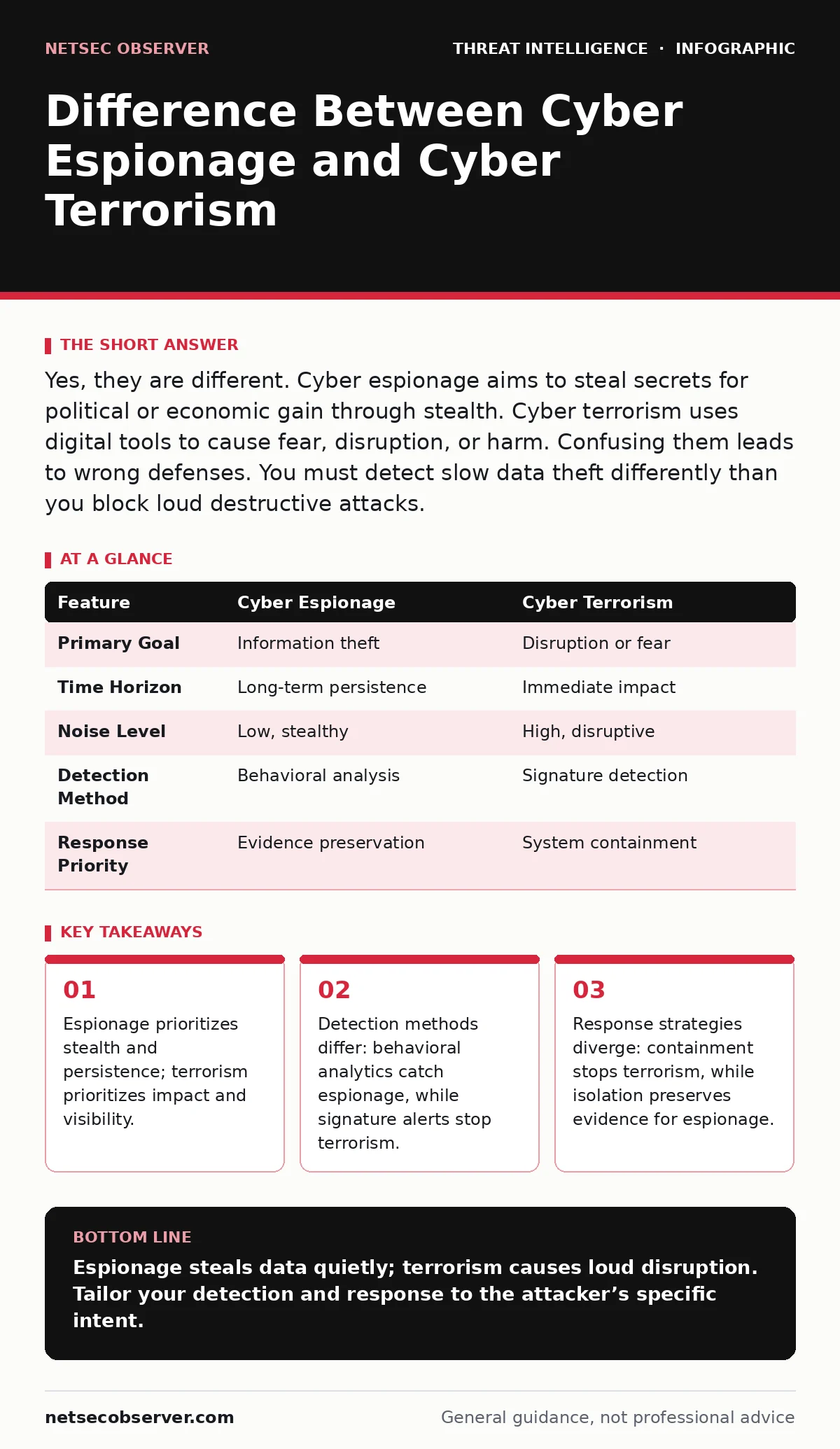
Yes, they are different. Cyber espionage aims to steal secrets for political or economic gain through stealth. Cyber terrorism uses digital tools to cause fear, disruption, or harm. Confusing them leads to wrong defenses. You must detect slow data theft differently than you block loud destructive attacks.
What is the difference between cyber espionage and cyber terrorism?
The difference between cyber espionage and cyber terrorism lies in their ultimate objective and operational tempo. Cyber espionage seeks to acquire sensitive information quietly over long periods. Cyber terrorism seeks to cause immediate disruption, fear, or physical harm. Understanding this distinction dictates your detection strategy. You cannot defend against slow data exfiltration using the same alarms designed for loud destructive attacks. The attacker’s intent determines the technical footprint you must hunt for.
How do the operational goals of each threat type differ?
Espionage groups prioritize access over destruction. They want to remain inside your network for months or years. Their goal is to copy intellectual property, government secrets, or personal data. Terrorism groups prioritize impact over persistence. They want to crash systems, leak embarrassing data, or disrupt critical infrastructure quickly. The terrorist attacker does not care if you detect them immediately. They care that the damage is visible and frightening. This difference changes how you design your security telemetry.
Why does stealth matter more to spies than to terrorists?
Spies rely on stealth to avoid detection until they have all the data they need. They move laterally through your network using legitimate credentials and standard protocols. They avoid triggering loud alarms. Terrorists often rely on shock value. They may use ransomware, denial-of-service attacks, or public data dumps. These actions create immediate noise. Your security metrics must reflect this difference. High-volume alerts might indicate terrorism. Low-volume, anomalous behavior often indicates espionage. You must tune your alerts to catch the quiet ones.
What technical indicators reveal an espionage campaign?
Espionage campaigns leave subtle traces in user and entity behavior analytics. Look for accounts accessing files they never touched before. Check for data transfers to unusual destinations at odd hours. These actions look like normal work but deviate from the baseline. Port scanning might reveal an attacker mapping your internal network. They are looking for valuable servers, not just open doors. Sigma rules can help you identify these specific behavioral patterns. You must correlate small anomalies to see the larger picture of theft.
| Feature | Cyber Espionage | Cyber Terrorism |
|---|---|---|
| Primary Goal | Information theft | Disruption or fear |
| Time Horizon | Long-term persistence | Immediate impact |
| Noise Level | Low, stealthy | High, disruptive |
| Detection Method | Behavioral analysis | Signature detection |
| Response Priority | Evidence preservation | System containment |
How should detection methods change based on the threat?
You must use different tools for different threats. Signature-based detection works well against known terrorist malware. It blocks files with known bad hashes. However, espionage tools are often custom-built. They do not appear in threat databases. You must rely on anomaly detection. Monitor for impossible travel, unusual login times, and large data exports. Intelligence cycle processes help you understand the adversary’s tactics. You must anticipate their next move rather than reacting to their last tool. This proactive stance is vital for catching spies.
See also: Dark Web Search Engines: Spotting the Hidden Warning Signs · Threat Intelligence Programs: Real Benefits and Hidden Costs
What is the correct incident response for each scenario?
Response strategies must match the attacker’s intent. If you suspect terrorism, your priority is containment. Isolate affected systems immediately to stop the spread. Restore from clean backups. Public communication is often necessary to manage fear. If you suspect espionage, your priority is evidence preservation. Do not shut down systems immediately. You may lose critical logs or memory data. Instead, isolate the network segment while preserving forensic images. You need to understand the scope of the breach. This requires patience and careful documentation.
Why do false positives confuse these two threat types?
False positives occur when normal activity looks like an attack. A large file transfer might look like espionage exfiltration. It could just be a quarterly report. A sudden spike in traffic might look like terrorism. It could just be a marketing campaign. You must tune your security telemetry to reduce noise. Use baseline data to define what is normal. If you treat every anomaly as terrorism, you will ignore slow espionage. If you treat every anomaly as espionage, you will miss urgent terrorist threats. Balance is key.
How do attribution challenges affect defense planning?
Attribution is difficult for both threat types. Espionage groups often disguise their origin. They use proxy servers and stolen credentials. Terrorism groups may claim responsibility to spread fear. They may use open-source tools to hide their identity. You cannot rely on attribution to choose your defense. You must defend against the behavior, not the name. Focus on securing your data and hardening your infrastructure. Do not waste resources trying to identify the attacker before securing your environment.
What long-term strategies reduce risk for both threats?
Strong identity management reduces the risk of both threats. Espionage groups need credentials to move laterally. Terrorism groups need access to deploy malware. Enforce multi-factor authentication everywhere. Limit privileges so users only access what they need. Regularly audit access rights. This reduces the attack surface. You also need robust backup strategies. Backups protect against ransomware and data loss. Test your backups regularly. Ensure they are isolated from the main network. This ensures you can recover even after a severe incident.
Key takeaways
- Espionage prioritizes stealth and persistence; terrorism prioritizes impact and visibility.
- Detection methods differ: behavioral analytics catch espionage, while signature alerts stop terrorism.
- Response strategies diverge: containment stops terrorism, while isolation preserves evidence for espionage.
Espionage steals data quietly; terrorism causes loud disruption. Tailor your detection and response to the attacker’s specific intent.
Frequently asked questions
Can a single attack be both espionage and terrorism?
Yes, an attacker might steal data and then leak it to cause fear. This hybrid approach combines the goals of both types.
How do I know if my company is a target for espionage?
High-value industries like defense, tech, and healthcare are common targets. Assess your data value and industry profile.
What is the first step in building a defense against espionage?
Implement strong logging and monitoring. You cannot detect what you do not record. Ensure logs are centralized and protected.
Does antivirus software stop cyber espionage?
Standard antivirus often misses espionage tools. They use custom code that does not match known signatures. You need behavioral detection.
How this guide was produced: written by the NetSec Observer editorial team with AI assistance, checked against the public references listed below, and reviewed when the facts change. See our editorial policy or report an error.