
Dark Web Search Engines: Spotting the Hidden Warning Signs
Dark web search engines often index leaked credentials and internal corporate documents long before security teams realize the exposure occurred.
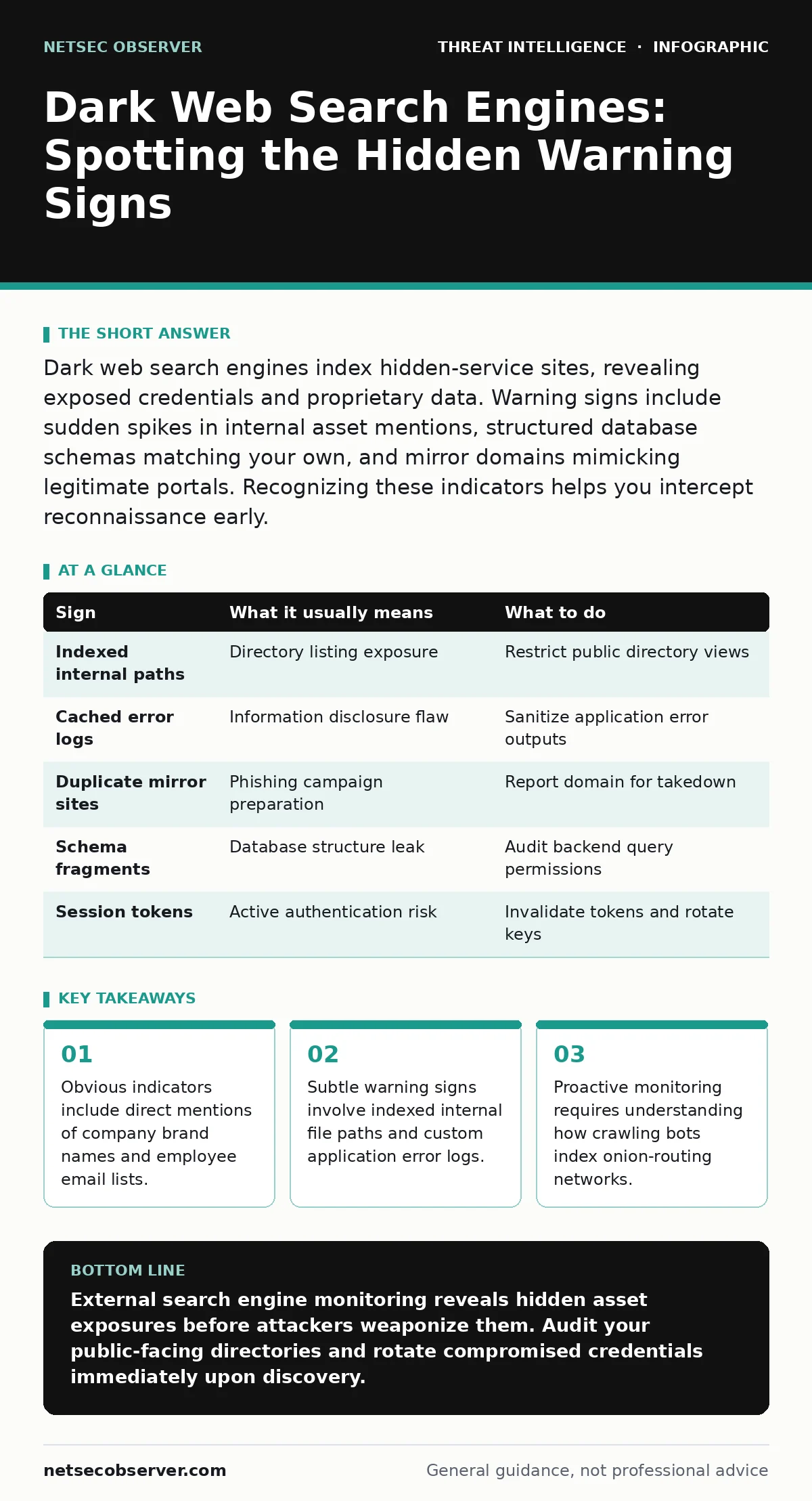
Dark web search engines index hidden-service sites, revealing exposed credentials and proprietary data. Warning signs include sudden spikes in internal asset mentions, structured database schemas matching your own, and mirror domains mimicking legitimate portals. Recognizing these indicators helps you intercept reconnaissance early.
Understanding Onion-Routing Indexers
Dark web search engines crawl overlay networks using specialized spiders that parse hidden-service directories constantly. These systems map structured databases to make illicitly harvested data searchable by anyone with an internet connection. Understanding this infrastructure changes how you view perimeter security, especially when dealing with advanced threats that bypass standard firewalls. Security teams frequently underestimate how quickly automated scrapers index newly exposed server directories across the hidden web, leaving networks vulnerable to exploitation.
Visible Indicators of Data Exposure
Visible indicators usually involve direct exposure of corporate assets on public-facing query pages. Employee email addresses paired with plaintext passwords appear immediately during simple keyword queries run by curious users. Brand names and proprietary product names surface alongside stolen documents, triggering immediate alerts for security personnel who monitor external data leaks. These obvious clues represent the final stage of a successful data exfiltration event that requires urgent containment and remediation.
Subtle Warning Signs in Cached Metadata
Subtle indicators require deeper inspection of query results and cached metadata fields. Fragmented database schemas matching internal application layouts often appear before complete data dumps hit public forums. Detailed internal file paths and server configuration details leak through automated indexing, which aids malicious actors performing targeted attacker reconnaissance against your infrastructure long before an actual breach makes headlines. Recognizing these faint signals prevents wider compromise across enterprise systems.
Anomalous Request Patterns and Scraping
Automated spiders generate specific request patterns that can overwhelm vulnerable web applications during ingestion. Defenders often mistake these crawling routines for benign web traffic or standard OSINT tools for investigators operating externally. Treating crawler logs as simple noise hides active data harvesting campaigns until the leaked assets appear in commercial query indexes, creating dangerous blind spots in your defense strategy. Analyzing user-agent strings helps separate malicious scrapers from legitimate visitors.
Diagnostic Reference Table
| Sign | What it usually means | What to do |
|---|---|---|
| Indexed internal paths | Directory listing exposure | Restrict public directory views |
| Cached error logs | Information disclosure flaw | Sanitize application error outputs |
| Duplicate mirror sites | Phishing campaign preparation | Report domain for takedown |
| Schema fragments | Database structure leak | Audit backend query permissions |
| Session tokens | Active authentication risk | Invalidate tokens and rotate keys |
See also: Phishing Infrastructure: How Attackers Build and Hide Their Networks · Difference Between Cyber Espionage and Cyber Terrorism
Hidden Costs of Automated Crawling
Hidden costs emerge when security teams chase every indexed fragment instead of prioritizing true operational risks. Automated indexers frequently cache outdated data that your organization patched months prior, creating phantom alerts. Establishing clear triage thresholds prevents alert fatigue among your security staff during major threat investigations.
Third-Party Vendor Data Leaks
Third-party vendors often leak corporate credentials that appear inside hidden search engine indexes before your internal systems flag the compromise. Supply chain partners maintain varying security postures that directly impact your external threat profile. Tracing the origin of leaked assets requires auditing partner access permissions and enforcing strict multifactor authentication requirements across all connected external networks to prevent unauthorized data collection by malicious external actors.
Practical Remediation Steps
Fixing exposure requires rotating compromised credentials immediately and revoking active session tokens. Monitoring egress traffic patterns helps identify unauthorized data exfiltration before indexers ingest the material. Deploying internal honeytokens can alert your team when automated scrapers attempt to parse hidden company directories. Maintaining rigorous access controls ensures that accidental disclosures do not turn into widespread security incidents affecting your entire organization and customer base.
Integrating Threat Feeds for Defense
Threat intelligence programs must incorporate external search engine monitoring to catch exposures early. Manual searches fail to scale across multiple hidden networks and shifting domain structures. Automated ingestion of indicator feeds bridges the gap between internal log analysis and external asset visibility without overwhelming security analysts with repetitive manual tasks. Building effective workflows around these feeds transforms raw data into actionable defensive postures across the enterprise.
Managing Search Engine Caches
Search engine caches preserve historical copies of compromised pages long after administrators remove the original content from live servers. Removing this cached material requires submitting explicit takedown requests directly to index operators or altering robots exclusion protocols to block future crawls. Ignoring cached records leaves an open window for malicious actors to harvest expired credentials that remain valid within legacy enterprise systems requiring immediate administrative attention.
Evaluating Extracted Telemetry
Telemetry data gathered from crawler connection attempts provides valuable insight into active collection campaigns targeting your sector. Monitoring source IP addresses associated with known indexing bots reveals which portions of your web estate attract the highest interest. Correlating this telemetry with broader industry threat reports helps anticipate upcoming credential stuffing waves before attackers deploy automated scripts against your authentication portals across global server deployments.
Key takeaways
- Obvious indicators include direct mentions of company brand names and employee email lists.
- Subtle warning signs involve indexed internal file paths and custom application error logs.
- Proactive monitoring requires understanding how crawling bots index onion-routing networks.
External search engine monitoring reveals hidden asset exposures before attackers weaponize them. Audit your public-facing directories and rotate compromised credentials immediately upon discovery.
Frequently asked questions
How do dark web search engines find hidden service sites?
These platforms rely on specialized crawling bots that traverse onion-routing directories and parse linked pages automatically.
Why do internal file paths appear in search results?
Misconfigured directory permissions and exposed developer environments allow external spiders to index backend file structures.
Can you remove cached data from dark web search engines?
Index operators rarely honor direct removal requests, making immediate credential rotation and asset remediation your primary defense.
How do honeytokens help detect automated scrapers?
Placing fake credentials or hidden files inside your directory structure alerts security teams when automated crawlers attempt to harvest them.
How this guide was produced: written by the NetSec Observer editorial team with AI assistance, checked against the public references listed below, and reviewed when the facts change. See our editorial policy or report an error.