
Phishing Infrastructure: How Attackers Build and Hide Their Networks
Attackers hide phishing sites inside legitimate cloud services to bypass traditional security filters and mimic trusted domains.
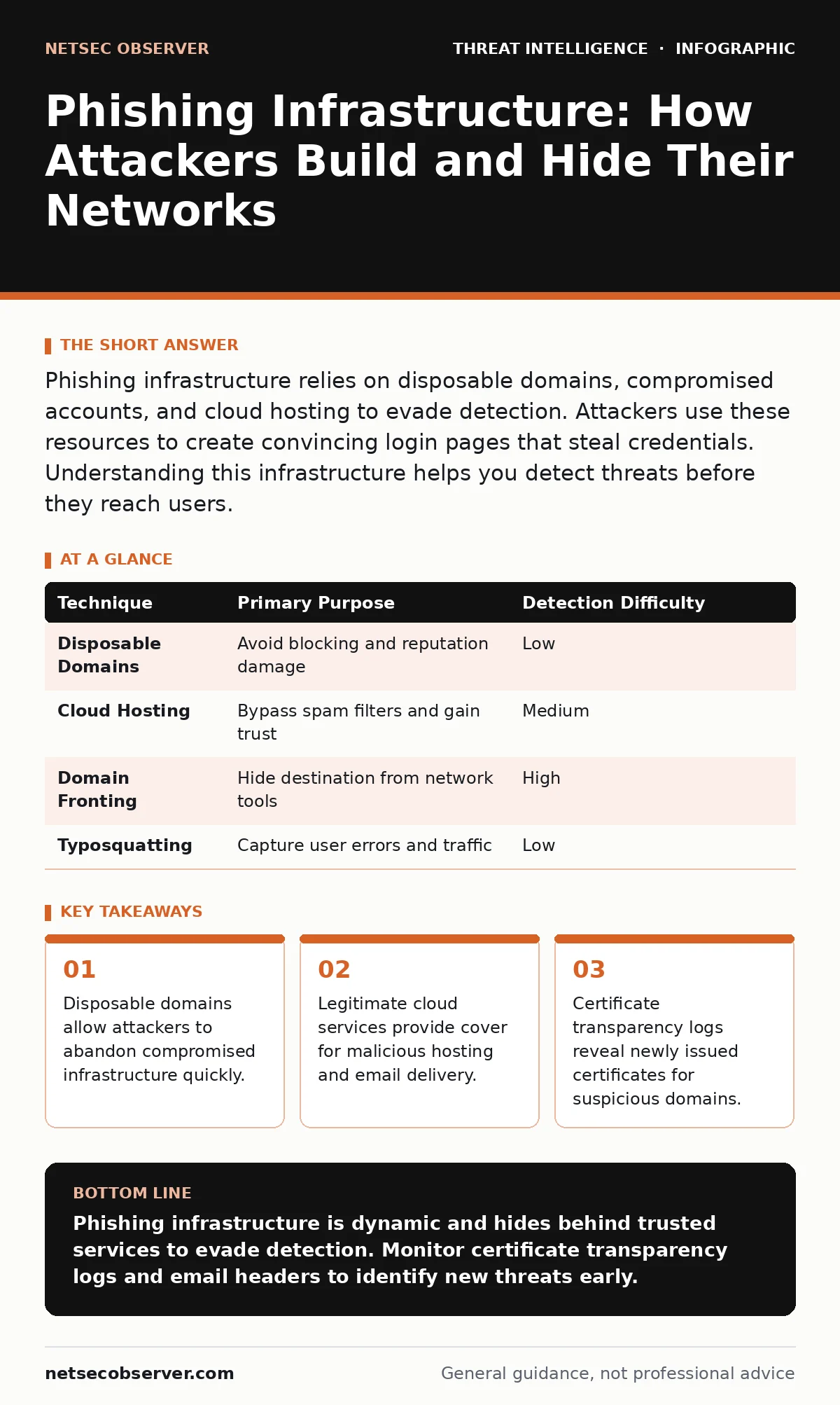
Phishing infrastructure relies on disposable domains, compromised accounts, and cloud hosting to evade detection. Attackers use these resources to create convincing login pages that steal credentials. Understanding this infrastructure helps you detect threats before they reach users.
What is phishing infrastructure?
Phishing infrastructure consists of the technical components attackers use to deliver fraudulent messages and host malicious landing pages. This infrastructure includes domain names, email servers, web hosts, and redirect services. Attackers build these components to mimic legitimate organizations. They aim to trick users into entering sensitive data or downloading malware. The infrastructure is often temporary and designed to disappear after a single campaign.
Why do attackers use disposable domains?
Attackers use disposable domains because they are cheap and easy to register in bulk. A disposable domain is a web address registered for a short period to conduct malicious activity. Once security vendors detect the domain and block it, the attacker abandons it. They then register a new domain that looks similar to the previous one. This constant rotation makes it difficult for filters to keep up. The cost of registration is low compared to the value of stolen credentials.
How do attackers hide behind legitimate cloud services?
Attackers register accounts with legitimate cloud providers to host phishing pages and send emails. These services offer high reputation scores that bypass spam filters. Attackers use free tiers or compromised accounts to avoid payment detection. They create subdomains that look like official corporate URLs. This technique exploits the trust users place in major technology platforms. Security teams must inspect the full URL path, not just the domain name, to identify these threats.
What role do domain fronting play in evasion?
Domain fronting is a technique where attackers use a legitimate domain to hide the true destination of their traffic. The attacker sends a request to a trusted content delivery network. The request contains the malicious domain in the header. The content delivery network forwards the request to the malicious server. This hides the malicious domain from network inspection tools. It allows attackers to bypass security controls that block known bad domains.
| Technique | Primary Purpose | Detection Difficulty |
|---|---|---|
| Disposable Domains | Avoid blocking and reputation damage | Low |
| Cloud Hosting | Bypass spam filters and gain trust | Medium |
| Domain Fronting | Hide destination from network tools | High |
| Typosquatting | Capture user errors and traffic | Low |
How do typosquatting and lookalike domains work?
Typosquatting involves registering domain names that are slight misspellings of popular websites. Attackers rely on users making typing errors when entering URLs. Lookalike domains use visual tricks to deceive users. Attackers might replace the letter "o" with the number "0". They might use characters from other alphabets that look identical to Latin letters. These domains appear identical to the human eye. Automated systems must check for homograph attacks to detect them.
How can you detect new phishing infrastructure?
You can detect new phishing infrastructure by analyzing open-source intelligence (OSINT) data. Security teams collect data from public sources to identify threats. This includes monitoring domain registration records and certificate transparency logs. You can also analyze web archives for cached phishing pages. Integrating this data with a threat intelligence program helps automate detection. Early detection allows you to block domains before users click links.
Why is email header analysis critical?
Email headers contain metadata that reveals the path of an email. Attackers often spoof the "From" address to appear legitimate. However, the headers show the actual sending server. Analyzing these headers helps identify forged messages. You can trace the email back to its origin. This technique works even if the display name looks correct. It is a fundamental skill for investigating suspected phishing attempts.
How do attackers evade security telemetry?
Attackers modify their infrastructure to avoid triggering security telemetry alerts. Telemetry data includes logs from endpoints, networks, and applications. Attackers use slow-speed attacks to stay below detection thresholds. They might use legitimate applications to download malicious files. This technique, known as living off the land, avoids installing new software. It reduces the digital footprint of the attack. Security teams must correlate multiple data sources to spot these subtle behaviors.
What is the lifecycle of a phishing campaign?
A phishing campaign follows a predictable lifecycle from setup to takedown. Attackers first acquire domains and hosting resources. They then craft the fraudulent content and email messages. The campaign launches with a burst of emails to many targets. Once detected, the attacker may pivot to new domains. Understanding this lifecycle helps defenders anticipate the next step. It allows for proactive blocking of related infrastructure.
How does user behavior impact infrastructure success?
User behavior determines the success of phishing infrastructure. Attackers design their infrastructure to exploit human psychology. They create urgency and fear to bypass rational thought. Users who do not verify URLs are more likely to fall for traps. Training users to check for subtle differences in domains reduces risk. However, sophisticated attacks can fool even experienced users. Technical controls must supplement user awareness.
Key takeaways
- Disposable domains allow attackers to abandon compromised infrastructure quickly.
- Legitimate cloud services provide cover for malicious hosting and email delivery.
- Certificate transparency logs reveal newly issued certificates for suspicious domains.
Phishing infrastructure is dynamic and hides behind trusted services to evade detection. Monitor certificate transparency logs and email headers to identify new threats early.
Frequently asked questions
How do I block a phishing domain?
Add the domain to your email filter and web proxy block list. Update your security rules to alert on any traffic to that domain.
What is the difference between spear phishing and whaling?
Spear phishing targets specific individuals within an organization. Whaling targets high-level executives to gain access to sensitive data or authorize transfers.
Can I trust a URL with HTTPS?
No, HTTPS only encrypts the connection. It does not verify that the website is legitimate. Attackers can obtain certificates for malicious domains.
How do I report a phishing email?
Forward the email to your security team without deleting it. Preserve the headers and attachments for analysis.
How this guide was produced: written by the NetSec Observer editorial team with AI assistance, checked against the public references listed below, and reviewed when the facts change. See our editorial policy or report an error.