
Threat Intelligence Programs: Real Benefits and Hidden Costs
Threat intelligence slows response time by adding context, but it creates a heavy operational burden that most small teams cannot sustain without automation.
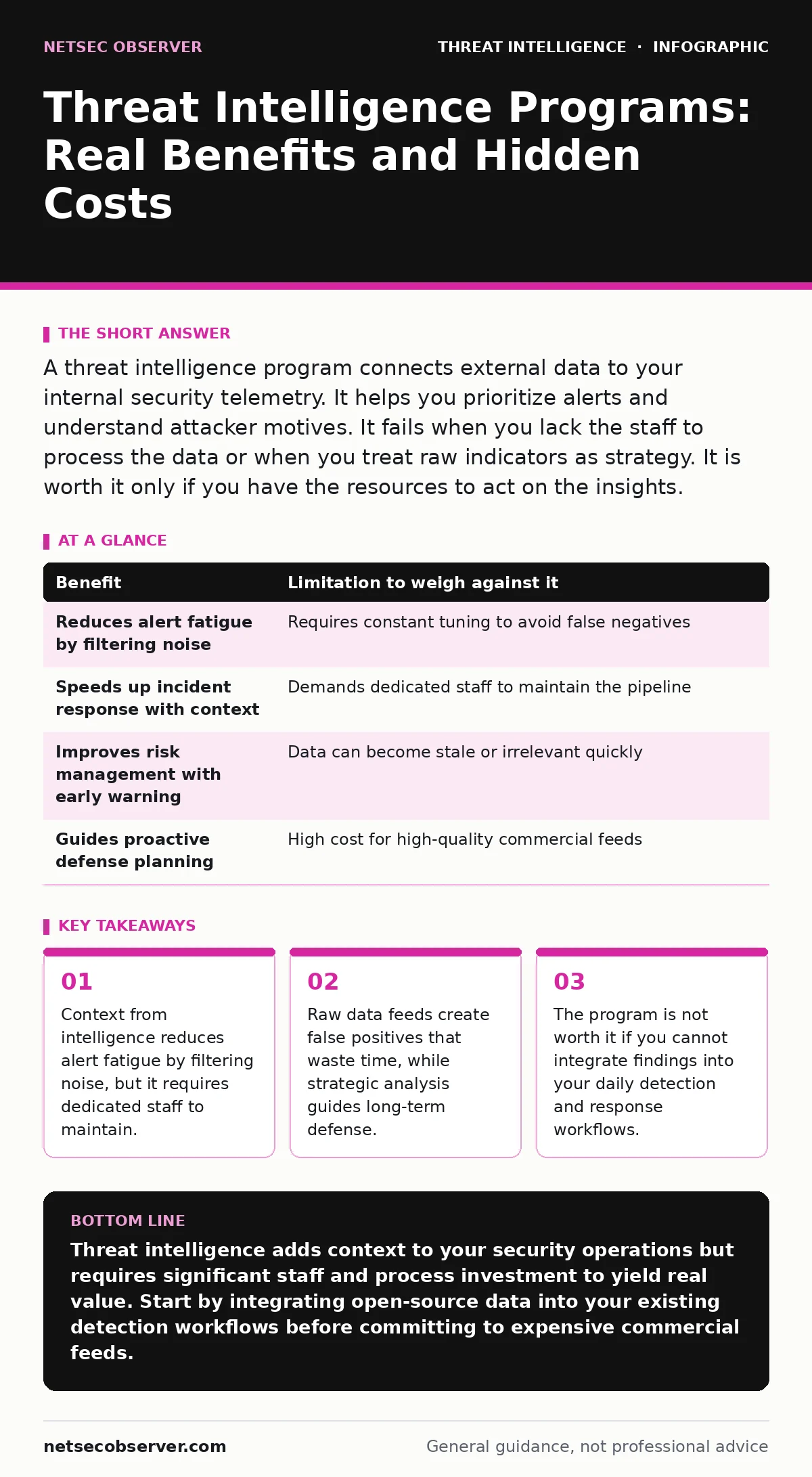
A threat intelligence program connects external data to your internal security telemetry. It helps you prioritize alerts and understand attacker motives. It fails when you lack the staff to process the data or when you treat raw indicators as strategy. It is worth it only if you have the resources to act on the insights.
What a Threat Intelligence Program Actually Does
A threat intelligence program collects, processes, and analyzes data about potential attackers. It turns raw information into actionable insights. You use these insights to improve your defenses. The program connects external events to your internal environment. It helps you understand who is targeting you and why. This context changes how you prioritize security tasks. You stop reacting to every alert and start focusing on real threats. The program supports your overall security posture by providing direction. It does not fix vulnerabilities on its own. It tells you where to look and what to expect.
Concrete Benefits of Structured Intelligence
Intelligence reduces alert fatigue significantly. You receive thousands of logs daily. Most are noise. Intelligence helps you filter out irrelevant events. You focus on indicators that match your specific industry or technology stack. This prioritization saves time for your analysts. You also gain visibility into attacker tactics. Understanding the "how" and "why" behind an attack helps you build better defenses. You can adjust your firewall rules or update your Sigma rules to catch new patterns. Intelligence turns reactive measures into proactive planning. You anticipate moves before they happen.
Intelligence improves incident response speed. When an attack occurs, you already know the context. You recognize the tools and techniques used. This familiarity shortens the investigation time. You can contain the threat faster. You also improve risk management. Intelligence highlights emerging threats before they hit your network. You can prepare mitigation strategies in advance. This preparation reduces the impact of successful attacks. You protect your most valuable assets more effectively.
| Benefit | Limitation to weigh against it |
|---|---|
| Reduces alert fatigue by filtering noise | Requires constant tuning to avoid false negatives |
| Speeds up incident response with context | Demands dedicated staff to maintain the pipeline |
| Improves risk management with early warning | Data can become stale or irrelevant quickly |
| Guides proactive defense planning | High cost for high-quality commercial feeds |
Honest Limitations and Hidden Costs
Threat intelligence creates a new workload. You must collect, store, and analyze data. This process requires skilled personnel. Many organizations hire analysts who cannot keep up with the volume. The data becomes a burden rather than a help. You also face the risk of false positives. External indicators often apply to multiple organizations. An IP address flagged as malicious might be benign in your context. Acting on every alert wastes resources. You must validate each finding against your environment. This validation takes time and expertise.
Data quality varies widely. Open sources are free but unverified. Commercial feeds are expensive and may contain duplicates. You must trust the source. Bad intelligence leads to bad decisions. You might block legitimate traffic or ignore a real threat. The program also has a shelf life. Threats change quickly. An indicator that is valid today may be useless tomorrow. You must constantly refresh your data. This maintenance cost is often underestimated. The program requires ongoing investment to stay effective.
When It Is Worth It
You should build a threat intelligence program if you have high-value targets. Large organizations in finance, healthcare, or energy attract advanced attackers. These attackers use sophisticated tactics. You need deep context to defend against them. You also need the staff to support the program. Hire analysts who can interpret data and act on it. They must integrate findings into your security telemetry. If you have the budget for tools and people, the program pays off. It helps you stay ahead of persistent threats.
The program is also worth it if you have complex environments. Large networks with many endpoints and cloud services are hard to monitor. Intelligence helps you focus on the most critical areas. You can tailor your defenses to your specific risks. You also benefit if you have a mature security operation. You already have processes for detection and response. Intelligence enhances these processes. It adds a layer of understanding that raw logs cannot provide. You gain a strategic advantage over attackers.
When It Is Not Worth It
Do not start a program if you lack basic security hygiene. You cannot defend against advanced threats if your systems are unpatched. Fix your vulnerabilities first. Ensure you have proper access controls and logging. A threat intelligence program will not save you from basic mistakes. You also should not start if you have no staff to manage it. Raw data is useless without analysis. You cannot outsource the interpretation of threats. You need people who understand your environment. If you cannot hire or train them, the program will fail.
The program is not worth it if you cannot act on the data. You must integrate intelligence into your workflows. If you collect data but never change your defenses, you waste money. You also should not start if you have limited resources. Small businesses often face different threats than large enterprises. They may not need deep strategic analysis. Focus on basic protection measures instead. Use automated tools to handle routine tasks. Save your budget for essential security controls. Do not chase intelligence for the sake of appearing sophisticated.
See also: Phishing Infrastructure: How Attackers Build and Hide Their Networks · Difference Between Cyber Espionage and Cyber Terrorism
Integrating Intelligence Into Daily Work
You must connect intelligence to your daily operations. Start by mapping external data to your internal logs. Look for matches in your network enumeration results. Check for known malicious IPs or domains. Use this data to refine your detection rules. Update your Sigma rules to catch new patterns. This integration makes intelligence actionable. You move from passive consumption to active defense. You also need to share findings across teams. Developers, operations, and security must all benefit from the data. Share insights through regular reports or dashboards.
You should also track the effectiveness of your program. Measure how much time intelligence saves you. Count the number of blocked attacks. Track the reduction in false positives. Use these metrics to justify the investment. Adjust your sources based on performance. Drop feeds that provide little value. Add sources that match your current risks. Keep the program lean and focused. Avoid collecting data you do not use. Efficiency is key to long-term success.
Common Mistakes to Avoid
Do not treat all indicators as equal. Some sources are more reliable than others. Verify the context of each finding. Do not automate responses based on unverified data. You risk disrupting business operations. Do not ignore strategic intelligence. Tactical data like IP addresses is useful, but strategic insights guide long-term planning. Balance both types of data. Do not work in isolation. Collaborate with other organizations in your industry. Share anonymized data to improve collective defense. This collaboration enhances your situational awareness.
You must also avoid analysis paralysis. Do not spend too much time researching low-risk threats. Focus on attacks that affect your organization. Prioritize based on likelihood and impact. Do not neglect the human element. Train your staff to use intelligence effectively. They must understand how to apply the data. Provide clear guidelines for action. Ensure everyone knows their role in the program. Consistency is vital for success.
Building a Sustainable Process
A sustainable program relies on clear processes. Define who collects, analyzes, and disseminates intelligence. Document the workflow. Ensure everyone follows the same steps. Use tools to automate repetitive tasks. Let humans focus on complex analysis. Review the program regularly. Assess what is working and what is not. Adjust based on feedback. Keep the program aligned with your business goals. Intelligence should support your mission, not distract from it.
You must also plan for the future. Threats will evolve. Your program must adapt. Stay informed about new technologies and techniques. Attend conferences and read research papers. Keep your skills sharp. Invest in training for your team. A knowledgeable staff is your best asset. They can interpret data better than any tool. They can spot trends and anticipate changes. Build a culture of continuous learning. This mindset ensures long-term resilience.
Key takeaways
- Context from intelligence reduces alert fatigue by filtering noise, but it requires dedicated staff to maintain.
- Raw data feeds create false positives that waste time, while strategic analysis guides long-term defense.
- The program is not worth it if you cannot integrate findings into your daily detection and response workflows.
Threat intelligence adds context to your security operations but requires significant staff and process investment to yield real value. Start by integrating open-source data into your existing detection workflows before committing to expensive commercial feeds.
Frequently asked questions
How do I measure the success of my threat intelligence program?
Track the reduction in alert noise, the speed of incident response, and the number of prevented attacks. Compare these metrics against baseline performance before the program started.
Can I use threat intelligence if I have a small security team?
Yes, but focus on automated integration and high-value data sources. Avoid manual analysis of large datasets. Use the intelligence to prioritize tasks, not to replace basic security hygiene.
What is the difference between tactical and strategic intelligence?
Tactical intelligence provides immediate indicators like IP addresses or file hashes. Strategic intelligence offers insights into attacker motives and long-term trends. You need both for a complete defense.
How does threat intelligence help with attacker reconnaissance?
It helps you detect early signs of probing, such as port scanning or network enumeration. By recognizing these patterns, you can block attackers before they exploit vulnerabilities.
How this guide was produced: written by the NetSec Observer editorial team with AI assistance, checked against the public references listed below, and reviewed when the facts change. See our editorial policy or report an error.