
OSINT tools for investigators map digital footprints
Public data collection requires strict verification because threat actors routinely plant fabricated artifacts across indexed web pages.
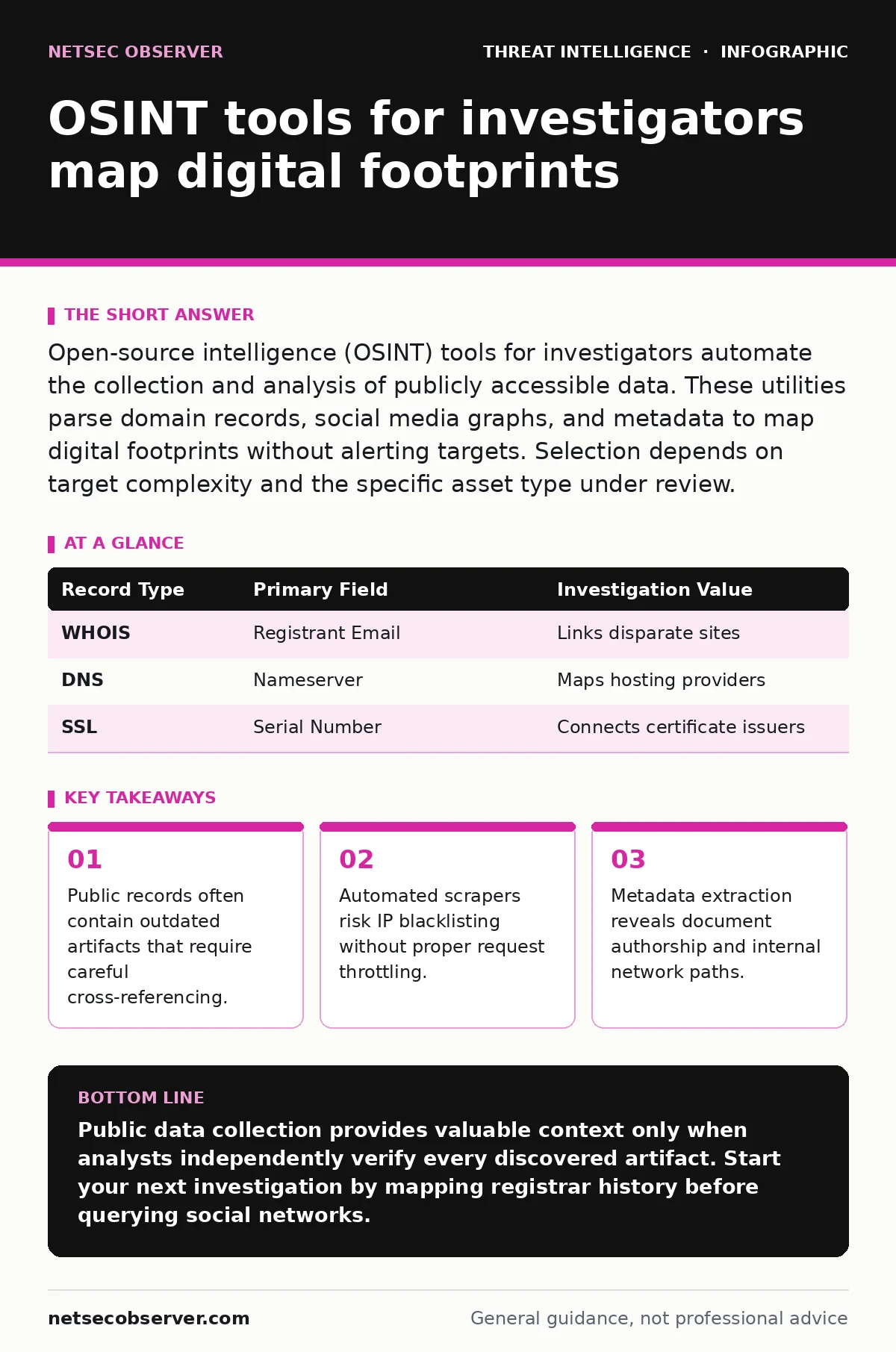
Open-source intelligence (OSINT) tools for investigators automate the collection and analysis of publicly accessible data. These utilities parse domain records, social media graphs, and metadata to map digital footprints without alerting targets. Selection depends on target complexity and the specific asset type under review.
What are open-source intelligence tools for investigators?
Open-source intelligence tools for investigators are software applications designed to gather, filter, and analyze publicly available data. These utilities transform raw internet data into structured information for security assessments.
Investigators rely on these programs to accelerate manual research tasks. 3 distinct categories dominate the field: network mappers, profile aggregators, and document parsers. Each category handles a specific format of public information.
How do domain registration records aid in digital investigations?
Domain registration records aid in digital investigations by exposing ownership details, administrative contacts, and historical changes tied to internet infrastructure. This process supports attacker reconnaissance by revealing associated infrastructure before an incident escalates.
Registrar databases store contact emails and creation dates. 2 checks matter most when reviewing these files: verifying historical ownership shifts and identifying shared registrar accounts across unrelated domains.
| Record Type | Primary Field | Investigation Value |
|---|---|---|
| WHOIS | Registrant Email | Links disparate sites |
| DNS | Nameserver | Maps hosting providers |
| SSL | Serial Number | Connects certificate issuers |
Why is metadata extraction critical for document analysis?
Metadata extraction is critical for document analysis because hidden file properties frequently reveal internal usernames, software versions, and local directory paths. Investigators examine these embedded details to understand how documents were generated.
Office suites and image editors automatically append author details to saved files. 4 attributes deserve close inspection: original creation timestamps, editing duration, author full names, and local machine identifiers.
What role do command-line utilities play in network mapping?
Command-line utilities play a central role in network mapping by querying authoritative name servers and routing tables directly. Security teams rely on these direct queries to bypass cached browser results and view live network topology.
Terminal tools query public records without loading graphical browser scripts. This mechanism prevents browser fingerprinting and speeds up bulk queries across large IP blocks.
How can automated scrapers handle rate limiting safely?
Automated scrapers handle rate limiting safely by implementing randomized request delays and rotating exit nodes across distinct subnets. Without these controls, automated tools trigger defensive blocks that halt data collection entirely.
Aggressive polling alerts target administrators immediately. 3 parameters require careful tuning: request frequency, concurrent thread limits, and user-agent string rotation.
See also: Phishing Infrastructure: How Attackers Build and Hide Their Networks · Difference Between Cyber Espionage and Cyber Terrorism
What hidden costs arise from relying entirely on web-based search engines?
Hidden costs arise from relying entirely on web-based search engines because commercial search indexes miss deep web content and obscure newly registered assets. Investigators overcome this gap by integrating raw database queries into the intelligence cycle.
Public search engines prioritize popular content over obscure infrastructure records. Relying solely on standard web results leaves blind spots around newly deployed staging servers and hidden file repositories.
How do social media graphs expose organizational structures?
Social media graphs expose organizational structures by mapping personal connections, employment history, and shared conference attendance among employees. Attackers exploit these relationship maps to craft targeted social engineering campaigns.
Platform APIs allow automated relationship mapping across professional networks. 2 vulnerabilities emerge here: employee oversharing and lax privacy settings on organizational directories.
When do common OSINT methods fail during complex inquiries?
Common OSINT methods fail during complex inquiries when targets use privacy protection services or plant false attribution markers across public forums. Investigators must validate every data point against independent sources to avoid acting on manipulated telemetry.
Adversaries understand how investigators gather public records. 3 deceptive practices complicate analysis: rented proxy networks, synthetic profile creation, and seeded disinformation.
How do investigators connect public data to internal anomalies?
Investigators connect public data to internal anomalies by matching external actor infrastructure against internal indicators of attack observed on local network boundaries. This synthesis transforms isolated web snippets into actionable defensive context.
External research gains real value only when correlated with internal observations. 2 data streams must merge: external threat actor infrastructure and internal boundary log events.
Key takeaways
- Public records often contain outdated artifacts that require careful cross-referencing.
- Automated scrapers risk IP blacklisting without proper request throttling.
- Metadata extraction reveals document authorship and internal network paths.
Public data collection provides valuable context only when analysts independently verify every discovered artifact. Start your next investigation by mapping registrar history before querying social networks.
Frequently asked questions
Can browser extensions replace dedicated OSINT software suites?
Browser extensions offer quick access to page metadata and local storage values, but they lack the bulk processing power needed for large infrastructure investigations.
How do privacy services obscure domain ownership records?
Privacy services replace real registrant names and contact details with proxy provider information in public databases.
Why should investigators avoid using personal accounts for public research?
Personal accounts expose personal identifiers to target servers, which can alert adversaries and compromise investigator anonymity.
What indicates that a public profile might be synthetic?
Synthetic profiles often feature excessively generic connection networks, low interaction diversity, and stock photography images across connected platforms.
How this guide was produced: written by the NetSec Observer editorial team with AI assistance, checked against the public references listed below, and reviewed when the facts change. See our editorial policy or report an error.