
Indicators of Attack: Definition, Detection, and Practical Usage
Indicators of attack reveal active adversary behavior rather than static malware signatures, allowing defenders to interrupt ongoing compromises before data exfiltration occurs.
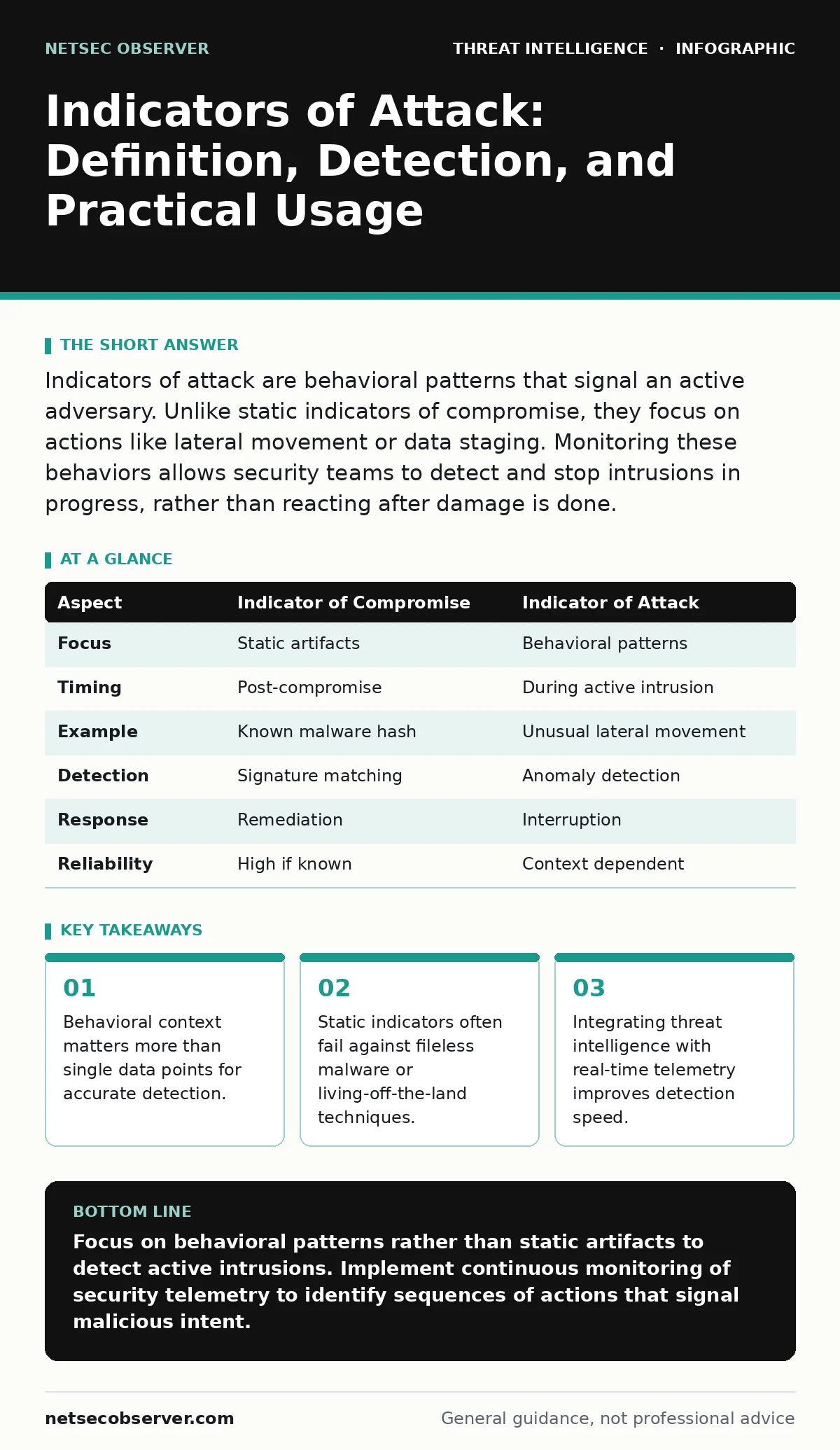
Indicators of attack are behavioral patterns that signal an active adversary. Unlike static indicators of compromise, they focus on actions like lateral movement or data staging. Monitoring these behaviors allows security teams to detect and stop intrusions in progress, rather than reacting after damage is done.
The Difference Between a Footprint and a Footstep
Imagine you are walking through a forest. Finding a discarded soda can tells you someone was there recently. It is a static object. It does not tell you if the person is still nearby or what they intend to do. Now imagine seeing broken branches and fresh mud tracks leading toward your cabin. This is an action in progress. It signals immediate intent and movement.
In cybersecurity, the soda can is an indicator of compromise. The broken branches are an indicator of attack. The distinction changes how you respond. A static artifact suggests past activity. A behavioral pattern suggests current activity. You cannot stop a theft by cleaning up the trash left behind. You stop it by intercepting the person taking your belongings.
| Aspect | Indicator of Compromise | Indicator of Attack |
|---|---|---|
| Focus | Static artifacts | Behavioral patterns |
| Timing | Post-compromise | During active intrusion |
| Example | Known malware hash | Unusual lateral movement |
| Detection | Signature matching | Anomaly detection |
| Response | Remediation | Interruption |
| Reliability | High if known | Context dependent |
Where the Term Comes From in Practice
The concept emerged because traditional security tools failed against sophisticated adversaries. Early detection relied on hashes. A hash is a unique digital fingerprint of a file. If security software knew the fingerprint of a virus, it could block it. This worked against mass-market malware. It failed against custom attacks where adversaries changed their code slightly each time.
Security researchers realized that while the code changed, the behavior did not. An adversary still needs to move between computers. They still need to elevate privileges. They still need to stage data for theft. These actions create observable effects. The term shifted focus from "what is bad" to "what is doing bad things." This shift aligns with the MITRE ATT&CK framework, which catalogs these behaviors systematically. By mapping actions to known tactics, defenders can recognize attacks even if the specific tool is new.
How Detection Works Day to Day
Detection requires visibility. You must collect data from endpoints, networks, and cloud services. This data is known as security telemetry. Telemetry includes login events, process creations, and network connections. Alone, these logs are noise. Together, they form a timeline of activity.
An indicator of attack is a sequence of telemetry events that match a known malicious pattern. For example, a single remote login is normal. A remote login followed immediately by a privilege escalation and then a search for sensitive files is not. The sequence reveals intent. Security tools use rules or machine learning to identify these sequences. The goal is to flag the behavior before the adversary completes their objective. This approach requires accurate baselines. You must know what normal looks like to spot the abnormal.
The Hidden Cost of Context
The primary challenge with behavioral detection is context. Not all unusual behavior is malicious. System administrators perform similar actions during maintenance. They move between systems. They elevate privileges. They access sensitive files. The difference is usually authorization and timing.
If your detection rules are too broad, you generate alerts for legitimate work. This is called alert fatigue. Analysts ignore alerts when they are constantly false positives. If your rules are too narrow, you miss the attack. The adversary adapts. They might slow down their actions to look like normal maintenance. They might use legitimate tools to perform malicious tasks. This technique is often called living-off-the-land. It makes the indicator of attack look like routine administrative work. Balancing sensitivity and specificity is difficult. It requires continuous tuning of your detection logic.
What People Usually Get Wrong
Many teams confuse indicators of attack with indicators of compromise. They build detection rules around file hashes or IP addresses. These are static. Adversaries change them easily. A new IP address or a renamed executable bypasses static rules instantly. Behavioral indicators are harder to disguise. An adversary can change their tool, but they cannot change the need to move laterally or exfiltrate data.
Another common error is treating each indicator in isolation. A single event rarely proves an attack. Context is king. You must correlate events across time and scope. A failed login is noise. Five hundred failed logins from one source followed by a successful login and immediate file transfer is a story. The story indicates an attack. Isolated data points lack the narrative needed for confident action.
See also: Honeytokens Explained: Silent Traps for Data Breaches · Detect Spear Phishing: Log Signals and Hidden Attack Vectors
Integrating with Other Defenses
Indicators of attack do not work alone. They complement other security practices. For instance, attacker reconnaissance often precedes an attack. Detecting early scanning or probing can trigger heightened monitoring for subsequent behavioral indicators. If you see enumeration, you watch closely for exploitation attempts.
Similarly, honeytokens can serve as tripwires. These are fake credentials or data files placed in sensitive areas. If accessed, they trigger an alert. Since legitimate users never touch them, any access is by definition an indicator of attack. This provides a high-confidence signal. It cuts through the noise of normal operations. Combining tripwires with behavioral analysis creates a layered defense. It catches both the initial breach and the subsequent movement.
The Reality of False Positives
No detection system is perfect. Behavioral analysis will always generate false positives. The key is response. When an alert fires, you must investigate. You must determine if the behavior is authorized. This investigation is part of the process. It is not a failure of the tool. It is the cost of visibility.
You must also consider log tampering. Adversaries know you are watching. They may delete logs to hide their tracks. If your telemetry is incomplete, your behavioral analysis fails. You see gaps in the timeline. These gaps are themselves indicators. A sudden stop in logging activity during a suspected intrusion is a strong signal of active defense evasion. Ensure your logging infrastructure is resilient. Store logs in a separate, secure location. This preserves the evidence needed to reconstruct the attack.
Moving Beyond Detection
Detection is only the first step. You must have a plan to respond. When you identify an indicator of attack, you must contain the threat. Isolate the affected system. Reset credentials. Block the adversary’s communication channels. Then, you must hunt. Look for other signs of compromise. The adversary may have moved elsewhere.
This process requires discipline. You cannot rely on automation alone. Human judgment is necessary to interpret context. You must understand your environment. You must know who is doing what and why. This knowledge turns data into intelligence. It transforms a list of alerts into a clear picture of the threat. By focusing on behavior, you stay ahead of the adversary’s tools. You fight their tactics instead of their code.
Key takeaways
- Behavioral context matters more than single data points for accurate detection.
- Static indicators often fail against fileless malware or living-off-the-land techniques.
- Integrating threat intelligence with real-time telemetry improves detection speed.
Focus on behavioral patterns rather than static artifacts to detect active intrusions. Implement continuous monitoring of security telemetry to identify sequences of actions that signal malicious intent.
Frequently asked questions
How do indicators of attack differ from threat intelligence?
Threat intelligence is information about adversaries, their motives, and their methods. Indicators of attack are specific, observable behaviors within your environment that match those methods. Intelligence informs what to look for; indicators are what you actually see.
Can machine learning replace human analysts in detecting attacks?
Machine learning can identify patterns at scale, but it struggles with context. It may flag unusual activity that is actually legitimate. Human analysts are needed to interpret the results, validate the threat, and decide on the appropriate response.
What is the most common indicator of attack?
There is no single most common indicator. Attacks vary. However, lateral movement and privilege escalation are frequent behaviors across many intrusion types. Monitoring for unusual access patterns is generally more effective than looking for specific malware.
How do I start implementing behavioral detection?
Begin by baselining normal activity in your environment. Identify what typical user and system behavior looks like. Then, define rules for deviations that align with known attack tactics. Start with high-confidence behaviors to minimize false positives.
How this guide was produced: written by the NetSec Observer editorial team with AI assistance, checked against the public references listed below, and reviewed when the facts change. See our editorial policy or report an error.