How OSINT Works: The Mechanics of Open-Source Intelligence
OSINT is not a magic search tool; it is a rigorous process of filtering public noise to find specific signals that reveal hidden infrastructure or intent.
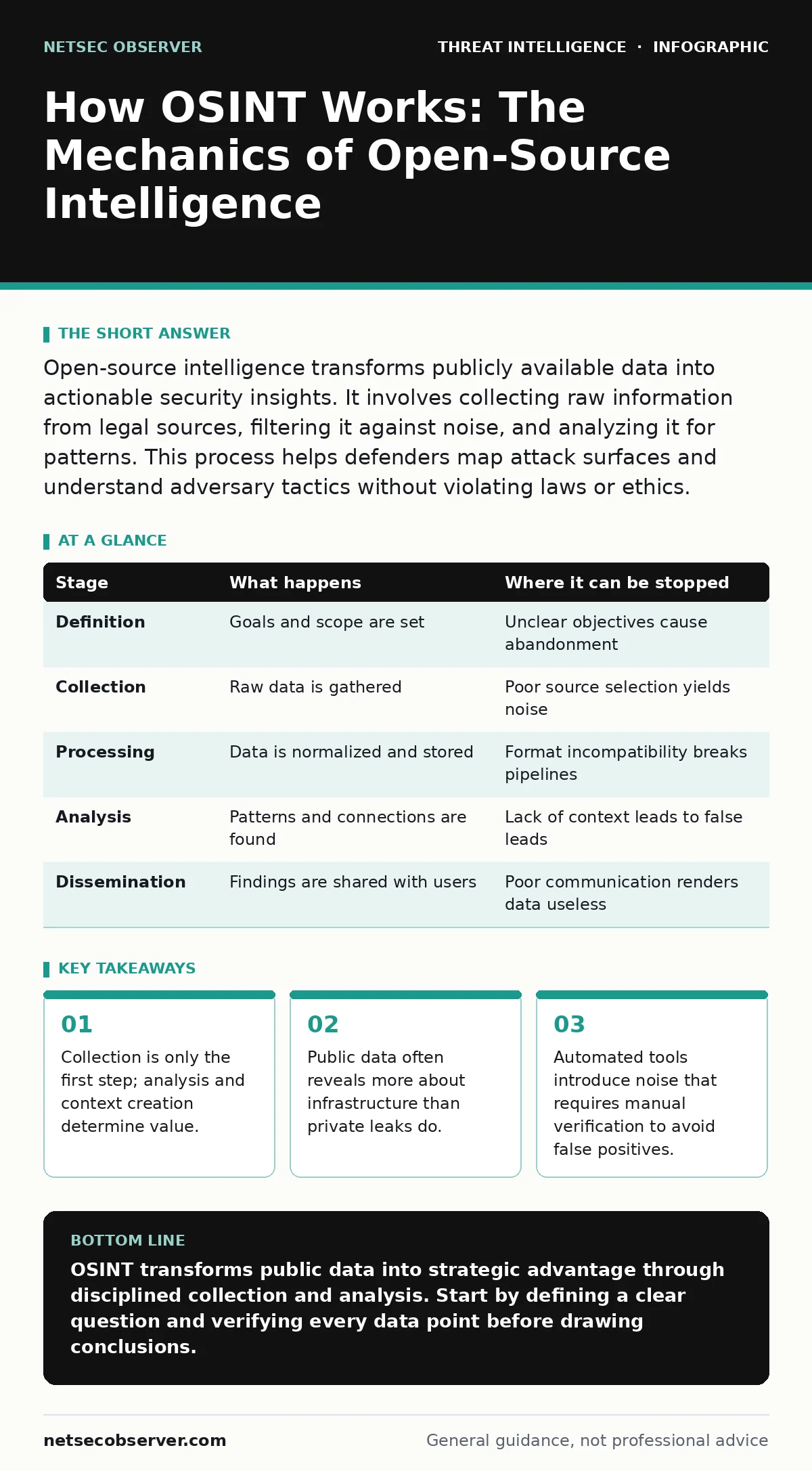
Open-source intelligence transforms publicly available data into actionable security insights. It involves collecting raw information from legal sources, filtering it against noise, and analyzing it for patterns. This process helps defenders map attack surfaces and understand adversary tactics without violating laws or ethics.
The Foundation of Public Data
Open-source intelligence (OSINT) relies on information that is legally available to the public. This includes news articles, social media posts, government records, and technical databases. Many beginners mistake OSINT for simple web searching. It is actually a structured methodology for turning raw data into intelligence.
The value lies in the connection between disparate data points. A single IP address is just a number. That same IP address, linked to a domain registration and a specific software version, becomes a potential entry point. You are building a picture from fragments that everyone else ignores because they seem insignificant.
Stage 1: Requirement Definition
Before collecting data, you must define the specific question you are trying to answer. Vague goals lead to wasted time and data overload. If you need to know if a company uses a specific cloud provider, your search parameters differ from finding their internal network layout.
This stage prevents scope creep. You decide what data is relevant and, just as importantly, what data you will ignore. This discipline saves hours of manual review later. It also ensures your findings can be acted upon by other teams.
| Stage | What happens | Where it can be stopped |
|---|---|---|
| Definition | Goals and scope are set | Unclear objectives cause abandonment |
| Collection | Raw data is gathered | Poor source selection yields noise |
| Processing | Data is normalized and stored | Format incompatibility breaks pipelines |
| Analysis | Patterns and connections are found | Lack of context leads to false leads |
| Dissemination | Findings are shared with users | Poor communication renders data useless |
Stage 2: Collection
Collection involves gathering raw data from multiple sources. You might scrape public directories, query domain name system (DNS) records, or review public code repositories. The key is variety. Relying on a single source creates blind spots.
Automated tools can gather large volumes of data quickly. However, they also gather irrelevant information. You must balance speed with precision. Collecting too much data slows down the analysis phase. Collecting too little risks missing critical indicators.
Stage 3: Processing
Raw data is messy and inconsistent. Processing cleans this data into a usable format. This might involve converting timestamps to a standard format, normalizing IP addresses, or removing duplicates. Without this step, your analysis tools cannot correlate events effectively.
This stage often involves storage decisions. You need a system that allows for easy retrieval and linking of data points. A simple spreadsheet works for small projects, but larger efforts require structured databases. The goal is to make the data searchable and comparable.
Stage 4: Analysis
Analysis is where intelligence is created. You look for connections between the processed data points. You might cross-reference a domain name with known malicious infrastructure or identify unusual network behaviors. This is where you apply context to the raw facts.
You are looking for anomalies. A server that responds to a standard probe is normal. A server that responds with a specific error code indicating a legacy operating system is interesting. You combine these technical clues with public information to build a profile of the target.
See also: Threat Intelligence Programs: Real Benefits and Hidden Costs · Phishing Infrastructure: How Attackers Build and Hide Their Networks
Stage 5: Dissemination
The final stage is sharing the findings with the people who can act on them. A technical report full of raw data is useless to a manager. A high-level summary without technical detail is useless to an engineer. You must tailor the output to the audience.
Clear communication ensures the intelligence leads to action. If the team does not understand the risk, they will not fix it. Documentation should include the source of the information, the method used to find it, and the recommended next steps. This builds trust in the OSINT process.
Applying OSINT to Defense
OSINT is not just for attackers. Defenders use it to understand their own exposure. By thinking like an adversary, you can identify weaknesses before they are exploited. This proactive approach strengthens your security posture.
You can use OSINT to monitor for leaked credentials or exposed data. Regular checks help you maintain control over your digital footprint. It also helps you understand the broader threat environment. Knowing what tactics are currently popular helps you prioritize your defenses.
Integrating with Other Frameworks
OSINT works best when combined with other security practices. You can map your findings to the MITRE ATT&CK framework to understand the tactics and techniques used by adversaries. This provides a common language for discussing threats.
It also complements indicators of attack by providing context to raw signals. An IP address is an indicator. Knowing that IP address is associated with a specific campaign is intelligence. This depth allows for better decision-making and resource allocation.
Common Pitfalls and Ethics
OSINT operates in a legal gray area for some. Always respect privacy laws and terms of service. Do not access data that requires authentication or bypasses security controls. The goal is to use publicly available information, not to hack systems.
Another pitfall is confirmation bias. You might look for evidence that supports your initial hypothesis and ignore contradictory data. Stay objective. Let the data guide your conclusions, not your assumptions. This ensures your intelligence is reliable and actionable.
The Human Element
Technology can collect and process data, but humans provide the intuition. Tools can find patterns, but they cannot understand nuance or intent. The analyst’s role is to interpret the data and provide strategic insight.
This human judgment is irreplaceable. It allows you to distinguish between a coincidence and a threat. It also enables you to communicate the significance of your findings to stakeholders. OSINT is a partnership between tool and thinker.
Key takeaways
- Collection is only the first step; analysis and context creation determine value.
- Public data often reveals more about infrastructure than private leaks do.
- Automated tools introduce noise that requires manual verification to avoid false positives.
OSINT transforms public data into strategic advantage through disciplined collection and analysis. Start by defining a clear question and verifying every data point before drawing conclusions.
Frequently asked questions
Is OSINT legal?
Yes, as long as you only access publicly available information. Do not bypass security controls or access data that requires permission.
How do I start an OSINT investigation?
Begin with a clear objective. Identify the specific questions you need to answer and the sources that are likely to contain the answers.
What tools are best for OSINT?
There is no single best tool. Use a combination of search engines, public databases, and specialized software that fits your specific needs and skill level.
Can OSINT replace other security measures?
No, OSINT complements other measures. It provides external visibility but does not replace internal monitoring, patching, or access controls.
How this guide was produced: written by the NetSec Observer editorial team with AI assistance, checked against the public references listed below, and reviewed when the facts change. See our editorial policy or report an error.