
Intelligence Cycle CIA: How the Feedback Loop Actually Works
The intelligence cycle is not a linear report-writing task but a continuous feedback loop where collection errors compound into strategic failures if validation is skipped.
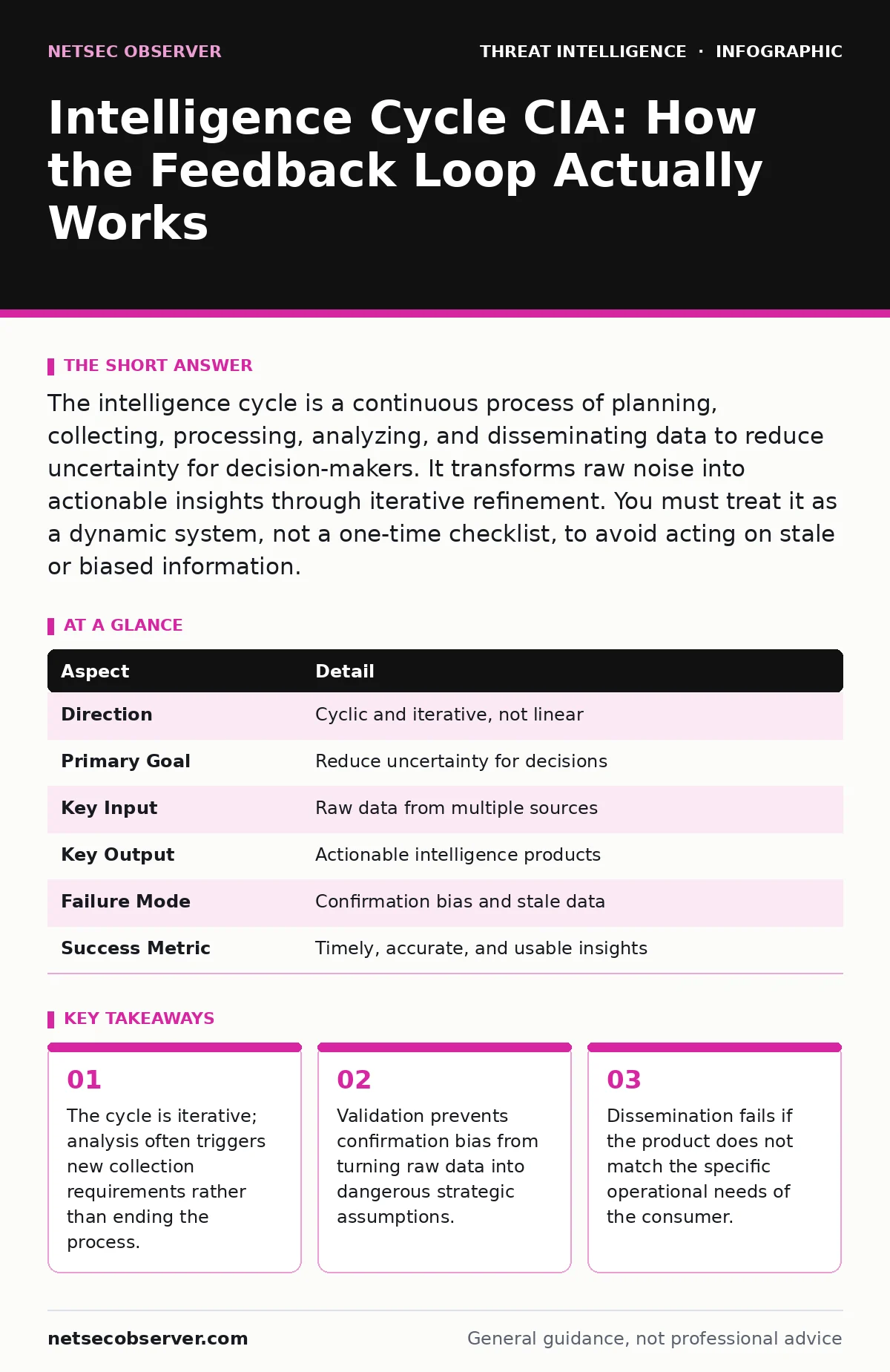
The intelligence cycle is a continuous process of planning, collecting, processing, analyzing, and disseminating data to reduce uncertainty for decision-makers. It transforms raw noise into actionable insights through iterative refinement. You must treat it as a dynamic system, not a one-time checklist, to avoid acting on stale or biased information.
The Core Mechanics of the Intelligence Cycle
The intelligence cycle is a structured methodology for turning raw data into reliable information that supports decision-making. It operates as a closed loop where each stage feeds directly into the next, allowing for continuous correction and refinement. This structure prevents organizations from acting on isolated data points without context.
Imagine a detective who finds a single fingerprint at a scene. That print is raw data. Identifying the person is processing. Understanding why they were there is analysis. Telling the patrol officer to watch that address is dissemination. If the officer reports new sightings, the cycle restarts. This loop ensures that conclusions evolve as new evidence emerges, rather than remaining static guesses.
| Aspect | Detail |
|---|---|
| Direction | Cyclic and iterative, not linear |
| Primary Goal | Reduce uncertainty for decisions |
| Key Input | Raw data from multiple sources |
| Key Output | Actionable intelligence products |
| Failure Mode | Confirmation bias and stale data |
| Success Metric | Timely, accurate, and usable insights |
Planning and Direction: Defining the Gap
Planning begins by identifying what you do not know. You must define the specific question that requires an answer before you start collecting data. This step prevents the common error of gathering everything and knowing nothing. If you do not define the intelligence gap, you cannot prioritize which sources are worth the effort.
This stage requires you to list known facts and highlight missing pieces. You must decide what level of detail is necessary. A high-level strategic overview requires different data than a technical forensic investigation. Skipping this step leads to resource waste and analysis paralysis. You collect too much noise and drown the signal.
Collection: Gathering Raw Materials
Collection involves acquiring data from various sources to fill the intelligence gaps identified in planning. Sources fall into two categories: human intelligence, which comes from people, and signals intelligence, which comes from electronic systems. You must balance the breadth of coverage with the depth of verification.
Relying on a single source type creates blind spots. An attacker might hide their network activity while leaving social media traces. You need multiple perspectives to cross-reference findings. During attacker reconnaissance, adversaries often probe for weaknesses before striking. Your collection must detect these early probes. If you only monitor network traffic, you miss the human element of social engineering.
Processing and Exploitation: Cleaning the Data
Raw data is rarely ready for analysis. Processing converts raw inputs into a standardized format that analysts can use. This includes translating foreign languages, decrypting communications, and organizing disparate data points into a coherent structure. Without this step, analysts spend most of their time searching for information rather than interpreting it.
Automation helps here, but it introduces noise. Tools that scrape public data often return duplicates or outdated entries. You must filter out irrelevant items before they reach the analyst. This is where security telemetry becomes vital. It provides the raw logs and metrics that need cleaning. If you feed dirty data into your analysis, your conclusions will be flawed. Garbage in, garbage out is a hard rule in this phase.
Analysis and Production: Creating Meaning
Analysis is the core of the cycle. It involves interpreting processed data to answer the original question. You look for patterns, anomalies, and causal relationships. This is where you move from "what happened" to "why it happened" and "what will happen next." You must challenge your own assumptions to avoid confirmation bias.
A common error is assuming correlation implies causation. Just because two events happened together does not mean one caused the other. You must consider alternative explanations. User and entity behavior analytics helps here by establishing baselines for normal activity. When behavior deviates from the baseline, it signals potential threat. You must document your reasoning so others can verify your logic.
See also: Threat Intelligence Programs: Real Benefits and Hidden Costs · Phishing Infrastructure: How Attackers Build and Hide Their Networks
Dissemination: Delivering the Insight
Dissemination delivers the final intelligence product to the decision-maker. The format must match the consumer’s needs. A executive needs a brief summary. A technical team needs detailed indicators. If you send a technical report to a board member, they will ignore it. If you send a vague summary to engineers, they cannot act on it.
Timing is as important as accuracy. Intelligence that arrives after the event is historical, not actionable. You must establish clear channels for urgent alerts versus routine updates. Security metrics help you track how quickly intelligence reaches the right people. If dissemination is slow, the entire cycle fails because the decision is made without the necessary context.
Exploitation and Feedback: Closing the Loop
The cycle does not end at dissemination. You must evaluate whether the intelligence product helped the decision-maker. Did the action taken prevent the threat? Did it reveal new information? This feedback informs the next planning phase. If the intelligence was ignored, you must understand why. Was it unclear? Was it too late?
This feedback loop is where most organizations fail. They treat intelligence as a product to be delivered rather than a service to be refined. You must actively seek input from consumers. This continuous improvement ensures that your collection efforts align with actual operational needs. Ignoring feedback leads to stagnation and irrelevance.
What People Usually Get Wrong
Many practitioners view the intelligence cycle as a linear, one-time process. They plan, collect, analyze, and then stop. This ignores the iterative nature of threat environments. Threats evolve, and so must your understanding. You must treat each dissemination as a starting point for new collection.
Another common mistake is over-reliance on automated tools. Tools can collect data, but they cannot judge context. Human analysts are needed to interpret nuances. Sigma rules provide a standardized way to detect threats, but they require tuning. If you set rules too broadly, you generate noise. If you set them too narrowly, you miss threats. Balance is key.
Key takeaways
- The cycle is iterative; analysis often triggers new collection requirements rather than ending the process.
- Validation prevents confirmation bias from turning raw data into dangerous strategic assumptions.
- Dissemination fails if the product does not match the specific operational needs of the consumer.
Frequently asked questions
Is the intelligence cycle only for government agencies?
No, the intelligence cycle applies to any organization that needs to make decisions based on incomplete information. Corporations, hospitals, and schools all use variations of this cycle to manage risk and security.
How does the intelligence cycle differ from incident response?
Incident response is reactive and focuses on containing a specific event. The intelligence cycle is proactive and continuous, aiming to understand threats before they cause damage. Intelligence informs response, but response data also feeds back into intelligence.
Can automation replace the analysis phase?
Automation can handle data processing and pattern matching, but it cannot replace human judgment in analysis. Context, intent, and strategic implications require human insight. Automation supports analysts but does not replace them.
What is the biggest risk in the planning phase?
The biggest risk is defining the wrong question. If you plan to collect data for the wrong problem, all subsequent stages are wasted effort. Clear, specific intelligence requirements are the foundation of effective cycles. BOTTOM LINE: The intelligence cycle is a continuous loop that turns raw data into actionable decisions through iterative refinement. Start by defining your intelligence gaps clearly to ensure your collection and analysis efforts remain focused and effective.
How this guide was produced: written by the NetSec Observer editorial team with AI assistance, checked against the public references listed below, and reviewed when the facts change. See our editorial policy or report an error.