
Sigma Notation Rules: How to Write Agnostic Detection Logic
Sigma rules separate detection logic from platform syntax, allowing you to write one pattern that works across multiple security tools without rewriting code for each vendor.
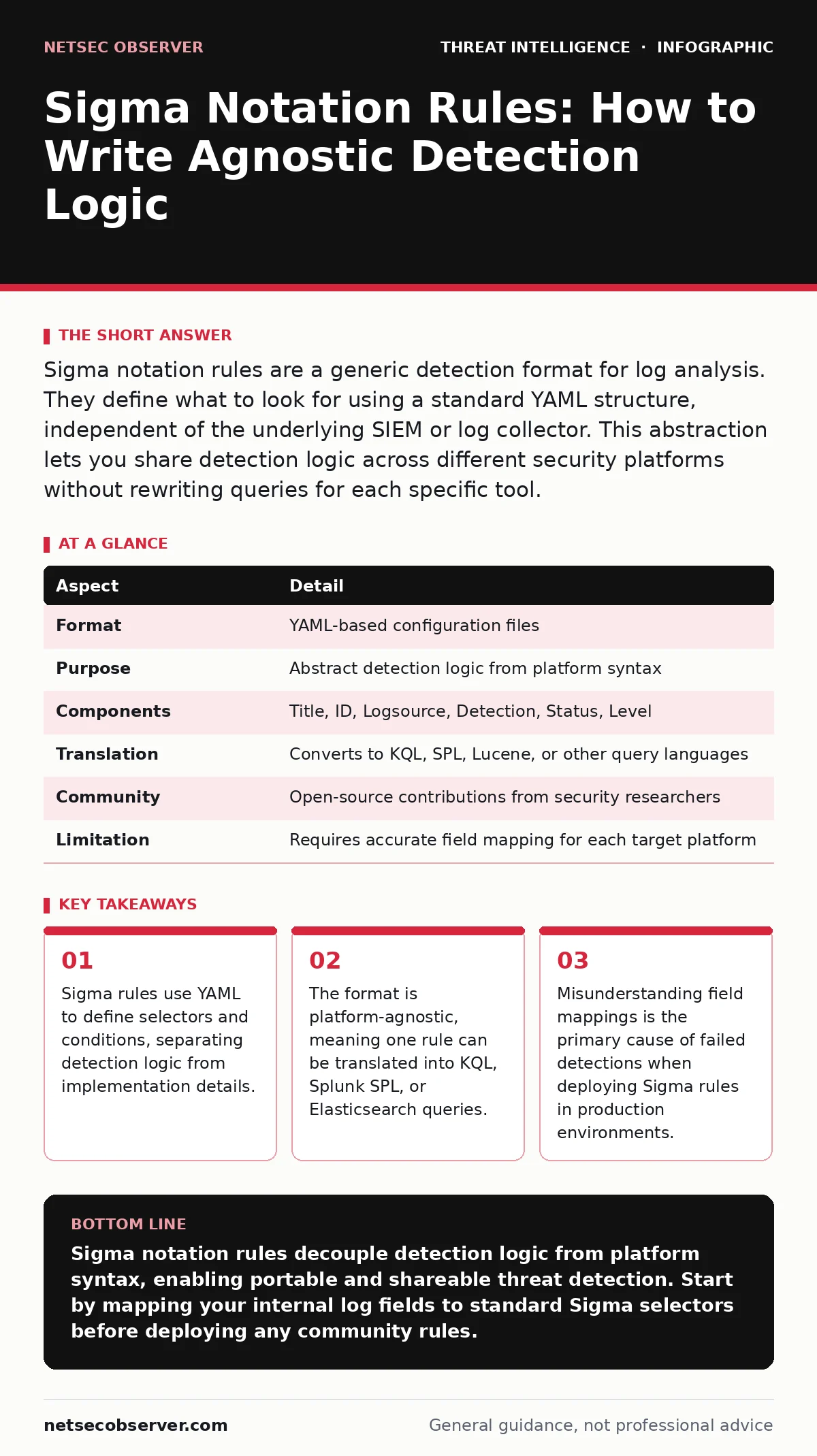
Sigma notation rules are a generic detection format for log analysis. They define what to look for using a standard YAML structure, independent of the underlying SIEM or log collector. This abstraction lets you share detection logic across different security platforms without rewriting queries for each specific tool.
What Sigma Notation Rules Actually Are
Sigma notation rules are a standardized way to write detection logic for log data. They do not execute directly on your security tools. Instead, they serve as an intermediate format that describes what a threat looks in abstract terms. You write the rule once in Sigma syntax. A translator then converts that rule into the specific query language your Security Information and Event Management (SIEM) system understands.
This separation is the core value proposition. It allows detection engineers to focus on the threat behavior rather than the quirks of a specific vendor’s query engine. The format uses YAML, a human-readable data serialization standard. This makes the rules easy to read, edit, and share across teams.
Imagine you need to detect a specific command execution. In one tool, you might write a complex regular expression. In another, you might use a different keyword syntax. With Sigma notation rules, you define the field name and the value once. The translator handles the rest. This approach reduces the cognitive load on analysts who must switch between multiple platforms. It also creates a single source of truth for detection logic. When a rule is updated, you update the Sigma rule, not five different proprietary queries.
| Aspect | Detail |
|---|---|
| Format | YAML-based configuration files |
| Purpose | Abstract detection logic from platform syntax |
| Components | Title, ID, Logsource, Detection, Status, Level |
| Translation | Converts to KQL, SPL, Lucene, or other query languages |
| Community | Open-source contributions from security researchers |
| Limitation | Requires accurate field mapping for each target platform |
How the Abstraction Layer Works
The mechanism relies on two distinct layers: the detection logic and the data mapping. The detection logic defines the conditions that trigger an alert. It specifies which fields to check, what values to look for, and how to combine those checks. The data mapping defines where those fields live in your specific environment. Sigma notation rules contain only the detection logic. They assume field names like event.category or process.command_line. Your deployment pipeline must provide the mapping that translates these generic names into your actual log schema. If your SIEM calls the command line field cmd instead of process.command_line, the rule will fail unless you provide a translation map. This is the hidden cost of abstraction. You gain portability, but you must maintain accurate mappings for every data source you ingest.
The translation process is usually automated. Tools like Sigma CLI or built-in SIEM integrations parse the YAML file. They replace generic field names with platform-specific ones. They also convert the boolean logic into the correct query syntax. For example, a Sigma and condition becomes a AND operator in KQL or a comma-separated list in Splunk. This automation prevents syntax errors that often occur when manually porting rules. It also ensures consistency. Every instance of the rule uses the same logic, reducing the risk of configuration drift.
Who Benefits from Standardized Detection
This format affects anyone responsible for monitoring log data for malicious activity. Detection engineers gain efficiency by writing rules once and deploying them everywhere. Security analysts benefit from consistent alert quality. When rules are shared via a central repository, the entire community improves. A researcher who discovers a new attack pattern can publish a Sigma rule. Others can deploy it immediately, regardless of their tool stack. This accelerates the defense cycle. It reduces the time between threat discovery and operational detection.
Organizations that use multiple security platforms benefit the most. Many enterprises run a mix of on-premises and cloud-based tools. They might use one SIEM for network logs and another for endpoint logs. Sigma notation rules allow them to maintain a unified detection strategy. They do not need separate teams for each platform. A single team can manage the detection logic. Platform-specific teams handle the data ingestion and mapping. This division of labor scales better as the organization grows. It also reduces vendor lock-in. If you switch SIEM providers, you keep your detection logic. You only need to update the data mappings.
Common Mistakes in Rule Deployment
People usually get wrong the assumption that Sigma rules are plug-and-play. They are not. A rule is only as good as the data it queries. If your logs do not contain the fields the rule expects, the rule is useless. This is the most common failure mode. Teams copy rules from public repositories and deploy them without verifying their data coverage. They expect immediate value. They receive silence or false positives. The rule might look for a field that your endpoint agent does not collect. Or it might look for a value that is normalized differently in your environment.
Another frequent error is ignoring the status field in Sigma rules. This field indicates the maturity of the rule. A test status means the rule is experimental. It may have high false positive rates. A stable status means the rule has been tested and validated. Deploying unstable rules in production creates noise. It burdens analysts with irrelevant alerts. It erodes trust in the detection system. You must review the status before deploying any rule. You must also tune the rule for your environment. What works in one network may not work in another. Context matters.
Integrating with Threat Intelligence Programs
Sigma notation rules fit into a broader threat intelligence program. They operationalize indicators of compromise (IOCs) and tactics, techniques, and procedures (TTPs). When you receive new intelligence about an attacker group, you can translate that information into Sigma rules. This makes the intelligence actionable. It moves it from a report to a detection capability. You can also use these rules to hunt for historical activity. By running translated queries against archived logs, you can determine if an attacker was already present.
This integration requires discipline. You must map intelligence to specific log sources. Not all TTPs are visible in logs. Some attacker actions leave no trace. You must know what your sensors can see. This knowledge comes from understanding your security telemetry. You must document which data sources cover which attack phases. This mapping guides your rule writing. It ensures you are looking in the right places. It prevents you from wasting effort on detections that cannot be supported by your data.
See also: Detect Spear Phishing: Log Signals and Hidden Attack Vectors · OSINT tools for investigators map digital footprints
Building a Sustainable Detection Strategy
To succeed with Sigma notation rules, you need a repeatable process. Start by cataloging your data sources. Document the field names and formats for each log type. Create a mapping library that translates generic Sigma fields to your internal schema. Automate the translation and deployment of rules. Use version control to track changes to your rule set. This allows you to audit updates and roll back bad changes.
Test every rule before deployment. Use a staging environment that mirrors production. Inject known malicious activity to verify the rule fires. Check for false positives by running the rule against normal traffic. Tune the rule to reduce noise. Only then promote it to production. This rigorous process ensures quality. It builds confidence in your detection capabilities. It also makes your team more efficient. You spend less time fixing broken rules and more time hunting for threats.
The Role of Community and Standards
The strength of Sigma notation rules lies in the community. Thousands of rules are shared publicly. They cover a wide range of threats and platforms. You can leverage this collective knowledge. You do not need to write every rule from scratch. You can adapt existing rules for your environment. This accelerates your maturity. It allows you to focus on unique threats specific to your industry or infrastructure.
However, you must verify community rules. Not all contributions are high quality. Some may be outdated or inaccurate. You must review the logic. You must test the rule. You must ensure it fits your context. Blindly trusting public rules is risky. It can introduce security gaps or operational chaos. Treat community rules as a starting point, not a final product. Adapt them to your needs. Maintain ownership of your detection logic. This balance between collaboration and control is key to long-term success.
Key takeaways
- Sigma rules use YAML to define selectors and conditions, separating detection logic from implementation details.
- The format is platform-agnostic, meaning one rule can be translated into KQL, Splunk SPL, or Elasticsearch queries.
- Misunderstanding field mappings is the primary cause of failed detections when deploying Sigma rules in production environments.
Sigma notation rules decouple detection logic from platform syntax, enabling portable and shareable threat detection. Start by mapping your internal log fields to standard Sigma selectors before deploying any community rules.
Frequently asked questions
Do Sigma rules work with all SIEM vendors?
Sigma rules work with any vendor that supports YAML-based translation or has a built-in Sigma parser. Major platforms like Splunk, Microsoft Sentinel, and Elastic have native support.
How do I handle false positives in Sigma rules?
You tune the rule by adding exclusion conditions or refining the selectors. You must test the modified rule against your baseline traffic to ensure it reduces noise without missing threats.
Can I write Sigma rules for custom log formats?
Yes, you can define custom field mappings for your proprietary logs. You must document these mappings clearly so other analysts understand how the generic Sigma fields translate to your data.
What is the difference between Sigma and YARA rules?
Sigma rules analyze log data for behavioral patterns. YARA rules analyze files or memory for static signatures. They serve different purposes in the detection lifecycle.
How this guide was produced: written by the NetSec Observer editorial team with AI assistance, checked against the public references listed below, and reviewed when the facts change. See our editorial policy or report an error.