
Dark Web Monitoring Mistakes That Waste Your Budget
Most organizations monitor the wrong data, creating false alerts that hide real threats and drain security team resources without reducing actual risk.
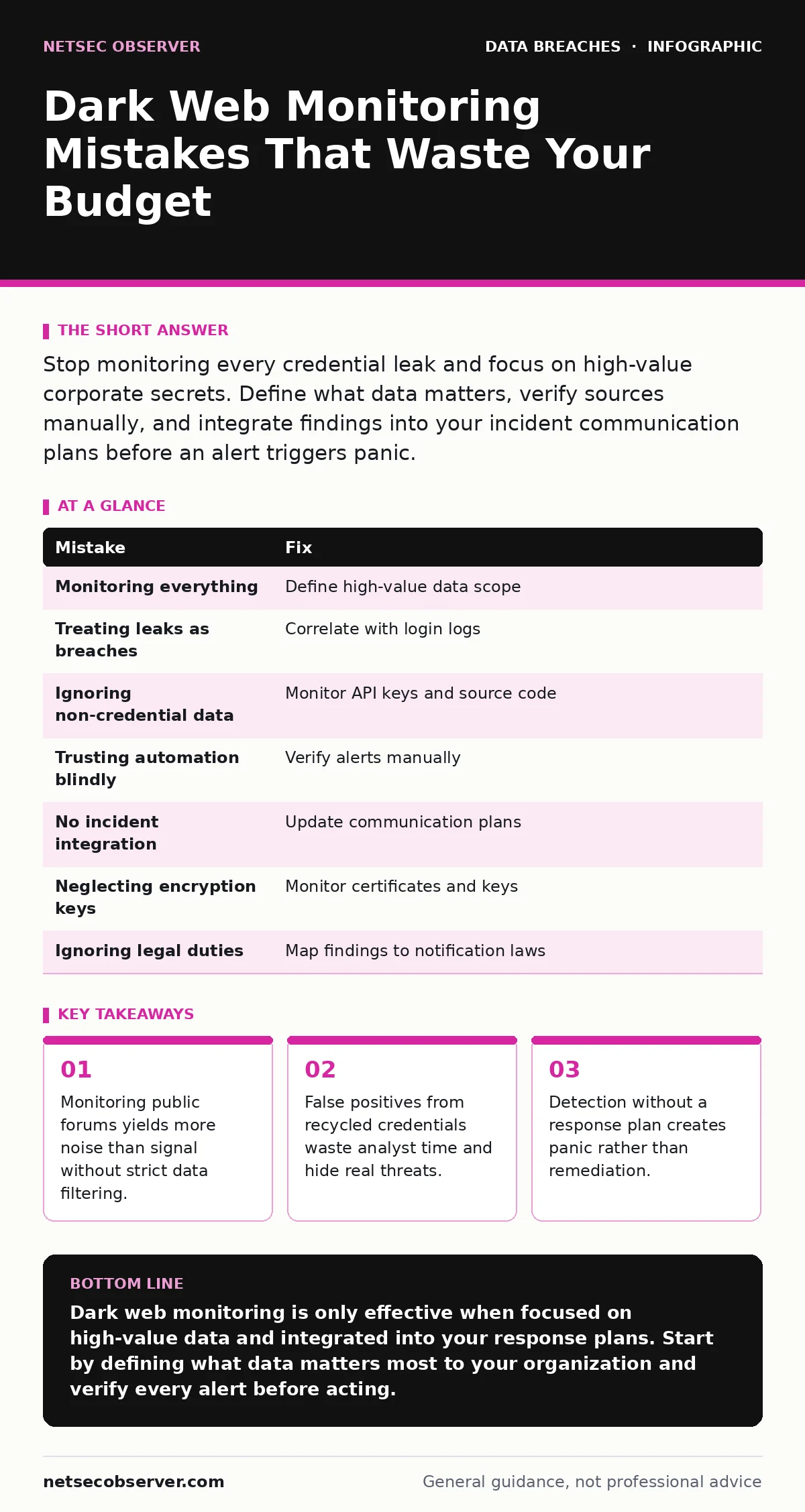
Stop monitoring every credential leak and focus on high-value corporate secrets. Define what data matters, verify sources manually, and integrate findings into your incident communication plans before an alert triggers panic.
Mistake 1: Monitoring Everything Without Prioritization
You likely feed your monitoring tool every email address and password hash available. This approach assumes all data carries equal risk. It does not. The dark web is flooded with old, irrelevant credentials from breaches years ago.
Why it hurts:
Your security team drowns in alerts that require no action. Analysts spend hours investigating recycled passwords that never affected your current infrastructure. This fatigue causes them to miss the one alert that indicates a genuine threat to your core systems.
The fix:
Define a narrow scope of high-value data. Monitor only executive emails, service account credentials, and proprietary intellectual property. Treat generic employee accounts as lower priority. This reduces noise and highlights actual compromise vectors.
Mistake 2: Treating Credential Leaks as Immediate Breaches
Finding your user’s email on a forum does not mean an attacker is inside your network. It means their password was exposed in a previous, unrelated incident. You must distinguish between data exposure and active intrusion.
Why it hurts:
You trigger emergency protocols for every leaked credential. This leads to alert fatigue and wasted resources. More dangerously, it masks the difference between a user reusing a password and an attacker actively exploiting a vulnerability in your application.
The fix:
Correlate leaked credentials with internal login logs. Check if the specific password hash matches any active sessions or recent login attempts. If the password was changed after the leak, the risk is low. If the user reused the password, force a reset immediately.
Mistake 3: Ignoring Non-Credential Data Types
Most monitoring focuses on usernames and passwords. This ignores a vast category of high-value targets. Attackers often look for source code, API keys, or internal documentation rather than simple login credentials.
Why it hurts:
You miss the theft of your intellectual property. An attacker may not need to log in as an administrator if they already have your API keys or database schemas. This type of theft is harder to detect and often goes unnoticed for months.
The fix:
Include hashes of your source code and sensitive documents in your monitoring queries. Watch for fragments of your internal domain names or specific project codenames. This requires integrating with your software development lifecycle to know what your secrets look like.
Mistake 4: Relying on Automated Alerts Without Verification
Automated tools scan forums and paste sites. They often misidentify data or flag false positives. Trusting these alerts without human verification creates a false sense of security or unnecessary panic.
Why it hurts:
You act on incorrect information. You might reset passwords for users who were never compromised, causing friction and support tickets. Conversely, you might ignore a true positive because you assume it is just another false alert from the tool.
The fix:
Implement a manual verification step for high-severity alerts. Have an analyst review the context of the leak. Check the forum post date and the reputation of the source. Verify that the data actually belongs to your organization before escalating.
Mistake 5: Failing to Integrate with Incident Response
Detecting a leak is useless if you do not have a plan to handle it. Many organizations monitor the dark web but treat findings as isolated events. They do not connect these findings to their broader security operations.
Why it hurts:
You lose valuable time deciding what to do during a crisis. Without a predefined process, teams argue over responsibility and next steps. This delay allows attackers to exploit the exposed data before you can mitigate the damage.
The fix:
Integrate dark web findings into your incident communication plans. Define clear roles for who handles credential resets, who contacts affected users, and who manages public statements. Run tabletop exercises that include dark web discovery scenarios.
See also: Difference Between Cyber Espionage and Cyber Terrorism · Cybersecurity Incident Response Team: How It Works and Why It Matters
Mistake 6: Neglecting Encryption Key Management in Monitoring
You monitor for passwords but ignore your encryption keys. If an attacker finds your private keys or certificates on the dark web, they can decrypt your data or impersonate your services. This is a critical oversight.
Why it hurts:
Your data remains compromised even if you change all passwords. Attackers can use stolen keys to access encrypted backups or decrypt traffic in transit. This renders your perimeter defenses meaningless.
The fix:
Include your public keys and certificate fingerprints in your monitoring queries. If a key appears in a forum, assume it is compromised. Revoke the certificate and generate a new key pair immediately. Review your encryption key management practices to prevent future exposure.
Mistake 7: Monitoring Without Understanding Legal Obligations
You detect a breach but do not know how to report it. Different jurisdictions have different rules for what constitutes a reportable incident. Ignoring these rules can lead to significant legal penalties.
Why it hurts:
You face fines and reputational damage for failing to notify regulators or affected individuals. Even if the breach is minor, the lack of a clear notification process can escalate the situation.
The fix:
Map your monitoring findings to breach notification laws. Know which data types trigger mandatory reporting. Ensure your legal team is involved in the monitoring process to classify incidents correctly from the start.
| Mistake | Fix |
|---|---|
| Monitoring everything | Define high-value data scope |
| Treating leaks as breaches | Correlate with login logs |
| Ignoring non-credential data | Monitor API keys and source code |
| Trusting automation blindly | Verify alerts manually |
| No incident integration | Update communication plans |
| Neglecting encryption keys | Monitor certificates and keys |
| Ignoring legal duties | Map findings to notification laws |
Key takeaways
- Monitoring public forums yields more noise than signal without strict data filtering.
- False positives from recycled credentials waste analyst time and hide real threats.
- Detection without a response plan creates panic rather than remediation.
Dark web monitoring is only effective when focused on high-value data and integrated into your response plans. Start by defining what data matters most to your organization and verify every alert before acting.
Frequently asked questions
How often should I check the dark web for my data?
Continuous monitoring is ideal because data appears and disappears quickly. If you use manual checks, perform them at least weekly for high-value assets.
Can I use free tools for dark web monitoring?
Free tools are limited and often inaccurate. They may miss critical data or provide false positives. Professional tools offer better coverage and verification.
What if I find my data but it is old?
Old data still poses a risk if users reuse passwords. Check if the credentials are still active in your systems. If they are, force a password change.
Does dark web monitoring replace other security measures?
No. It is a detection tool. You still need strong access controls, encryption, and regular third-party risk assessments to prevent breaches.
How this guide was produced: written by the NetSec Observer editorial team with AI assistance, checked against the public references listed below, and reviewed when the facts change. See our editorial policy or report an error.