Third-Party Risk Assessments: What They Reveal and Hide
Vendor checks measure policy compliance, not actual security posture, leaving your supply chain vulnerable to silent misconfigurations.
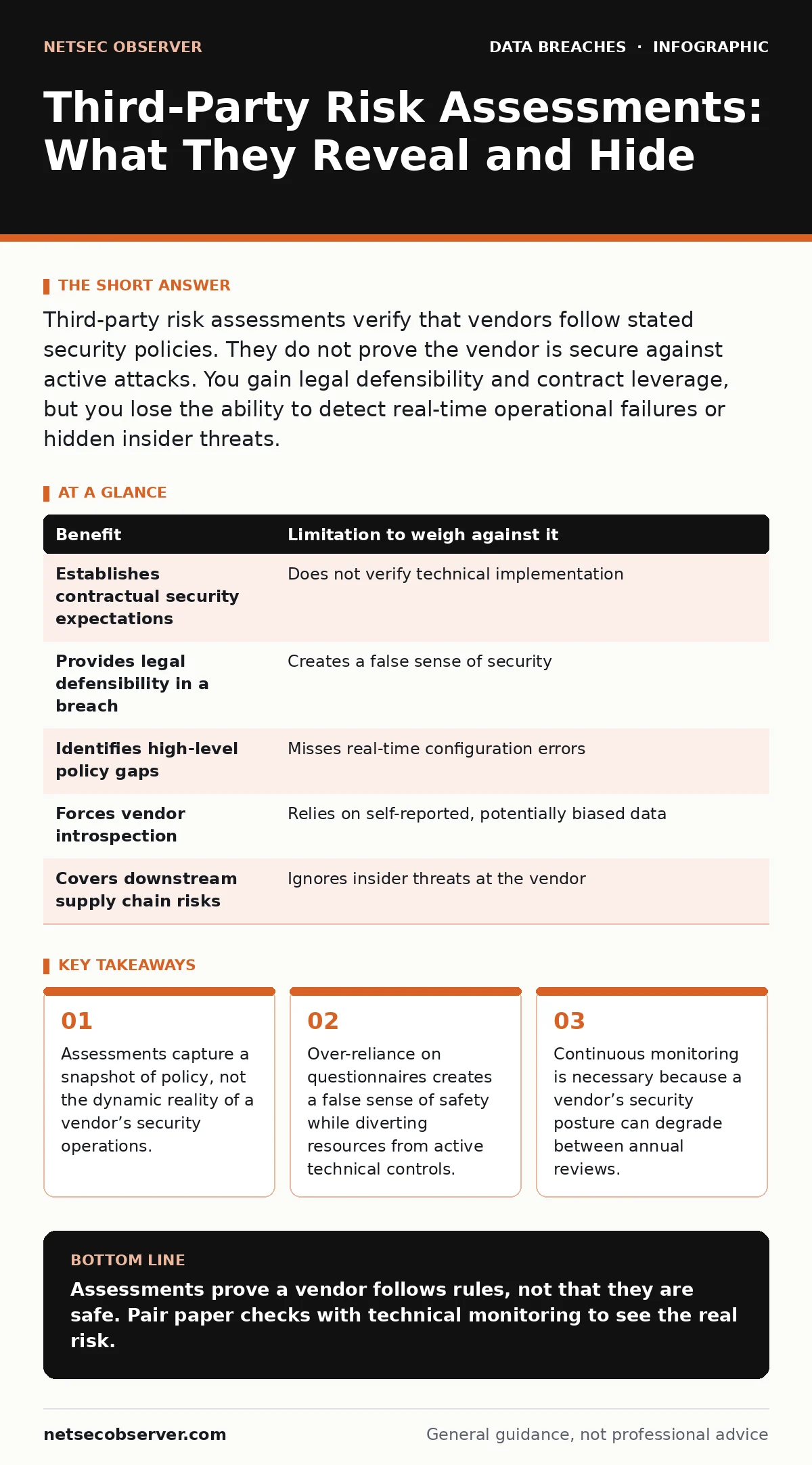
Third-party risk assessments verify that vendors follow stated security policies. They do not prove the vendor is secure against active attacks. You gain legal defensibility and contract leverage, but you lose the ability to detect real-time operational failures or hidden insider threats.
The Illusion of Security Compliance
A third-party risk assessment is a process where you evaluate the security controls of a vendor before granting them access to your data. Most organizations rely on questionnaires or audit reports to perform this evaluation. These documents list the policies the vendor claims to follow. They rarely show how those policies hold up under pressure.
You are buying trust based on paper, not proof. The vendor fills out a form stating they encrypt data at rest. You mark the box as satisfied. You do not see that the encryption keys are stored on an unpatched server in their DMZ. This gap between stated policy and actual implementation is where breaches begin.
Concrete Benefits of Vendor Due Diligence
The primary benefit of a third-party risk assessment is legal and contractual clarity. You establish a baseline of expected security behavior. If a breach occurs later, you have evidence that you exercised due care. This matters when you must comply with breach notification laws or face litigation.
Assessments also force vendors to confront their own gaps. Many small vendors do not have a dedicated security team. When you ask specific questions about incident communication plans, they may realize they lack one. The act of answering can drive improvement, even if the answers are initially weak.
You also gain visibility into the vendor’s supply chain. Large vendors often rely on smaller subcontractors. A thorough assessment asks about these downstream relationships. This helps you avoid inheriting risk from a vendor’s vendor, a layer of exposure many organizations ignore until it is too late.
The Hidden Costs and Limitations
The biggest limitation is the static nature of the data. A questionnaire answers how things worked on the day the form was filled out. It does not reflect changes made three days later. If a vendor disables multi-factor authentication to solve a login bug, your assessment remains green.
Questionnaires are also self-reported. There is no technical verification. A vendor can claim they perform regular penetration testing when they have not done one in years. You are trusting their word. This is a significant risk when the vendor holds sensitive data.
Weighing Benefits Against Limitations
You must balance the administrative burden against the actual risk reduction. The table below shows the trade-offs inherent in traditional risk assessments.
| Benefit | Limitation to weigh against it |
|---|---|
| Establishes contractual security expectations | Does not verify technical implementation |
| Provides legal defensibility in a breach | Creates a false sense of security |
| Identifies high-level policy gaps | Misses real-time configuration errors |
| Forces vendor introspection | Relies on self-reported, potentially biased data |
| Covers downstream supply chain risks | Ignores insider threats at the vendor |
When It Is Worth It
Third-party risk assessments are worth the effort when the vendor has direct access to sensitive data. If they can read, modify, or delete your customer records, you need to know their baseline controls. This is non-negotiable for cloud providers, payment processors, and HR platforms.
It is also worth it when you are entering a long-term contract. A five-year agreement locks you into a vendor’s security posture. If their standards drop in year three, you may be stuck with a risky partner. An initial assessment gives you leverage to demand improvements or exit clauses.
Consider the data type. If the vendor handles personally identifiable information, you face regulatory scrutiny. An assessment helps you prepare for audits by showing you vetted the vendor. It supports your broader strategy for privacy impact assessments and data governance.
See also: Dependency Updates: 8 Questions About Security Risks and Fixes · Breach Notification Laws: 10 FAQs Answered for Compliance
When It Is Not Worth It
You should skip deep assessments for low-risk vendors. If a vendor only provides generic software with no data access, the cost of assessment outweighs the risk. A simple security questionnaire is sufficient. Do not waste resources verifying controls for a vendor that cannot see your data.
It is not worth it if you already have continuous monitoring in place. If you use tools that scan the vendor’s external attack surface, you have real-time data. A static questionnaire adds little value. Focus on the alerts your monitoring tools generate instead.
Avoid over-assessing vendors with strong, independent certifications. If a vendor holds current, rigorous certifications from recognized bodies, their auditors have already checked the boxes. You can rely on their audit reports rather than reinventing the wheel. This is especially true for large, public companies with transparent security teams.
Moving Beyond Questionnaires
To bridge the gap between policy and practice, combine assessments with technical validation. Ask for evidence, not just statements. Request sample logs, architecture diagrams, or recent penetration test summaries. This moves the conversation from "what do you say you do" to "show me what you do."
Implement continuous monitoring where possible. Tools that scan for accidental data disclosure or database exposure can alert you to changes in real time. This complements the static assessment by providing ongoing visibility. You catch misconfigurations before they are exploited.
Remember that no assessment is perfect. Even the best checks miss insider threats or sophisticated attacks. Your defense must include incident response capabilities. If a vendor fails, you need a plan to isolate their access and notify affected parties. This is where your incident communication plans become critical.
Integrating Risk into Daily Operations
Third-party risk is not a one-time event. It is an ongoing process. Vendors change, update software, and hire new staff. Your risk exposure shifts with these changes. You must revisit assessments regularly, not just at contract renewal.
Train your procurement and legal teams to understand these limitations. They often push for quick approvals. They need to know that a signed contract does not equal security. Embed security reviews into the procurement workflow so they happen before access is granted.
Use the insights from assessments to improve your own security. If a vendor fails a check, note the pattern. If many vendors struggle with encryption key management, review your own practices. The lessons learned from third-party risk can strengthen your internal defenses.
Key takeaways
- Assessments capture a snapshot of policy, not the dynamic reality of a vendor’s security operations.
- Over-reliance on questionnaires creates a false sense of safety while diverting resources from active technical controls.
- Continuous monitoring is necessary because a vendor’s security posture can degrade between annual reviews.
Assessments prove a vendor follows rules, not that they are safe. Pair paper checks with technical monitoring to see the real risk.
Frequently asked questions
How often should I re-assess a vendor?
Re-assess annually for high-risk vendors. For low-risk vendors, every two to three years is sufficient. Increase frequency if the vendor changes their service model or data access levels.
Can I trust a vendor’s SOC 2 report?
A SOC 2 report provides independent verification of controls. It is more reliable than a self-reported questionnaire. However, it is still a snapshot in time and does not cover every potential threat vector.
What if a vendor refuses to answer security questions?
Treat refusal as a red flag. It suggests the vendor has nothing to hide or lacks transparency. You should generally avoid vendors who refuse basic security inquiries, especially if they handle sensitive data.
Do I need to assess every subcontractor?
You cannot assess every subcontractor directly. Instead, require your primary vendor to manage their subcontractors’ risk. Include clauses in your contract that hold the vendor responsible for downstream failures.
How this guide was produced: written by the NetSec Observer editorial team with AI assistance, checked against the public references listed below, and reviewed when the facts change. See our editorial policy or report an error.