Dependency Updates: 8 Questions About Security Risks and Fixes
Updating libraries often breaks applications more often than it fixes security holes, creating a hidden maintenance burden that teams ignore until a breach occurs.
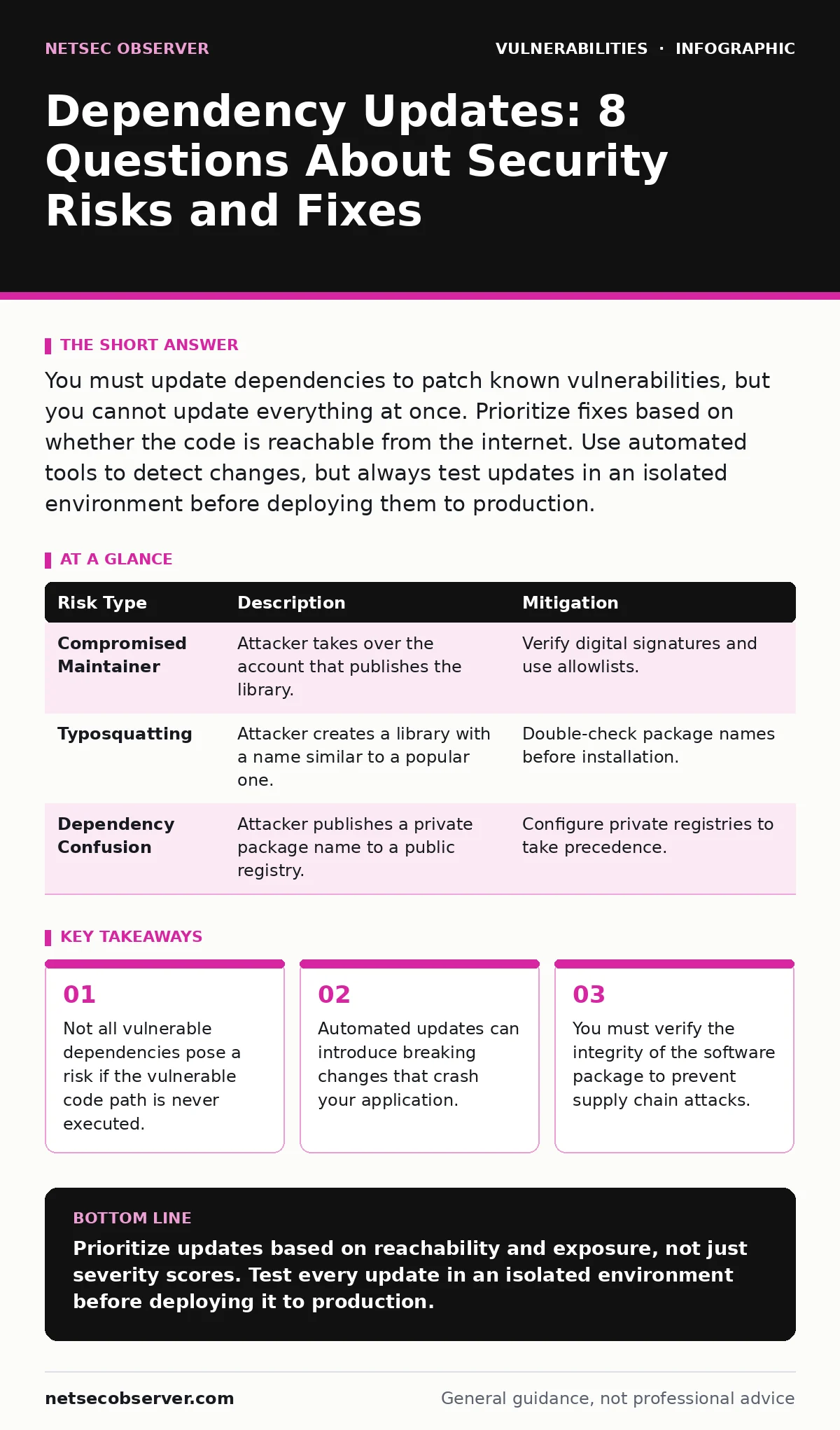
You must update dependencies to patch known vulnerabilities, but you cannot update everything at once. Prioritize fixes based on whether the code is reachable from the internet. Use automated tools to detect changes, but always test updates in an isolated environment before deploying them to production.
Why does updating dependencies break my application?
Software libraries change their public interfaces over time, which means functions you relied on may be removed or renamed. When you update a dependency, your code might call a function that no longer exists, causing the application to fail. This is known as a breaking change.
You face a trade-off between security and stability. Delaying updates keeps your application stable but leaves it exposed to known exploits. Updating immediately reduces exposure but increases the risk of introducing bugs.
How do I know if a vulnerability actually affects me?
A vulnerability in a library does not automatically mean your application is compromised. You must determine if the vulnerable code is reachable from your application’s entry points. If the vulnerable function is never called, the risk is theoretical rather than practical.
This concept is called reachability analysis. It requires mapping how your code interacts with the library. Many scanners flag all vulnerabilities in all dependencies, creating noise. You should focus only on the paths an attacker can actually trigger.
What is the supply chain risk in dependencies?
When you install a library, you trust that the code it contains is what the author intended. Attackers can compromise the account of a library maintainer or create a fake library with a similar name. This is a supply chain attack.
You are not just updating code; you are accepting trust from a third party. If that trust is broken, the attacker gains access to your system. This risk exists regardless of the quality of the original library.
To mitigate this, you should verify the digital signatures of the packages you install. This ensures the code has not been altered since it was published. You should also pin your dependencies to specific versions to prevent unexpected changes.
| Risk Type | Description | Mitigation |
|---|---|---|
| Compromised Maintainer | Attacker takes over the account that publishes the library. | Verify digital signatures and use allowlists. |
| Typosquatting | Attacker creates a library with a name similar to a popular one. | Double-check package names before installation. |
| Dependency Confusion | Attacker publishes a private package name to a public registry. | Configure private registries to take precedence. |
Should I update all dependencies automatically?
Automated tools can scan for new versions and propose updates, but they cannot judge compatibility. An automatic update might pull in a new version of a transitive dependency that conflicts with your other libraries. This can cause subtle bugs that are hard to trace.
You should use automation for detection, not for deployment. Let the tool tell you what is available, but require a human to review the changes. This balances efficiency with safety.
How do transitive dependencies increase risk?
Your application directly imports a few libraries, but those libraries import others. These indirect imports are transitive dependencies. You often have no control over them, yet they can contain severe vulnerabilities.
A single update to a direct dependency can change the entire tree of transitive dependencies. This is known as dependency drift. It can introduce new vulnerabilities or remove old ones without your explicit consent.
You must monitor the entire dependency tree, not just the direct imports. Tools that generate a Software Bill of Materials (SBOM) help you see every component in your application. This visibility is necessary for accurate risk assessment.
See also: Vulnerability Lifecycle: What Small Businesses Need to Know · Difference Between Attack Surface Management and Vulnerability Management
What is the cost of ignoring updates?
Ignoring updates accumulates technical debt and security debt. Each day you wait, the window for exploitation remains open. Attackers scan for known vulnerabilities in popular libraries. Your application becomes an easy target.
The cost of fixing a vulnerability after a breach is far higher than the cost of updating it beforehand. You risk data loss, reputation damage, and legal liability. Proactive maintenance is cheaper than reactive recovery.
How do I test updates safely?
You should never update dependencies directly in your production environment. Changes can cause outages that affect your users. Instead, use a staging environment that mirrors production.
Run your full test suite against the updated dependencies. This includes unit tests, integration tests, and security scans. If the tests pass, you have higher confidence that the update is safe. If they fail, you can roll back without impacting users.
Can I isolate the risk of a vulnerable dependency?
If you cannot update a dependency immediately, you can mitigate the risk by isolating it. Run the vulnerable component in a separate service or container with limited privileges. This limits the damage an attacker can do if they exploit the vulnerability.
You can also use a web application firewall to block known attack patterns. This adds a layer of defense without changing your code. However, this is a temporary measure, not a permanent fix.
How do I handle end-of-life dependencies?
Some libraries stop receiving updates when they reach end of life. This means no new security patches will be released. You are stuck with the last version, which may contain known vulnerabilities.
You must replace these dependencies with actively maintained alternatives. This often requires significant refactoring. Plan this migration early to avoid a crisis when a critical vulnerability is disclosed.
What is the role of exposure management?
Knowing your vulnerabilities is only half the battle. You must also understand how your application is exposed to the internet. A vulnerability in an internal service is less risky than one in a public-facing API.
Exposure management involves mapping your assets and their connectivity. This helps you prioritize updates based on actual risk. You should focus on the components that are directly accessible to attackers.
For more on understanding your attack surface, see the guide on exposure management. It explains how to identify and reduce the parts of your system that are visible to the outside world.
Key takeaways
- Not all vulnerable dependencies pose a risk if the vulnerable code path is never executed.
- Automated updates can introduce breaking changes that crash your application.
- You must verify the integrity of the software package to prevent supply chain attacks.
Prioritize updates based on reachability and exposure, not just severity scores. Test every update in an isolated environment before deploying it to production.
Frequently asked questions
How often should I update dependencies?
You should check for updates weekly and apply critical security patches immediately. Schedule regular maintenance windows for non-critical updates to minimize disruption.
What is a Software Bill of Materials (SBOM)?
An SBOM is a formal record containing the details and supply chain relationships of various components used in building software. It helps you track every library and version in your application.
Can I use an older version for stability?
You can use an older version, but you must accept the security risk. If the version is no longer supported, you should plan to migrate to a newer version or a different library.
How do I prevent dependency confusion?
Configure your package manager to prefer your private registry over public ones. This prevents attackers from publishing packages with internal names to public repositories.
How this guide was produced: written by the NetSec Observer editorial team with AI assistance, checked against the public references listed below, and reviewed when the facts change. See our editorial policy or report an error.