
Difference Between Attack Surface Management and Vulnerability Management
Vulnerability management scans known assets while attack surface management discovers hidden digital footprints that scanners miss entirely.
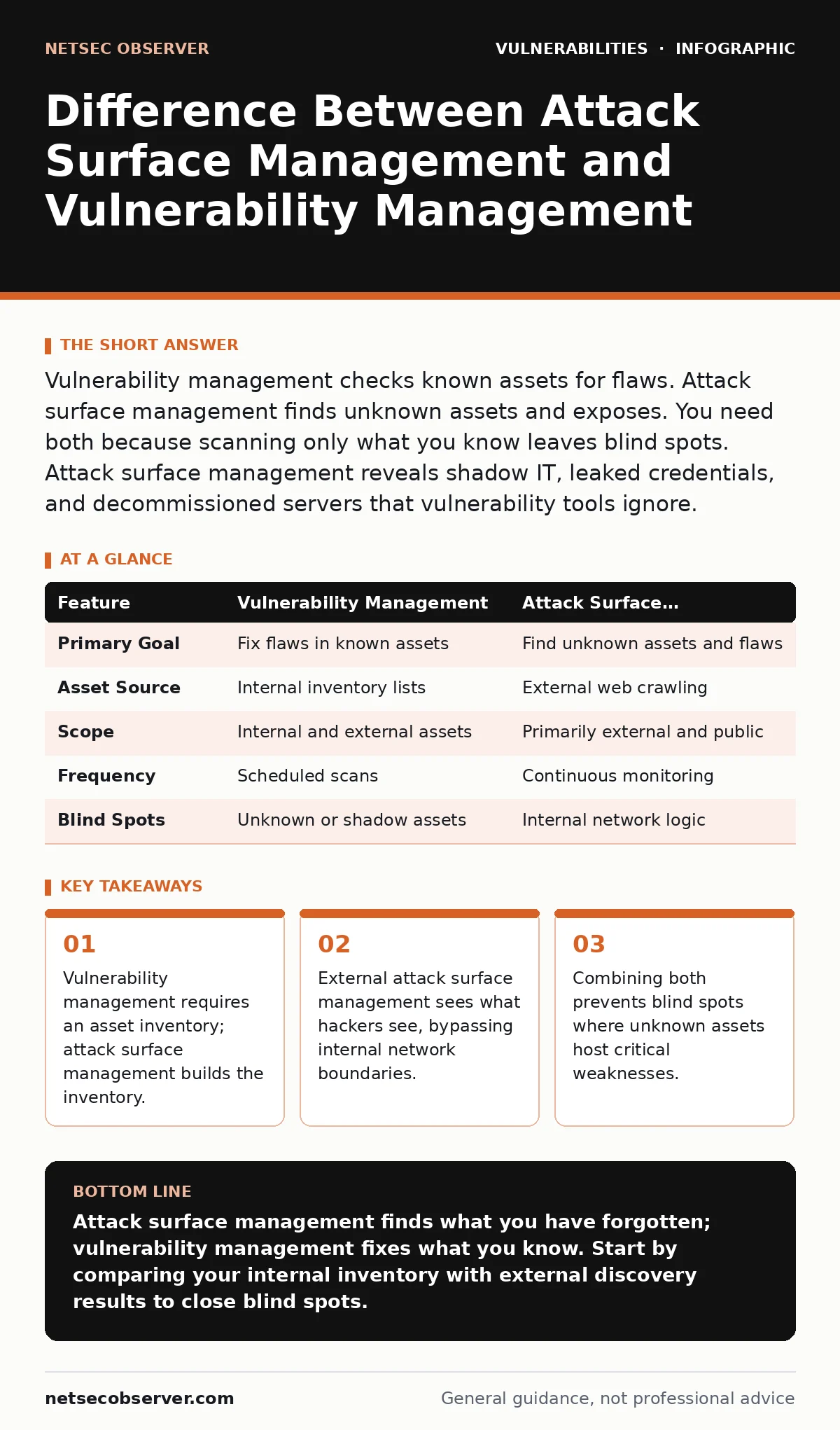
Vulnerability management checks known assets for flaws. Attack surface management finds unknown assets and exposes. You need both because scanning only what you know leaves blind spots. Attack surface management reveals shadow IT, leaked credentials, and decommissioned servers that vulnerability tools ignore.
What is the difference between attack surface management and vulnerability management?
Attack surface management identifies all digital assets and exposes, while vulnerability management assesses the security posture of known assets. Vulnerability management assumes you know what you own. Attack surface management questions that assumption. It looks for assets you forgot to register, misconfigured cloud buckets, and subdomains pointing to old infrastructure. One manages risk in known territory; the other maps the unknown territory.
How does asset visibility change the security outcome?
Asset visibility determines whether you secure the whole system or just the parts you remember. Vulnerability management tools scan IP ranges and hostnames you provide. If an asset is missing from that list, the tool ignores it. Attack surface management continuously crawls the internet to find references to your brand. It finds forgotten test environments and development servers. These hidden assets often lack patches. They become easy entry points for attackers.
Why do traditional scanners miss critical external risks?
Traditional scanners operate from inside the network or require explicit targets. They cannot see what the internet sees. Attackers do not need network access to exploit public-facing services. They exploit misconfigurations visible from the outside. Attack surface management simulates this external view. It identifies open ports, exposed APIs, and leaked data without entering the network. This external perspective reveals risks internal scanners never detect.
| Feature | Vulnerability Management | Attack Surface Management |
|---|---|---|
| Primary Goal | Fix flaws in known assets | Find unknown assets and flaws |
| Asset Source | Internal inventory lists | External web crawling |
| Scope | Internal and external assets | Primarily external and public |
| Frequency | Scheduled scans | Continuous monitoring |
| Blind Spots | Unknown or shadow assets | Internal network logic |
When should you prioritize discovery over scanning?
Prioritize discovery when your organization grows rapidly or uses many third-party services. Rapid growth creates shadow IT. Developers spin up resources without registering them. Third-party vendors connect to your systems. These connections create new attack vectors. If you scan only registered assets, you miss these new vectors. Discovery finds them first. Once found, you can scan them. Discovery prevents the blind spot; scanning fixes the flaw.
Imagine a company that acquires a smaller firm. The acquired firm has legacy servers. The main company’s vulnerability scanner does not know about them. Attack surface management finds these servers via DNS records. It alerts the team. The team then adds them to the vulnerability scanner. The sequence matters. Discovery must precede scanning for new assets.
How does exposure management fit into this framework?
Exposure management sits between discovery and scanning. It assesses the risk level of each discovered asset. Not all assets are equally dangerous. A public website is high risk. An internal database is lower risk if not exposed. Exposure management prioritizes which assets need immediate attention. It helps you focus resources on the most dangerous exposes. This prioritization prevents alert fatigue. You fix the most critical issues first.
See also: Vulnerability Lifecycle: What Small Businesses Need to Know · How the CISA KEV Catalog Works and Why You Must Patch It
What happens when you ignore the vulnerability lifecycle?
Ignoring the vulnerability lifecycle leads to recurring breaches. Finding a flaw is only the first step. You must patch, verify, and monitor. Vulnerability management handles this cycle for known assets. Attack surface management ensures no assets are left out of the cycle. If you skip discovery, assets fall through the cracks. They remain unpatched indefinitely. Attackers exploit these stale assets. A complete program integrates both disciplines.
Can hidden credentials bypass strong scanning protocols?
Hidden credentials can bypass even the strongest scanning protocols. Scanners check for open ports and software versions. They do not always check for leaked secrets. Attack surface management searches code repositories and public forums for leaked keys. It finds API tokens and passwords exposed by mistake. These credentials allow direct access. They bypass network defenses entirely. Monitoring for leaked secrets is a core part of managing your external attack surface.
How do you handle third-party supply chain risks?
Third-party supply chain risks require external visibility. Your vendors connect to your systems. They bring their own vulnerabilities. You cannot scan their internal networks. You can, however, monitor their public-facing assets. Attack surface management tracks your vendors’ digital footprints. It alerts you if their security posture degrades. This helps you manage risk beyond your direct control. It complements internal vulnerability management.
What is the practical step to start today?
Start by mapping your external digital footprint. Do not assume your inventory is complete. Use external tools to find what the internet sees. Compare this list with your internal records. Identify the gaps. These gaps are your blind spots. Prioritize securing these unknown assets. Then, integrate continuous monitoring. This approach closes the loop between discovery and remediation. It reduces the chance of surprise breaches.
Key takeaways
- Vulnerability management requires an asset inventory; attack surface management builds the inventory.
- External attack surface management sees what hackers see, bypassing internal network boundaries.
- Combining both prevents blind spots where unknown assets host critical weaknesses.
Attack surface management finds what you have forgotten; vulnerability management fixes what you know. Start by comparing your internal inventory with external discovery results to close blind spots.
Frequently asked questions
Do I need separate tools for attack surface and vulnerability management?
You can use integrated platforms, but the functions are distinct. Some tools combine both. Others require separate solutions. Choose based on your budget and complexity. Integration is key for efficiency.
How often should I run attack surface scans?
Run them continuously. The internet changes constantly. New subdomains appear. Old ones disappear. Continuous monitoring catches changes quickly. Scheduled scans miss rapid changes. Real-time data is more effective.
Is attack surface management only for large companies?
No. Small companies have external assets too. They often have fewer resources to manage them. Attack surface management helps them find hidden risks. It is scalable for any organization size.
Does this replace penetration testing?
No. Penetration testing simulates attacks. Attack surface management finds targets. They complement each other. Testing validates defenses. Management ensures all assets are covered. Use both for thorough security.
How this guide was produced: written by the NetSec Observer editorial team with AI assistance, checked against the public references listed below, and reviewed when the facts change. See our editorial policy or report an error.