
Attack Surface Management: 6 Common Misreadings and Correct Views
Attack surface management fails when teams treat it as a static inventory rather than a continuous mapping of reachable entry points and their changing states.
Attack surface management is not a one-time asset list or a vendor tool. It is the ongoing process of identifying all external-facing digital assets, understanding their context, and prioritizing risks based on reachability and exploitability, not just vulnerability scores.
Misreading: Attack surface management is just asset discovery
Correct reading: Asset discovery is the foundation, not the structure. You cannot manage what you do not know exists, but knowing a server exists tells you nothing about its risk. Attack surface management requires mapping the relationships between assets, their configurations, and their exposure to untrusted networks. A discovered asset is merely a node. The attack surface is the graph of connections, permissions, and dependencies that an attacker can traverse. Without this context, you are counting doors without checking if they are locked or if they lead to the vault.
Discovery tools scan for open ports and running services. They miss logical flaws, such as broken access control, where a user can access resources they should not. You must combine discovery with configuration analysis. This reveals not just what is present, but how it is exposed. An asset hidden behind a firewall is less risky than one exposed to the internet, even if both have the same vulnerabilities.
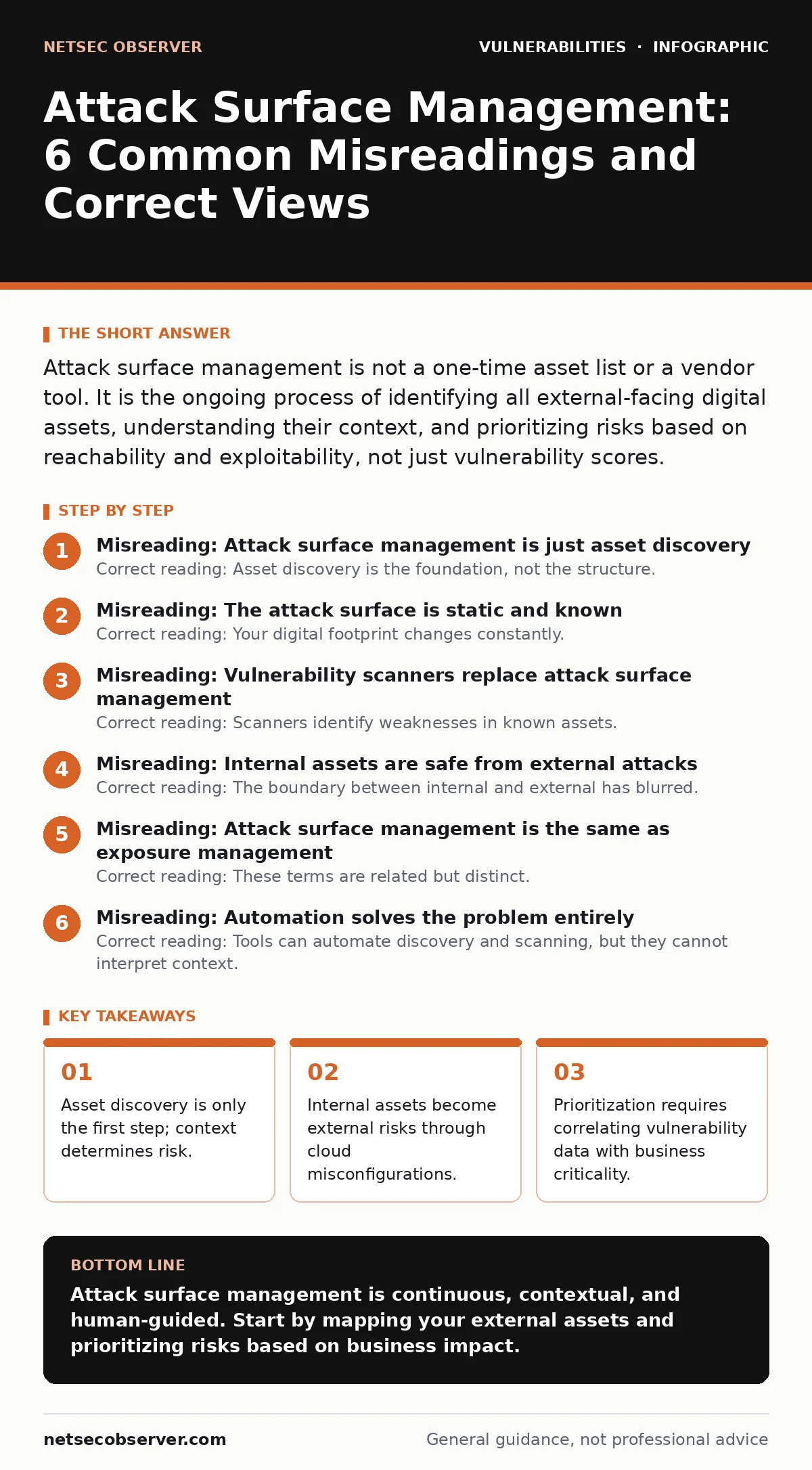
Misreading: The attack surface is static and known
Correct reading: Your digital footprint changes constantly. New services are deployed, old ones are decommissioned, and configurations drift. Shadow IT, where employees use unauthorized cloud services, expands the surface without IT awareness. Assume that any new deployment could introduce new entry points. Continuous monitoring is required because a single misconfiguration can expose an internal database to the public internet in minutes. The surface is fluid, not fixed.
Imagine a developer testing a new API endpoint. They forget to remove the test credentials before pushing to production. This creates a temporary but severe risk. Static inventories miss these transient exposures. You need real-time visibility into configuration changes. This includes monitoring for new subdomains, SSL certificates, and cloud storage buckets. The goal is to detect drift from the secure baseline as it happens, not after a breach occurs.
Misreading: Vulnerability scanners replace attack surface management
Correct reading: Scanners identify weaknesses in known assets. They do not identify unknown assets or logical vulnerabilities. Relying solely on scanners leaves blind spots. Attack surface management uses external reconnaissance techniques to see your environment as an attacker would. This includes searching for leaked credentials, exposed APIs, and misconfigured cloud storage. Scanners are internal tools. Attack surface management is external-facing intelligence.
Consider a system that is patched against known CVEs but has a logic flaw allowing command injection. A scanner might not detect this if it does not send the specific payload required to trigger the bug. Attack surface management prioritizes assets based on their external visibility and the likelihood of exploitation. It combines scanner data with threat intelligence and context. This ensures you fix the most dangerous issues first, not just the easiest ones to scan.
Misreading: Internal assets are safe from external attacks
Correct reading: The boundary between internal and external has blurred. Cloud adoption, remote work, and third-party integrations mean internal assets are often reachable from the internet. A misconfigured firewall rule or a compromised vendor account can give an attacker direct access to internal systems. You must treat all assets as potentially exposed. Segmenting networks limits lateral movement, but it does not prevent initial access.
Suppose an internal web application is only accessible via a VPN. If the VPN has a vulnerability, the internal application is now part of the external attack surface. Attack surface management requires mapping all potential paths to critical data. This includes understanding how third-party dependencies interact with your systems. A vulnerability in a library used by an internal tool can still be exploited if that tool is connected to the internet.
Misreading: Attack surface management is the same as exposure management
Correct reading: These terms are related but distinct. Exposure management focuses on identifying and reducing the exposure of assets to threats. It is a broader discipline that includes identity and access management, configuration management, and threat detection. Attack surface management is a subset that focuses specifically on identifying and prioritizing external entry points. You use attack surface management to feed data into your exposure management program.
Think of exposure management as the entire security strategy. Attack surface management is the reconnaissance phase. It tells you where the doors are. Exposure management determines which doors need better locks, which need alarms, and which should be walled off. You need both. Focusing only on the surface leaves you blind to internal threats. Focusing only on exposure without surface data leaves you guessing which external risks are most urgent.
See also: Vulnerability Exception Handling: Rules for Safe Risk Acceptance · How to Implement Security Metrics: A Step-by-Step Guide
Misreading: Automation solves the problem entirely
Correct reading: Tools can automate discovery and scanning, but they cannot interpret context. An automated system might flag a high-severity vulnerability on a server that is isolated and contains no sensitive data. A human analyst knows this risk is low. Conversely, a low-severity flaw on a public-facing login page is critical. Automation provides data. Humans provide judgment. You must integrate tool output into a risk-based decision process.
Imagine a tool reports 100 new findings. An automated system might prioritize them by CVSS score. A human analyst considers business impact, exploitability, and existing controls. This human-in-the-loop approach ensures resources are spent wisely. Automation reduces noise, but it does not eliminate the need for expertise. You still need to understand the vulnerability lifecycle to know when a patch is available and how quickly it must be applied.
Misreading: Attack surface management is only for large organizations
Correct reading: Small organizations have smaller surfaces, but they are often less prepared to manage them. Limited resources mean fewer controls and less visibility. Attackers target small organizations because they are easier to compromise. Even a single misconfigured server can lead to a breach. Attack surface management scales down. It becomes simpler but no less necessary. Focus on critical assets and external-facing services.
Suppose a small business uses a WordPress page builder vulnerabilities prone plugin. They may not realize this exposes their entire site. Attack surface management helps them identify such risks. It does not require expensive tools. Free scanners and manual reviews can start the process. The key is consistency. Regularly review your external footprint. Remove unused services. Keep software updated through timely dependency updates.
Key takeaways
- Asset discovery is only the first step; context determines risk.
- Internal assets become external risks through cloud misconfigurations.
- Prioritization requires correlating vulnerability data with business criticality.
- Automation cannot replace human judgment in threat modeling.
Attack surface management is continuous, contextual, and human-guided. Start by mapping your external assets and prioritizing risks based on business impact.
Frequently asked questions
How often should I update my attack surface map?
Continuously. Changes in cloud configurations and deployments happen daily. Real-time monitoring is ideal, but weekly reviews are a minimum.
What is the first step in attack surface management?
Identify all externally facing assets. Use passive reconnaissance to find subdomains, APIs, and cloud storage without interacting with the systems.
Does attack surface management replace penetration testing?
No. It identifies where to test. Penetration testing validates the findings. They are complementary disciplines.
How do I handle shadow IT in attack surface management?
Monitor for unauthorized domains and cloud resources. Integrate with DNS and cloud provider logs to detect deviations from approved configurations.
How this guide was produced: written by the NetSec Observer editorial team with AI assistance, checked against the public references listed below, and reviewed when the facts change. See our editorial policy or report an error.