
Broken Access Control: Step-by-Step Exploitation Mechanics
Most broken access control flaws occur because the server trusts the client to define permissions, allowing users to bypass restrictions by manipulating request parameters.
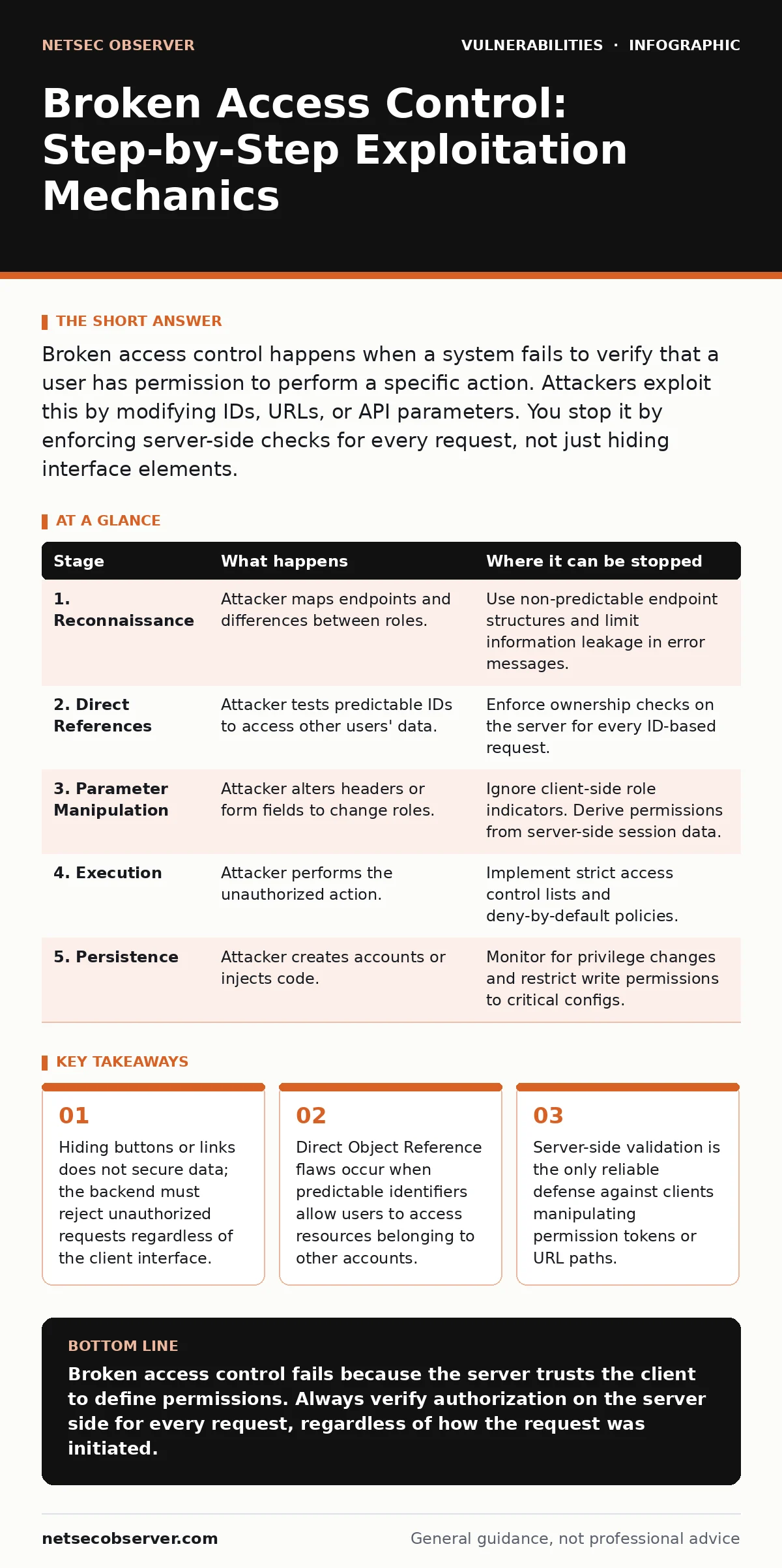
Broken access control happens when a system fails to verify that a user has permission to perform a specific action. Attackers exploit this by modifying IDs, URLs, or API parameters. You stop it by enforcing server-side checks for every request, not just hiding interface elements.
The Foundation of Trust Failure
Access control determines who can do what within a system. When this mechanism breaks, the barrier between users vanishes. This is not a network intrusion issue. It is a logic error in how the application verifies identity against action. You do not need to hack the server. You only need to convince the server that you are allowed to see or change something you are not.
The flaw relies on a misplaced assumption. Developers often assume that if a user can click a button, they are authorized to perform that action. This assumption fails when the client side is the only thing enforcing the rule. The server must always act as the final gatekeeper. If it accepts a request without verifying the sender's rights, the control is broken.
Stage 1: Reconnaissance and Mapping
The attacker begins by observing the application’s behavior. They create two accounts with different permission levels. One account might be a standard user. The other might be an administrator. They map out the URLs and API endpoints associated with each role. They note which requests return data and which return errors.
This stage relies on the predictability of the application structure. Many systems use clear naming conventions for endpoints. For example, a user profile might be at /user/profile while admin settings are at /admin/settings. The attacker records the structure of requests made by both accounts. They look for differences in headers, cookies, and body parameters. They are building a map of what the server expects to receive.
Stage 2: Identifying Direct References
Many applications use Direct Object References. This means the application uses a key, like a database ID, to access an object directly. If the ID is predictable, the path is exposed. Imagine a URL that looks like /documents/1234. If changing 1234 to 1235 returns another user's document, the control is broken.
The attacker tests this by incrementing or decrementing these IDs. They check if the server verifies ownership. Does the server check if the logged-in user owns document 1235? Or does it simply serve the file because the ID exists? If the latter is true, the attacker has found a vertical or horizontal privilege escalation path. Horizontal escalation allows access to peers' data. Vertical escalation allows access to higher-level functions.
Stage 3: Manipulating Request Parameters
If direct IDs do not work, the attacker manipulates the request structure. They capture the HTTP request using a proxy tool. They look for parameters that define permissions. These might be hidden fields in forms or headers in API calls. The attacker changes values like role=user to role=admin. They might also remove authentication tokens entirely to see if the server defaults to permissive behavior.
This stage exploits the difference between client-side and server-side validation. Client-side scripts might prevent a user from selecting "Admin" in a dropdown menu. However, the HTTP request is the truth. If the server processes the request based on the modified parameter without re-verifying the user's actual role, the attack succeeds. The server must ignore what the client says about permissions and check its own database.
Stage 4: Executing Unauthorized Actions
With a working parameter or ID, the attacker performs the action. They might read sensitive data, modify records, or execute administrative commands. The server processes the request as if it came from an authorized source. The application logs the action, but it attributes it to the attacker's valid session. This makes detection difficult because the request looks legitimate in structure.
The success of this stage depends on the lack of intermediate checks. The application must fail to link the action to the user's specific entitlements. It treats the request as a generic operation rather than a privileged one. This is where the flaw becomes a breach. The attacker gains the capability they lacked at the start.
Stage 5: Persistence and Expansion
Once access is gained, the attacker may look for ways to maintain it. They might create a new administrative account or modify existing permissions. They could also inject code into the application if the broken control allows file uploads or configuration changes. This expands the impact of the initial flaw.
The attacker may also use this access to pivot. If they can read database configurations, they might find credentials for other systems. This connects broken access control to other issues like SQL injection or server-side request forgery (SSRF). The initial breach is just the entry point. The goal is often deeper system compromise.
Where the Defense Must Hold
You can interrupt this process at multiple stages. The most effective stop is at Stage 2 and 3. The server must verify permissions for every request. This means checking the database or authorization service every time a resource is accessed. You cannot cache permissions indefinitely. You must validate the user's right to perform the specific action on the specific object.
Hiding interface elements is a usability feature, not a security control. It provides defense in depth but fails as a primary barrier. The server must reject unauthorized requests even if the user somehow constructs them. This requires strict server-side validation logic.
| Stage | What happens | Where it can be stopped |
|---|---|---|
| 1. Reconnaissance | Attacker maps endpoints and differences between roles. | Use non-predictable endpoint structures and limit information leakage in error messages. |
| 2. Direct References | Attacker tests predictable IDs to access other users' data. | Enforce ownership checks on the server for every ID-based request. |
| 3. Parameter Manipulation | Attacker alters headers or form fields to change roles. | Ignore client-side role indicators. Derive permissions from server-side session data. |
| 4. Execution | Attacker performs the unauthorized action. | Implement strict access control lists and deny-by-default policies. |
| 5. Persistence | Attacker creates accounts or injects code. | Monitor for privilege changes and restrict write permissions to critical configs. |
The Hidden Cost of Complexity
A common mistake is assuming that complex authorization frameworks solve the problem. They often create new holes. If the framework is misconfigured, it may default to allowing access. You must test your implementation thoroughly. Check for edge cases where permissions might be ambiguous.
Another hidden cost is performance. Checking permissions for every request adds latency. Developers sometimes bypass checks for speed. This is a dangerous trade-off. Security must not be sacrificed for performance. Use efficient caching strategies that do not compromise validation.
Connecting to Broader Risks
Broken access control often enables other attacks. If an attacker can access administrative interfaces, they might exploit command injection vulnerabilities to run system commands. They might use server-side request forgery (SSRF) to scan internal networks. Understanding these connections helps you prioritize fixes.
You should also consider exposure management. Knowing what endpoints are exposed to the internet helps you focus your defense. If an endpoint is not public, it should not be accessible. This reduces the attack surface. Regularly review your access control policies to ensure they match your business requirements.
Key takeaways
- Hiding buttons or links does not secure data; the backend must reject unauthorized requests regardless of the client interface.
- Direct Object Reference flaws occur when predictable identifiers allow users to access resources belonging to other accounts.
- Server-side validation is the only reliable defense against clients manipulating permission tokens or URL paths.
Broken access control fails because the server trusts the client to define permissions. Always verify authorization on the server side for every request, regardless of how the request was initiated.
Frequently asked questions
Is hiding admin links enough to secure my application?
No. Hiding links only prevents casual users from seeing them. Attackers can still construct the requests directly. The server must reject unauthorized access attempts regardless of the interface.
How do I know if my IDs are predictable?
If you can guess the next ID by looking at the current one, they are predictable. Use random, non-sequential identifiers like UUIDs to make guessing difficult.
Does HTTPS fix broken access control?
No. HTTPS encrypts the data in transit but does not verify permissions. An attacker can still send valid requests with modified parameters over an encrypted connection.
How this guide was produced: written by the NetSec Observer editorial team with AI assistance, checked against the public references listed below, and reviewed when the facts change. See our editorial policy or report an error.