
Prevent SQL Injection: Stop Database Hacks at the Source
Parameterized queries separate code from data, making it impossible for attackers to alter your database logic through input fields.
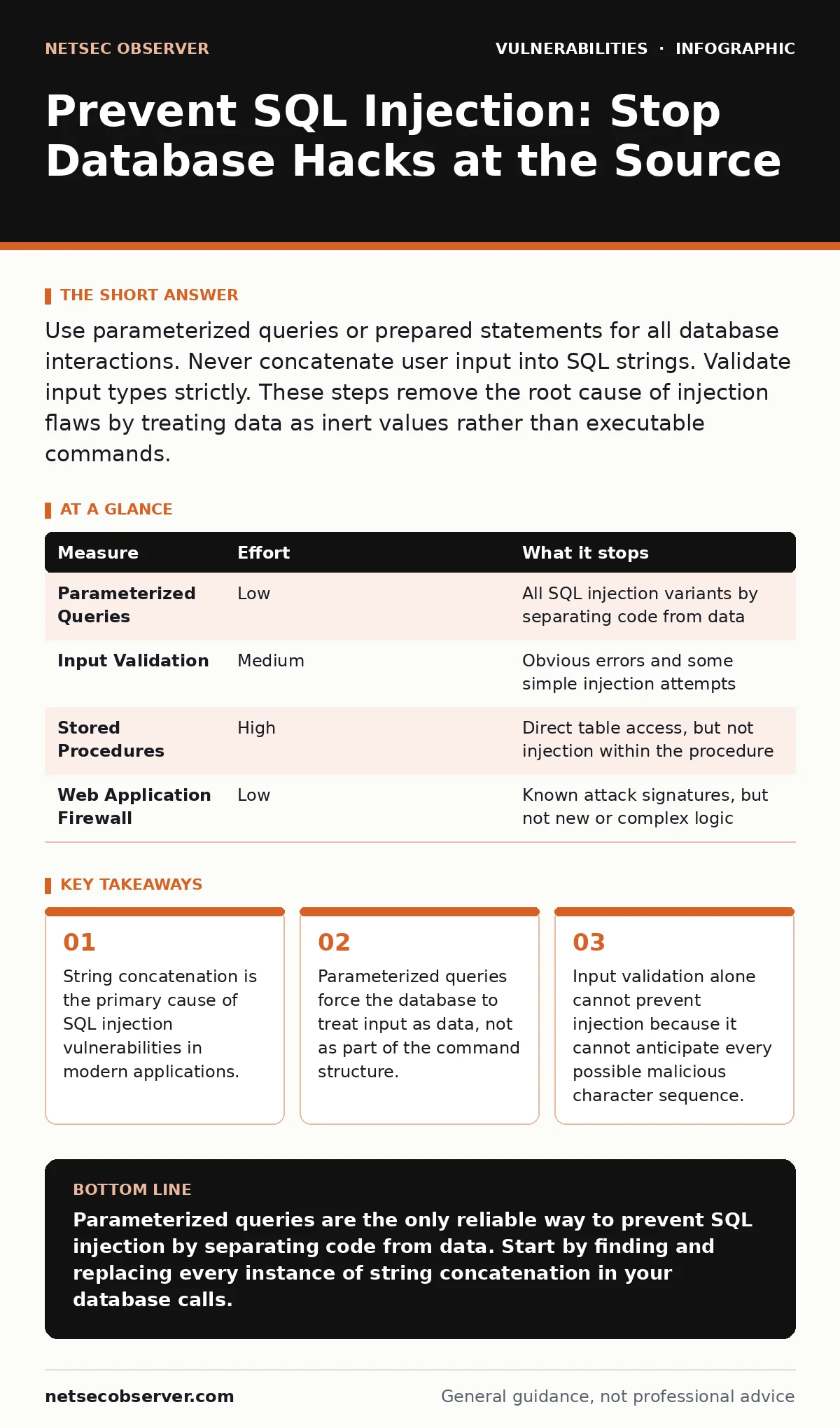
Use parameterized queries or prepared statements for all database interactions. Never concatenate user input into SQL strings. Validate input types strictly. These steps remove the root cause of injection flaws by treating data as inert values rather than executable commands.
The Root Cause: Mixing Code and Data
SQL injection occurs when your application sends user input directly to the database without separating the command from the content. Imagine you build a query by gluing pieces of text together. If a user types a name that includes a single quote, the database might interpret that quote as the end of the string and the rest of the input as a new command.
This happens because the database engine does not know where your intended data ends and the attacker's instructions begin. The application constructs the SQL statement on the fly, including the raw input. The database executes whatever string it receives. If that string contains malicious logic, the database runs it.
You must treat all external input as untrusted. This includes form fields, URL parameters, cookies, and HTTP headers. The database engine processes the query structure first, then binds the data values. If you fail to enforce this separation, you hand the attacker control over the database operations.
Priority One: Parameterized Queries
The most effective defense is to use parameterized queries, also known as prepared statements. This method sends the SQL command structure to the database separately from the data values. The database compiles the command first, establishing the expected data types and positions.
When you bind a variable to a parameter, the database treats it strictly as a value. It cannot alter the structure of the query. Even if the input contains SQL keywords or special characters, the database ignores them as command syntax. They remain inert text within the designated field.
This approach works across all major relational database systems. The application framework or driver handles the escaping and type checking. You do not need to manually sanitize the input for SQL characters. The mechanism itself prevents the injection by design, not by filtering.
| Measure | Effort | What it stops |
|---|---|---|
| Parameterized Queries | Low | All SQL injection variants by separating code from data |
| Input Validation | Medium | Obvious errors and some simple injection attempts |
| Stored Procedures | High | Direct table access, but not injection within the procedure |
| Web Application Firewall | Low | Known attack signatures, but not new or complex logic |
The Myth of Manual Escaping
Many developers attempt to prevent injection by manually escaping special characters. You might replace single quotes with two single quotes or add backslashes before metacharacters. This method is fragile and prone to human error.
Encoding issues can cause an escape character to be interpreted as part of the data. This allows the attacker to bypass your filters. You must know the exact behavior of the database driver and the character set. This knowledge is often incomplete or changes with updates. Parameterized queries remove this guesswork entirely.
Input Validation as a Secondary Layer
Input validation checks that data matches the expected format before it reaches the database. You verify that an age field contains only numbers or that an email address has the correct structure. This reduces the attack surface by rejecting malformed data early.
However, validation cannot replace parameterized queries. Attackers can often find ways to bypass format checks. They might use Unicode variations, null bytes, or unexpected data types that your validator does not recognize. Validation catches obvious mistakes, not clever evasion techniques.
Use validation to improve data quality and user experience. Do not rely on it for security. If your parameterized query fails, validation might stop a simple script, but it will not stop a determined attacker who understands your validation logic. Treat it as a hygiene practice, not a shield.
Stored Procedures and Their Limits
Stored procedures are precompiled SQL code stored on the database server. Developers often recommend them for security because they encapsulate logic and restrict direct table access. They can limit what an attacker can do if they gain entry.
However, stored procedures do not prevent injection if you build dynamic SQL inside them. If the procedure concatenates user input into a command string, it is vulnerable. The security comes from how you write the procedure, not from the procedure itself.
Using stored procedures adds complexity. You must manage permissions on the database side and update the procedures separately from the application. This often leads to outdated logic or inconsistent security practices. Parameterized queries within the application code are simpler and equally effective when implemented correctly.
See also: Detect SEO Poisoning: Log Signals and Hidden Attack Paths · HTTP Request Smuggling Warning Signs and Immediate Response Steps
What Does Not Work
Relying on blacklists of bad characters is ineffective. Attackers can encode their payloads in ways that bypass simple character checks. They might use hexadecimal encoding, URL encoding, or double encoding to hide malicious commands.
Obfuscating your database credentials does not help. If the application can run arbitrary SQL, the attacker can read configuration files or export data regardless of how hidden the credentials are. The flaw is in the query construction, not in the visibility of the password.
Integration with Other Security Practices
SQL injection often leads to further compromise. If an attacker can manipulate the database, they might access files on the server or initiate requests to internal systems. This connects to risks like server-side request forgery (SSRF) or command injection.
You should treat database security as part of a broader strategy. Ensure that the database account used by the application has minimal privileges. It should not be able to drop tables or modify schema unless absolutely necessary. This limits the damage even if an injection succeeds.
Regular dependency updates are also critical. Older database drivers or ORM libraries may have known flaws that allow bypassing parameterization. Keeping your software stack current closes these gaps. See the CISA Known Exploited Vulnerabilities catalog for prioritized patches.
Immediate Action Plan
You can reduce your risk significantly by auditing your codebase today. Look for places where you construct SQL strings using concatenation or string interpolation. Replace these with parameterized queries. This single change removes the majority of injection risk.
Review your input validation rules. Ensure they are strict and type-specific. Reject anything that does not match the expected format. This adds a layer of defense against malformed data and helps catch errors early.
Finally, check your database permissions. Ensure the application user cannot perform administrative tasks. This limits the impact of any successful attack. Combine these steps with regular testing to maintain a secure posture.
- Replace all string-concatenated SQL queries with parameterized statements.
- Implement strict type validation for all user inputs.
- Audit database user permissions to enforce least privilege.
Key takeaways
- String concatenation is the primary cause of SQL injection vulnerabilities in modern applications.
- Parameterized queries force the database to treat input as data, not as part of the command structure.
- Input validation alone cannot prevent injection because it cannot anticipate every possible malicious character sequence.
Parameterized queries are the only reliable way to prevent SQL injection by separating code from data. Start by finding and replacing every instance of string concatenation in your database calls.
Frequently asked questions
Can I use an ORM to prevent SQL injection?
Most Object-Relational Mappers use parameterized queries under the hood, making them safe. However, if you use raw SQL fragments or dynamic query builders within the ORM, you can still introduce vulnerabilities.
Does sanitizing input prevent SQL injection?
Sanitization removes or escapes dangerous characters, but it is error-prone. It does not guarantee security because attackers can find bypasses. Parameterized queries are superior because they change how the database interprets the input.
What if I can't change the database driver?
If you cannot use native parameterized queries, you must implement strict input validation and use a stored procedure that does not accept dynamic SQL. This is a weaker defense but better than nothing.
How do I test for SQL injection?
Use automated scanning tools that send probe payloads to your inputs. Follow this with manual testing to check for logical errors and blind injection techniques that scanners might miss.
How this guide was produced: written by the NetSec Observer editorial team with AI assistance, checked against the public references listed below, and reviewed when the facts change. See our editorial policy or report an error.