
HTTP Request Smuggling Warning Signs and Immediate Response Steps
Hidden request boundaries in web traffic often bypass security controls by exploiting how servers parse conflicting length headers.
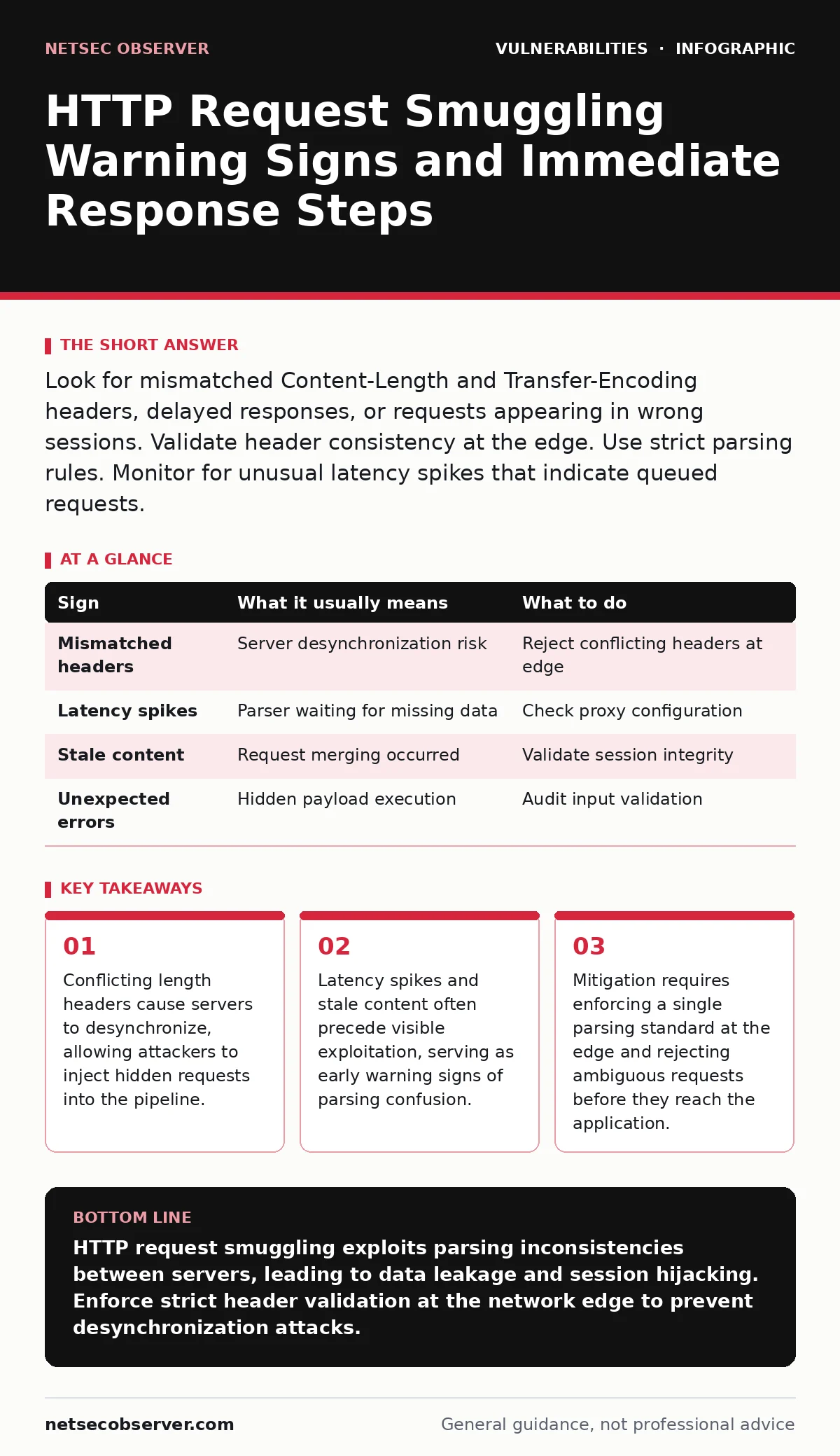
Look for mismatched Content-Length and Transfer-Encoding headers, delayed responses, or requests appearing in wrong sessions. Validate header consistency at the edge. Use strict parsing rules. Monitor for unusual latency spikes that indicate queued requests.
How Parsing Confusion Starts
Web servers process HTTP requests by reading headers to determine where one message ends and the next begins. When a server encounters conflicting information about message length, it may interpret the request differently than the client intended. This desynchronization is the root of HTTP request smuggling.
Imagine a scenario where a frontend proxy and a backend server disagree on where a request terminates. The proxy sees the request as complete and passes it along, while the backend believes more data is coming. The extra data, intended for the next user, gets attached to the current request. This allows an attacker to inject commands into another user's session.
Immediate Warning Signs
The most obvious signs appear in application logs and user experience. You will notice requests that seem to contain data from previous interactions. Users may report seeing content from other accounts or encountering errors that do not match their actions.
Monitor for unusual latency patterns. A sudden spike in response times often indicates that the server is waiting for data that will never arrive because the parser is stuck in a confused state. This delay happens while the server tries to reconcile conflicting header information.
Check for malformed responses. If the server returns partial HTML or unexpected status codes for simple requests, it may be processing smuggled data. These anomalies are often intermittent, making them easy to dismiss as network issues.
Subtle Indicators to Watch
Some signs are harder to detect because they do not break the application immediately. You might see requests that appear valid but contain hidden payloads. These payloads may not execute immediately but remain in the server's buffer, waiting for the next request to trigger them.
Look for inconsistencies in header validation. If your security tools allow requests with both Content-Length and Transfer-Encoding headers, you are vulnerable. Some servers prioritize one header over the other, creating a split-brain scenario.
Pay attention to session behavior. If a user's session ID appears in multiple concurrent requests from different sources, it may indicate that requests are being merged incorrectly. This is a strong indicator of parsing confusion at the network layer.
Response Actions
When you detect signs of request smuggling, act quickly. Do not rely on application-level fixes alone. The issue lies in how the infrastructure parses HTTP traffic. You must enforce strict parsing rules at the edge of your network.
Reject any request that contains conflicting length headers. If a request has both Content-Length and Transfer-Encoding, drop it immediately. This prevents the server from entering an ambiguous state. Configure your web application firewall to inspect headers before they reach the backend.
Review your proxy configuration. Ensure that all proxies in the chain use the same parsing logic. Inconsistencies between frontend and backend servers are the primary cause of smuggling vulnerabilities. Standardize on a single HTTP version and parsing standard.
Mitigation Strategies
Implement header validation at every layer. Your web server should reject requests with ambiguous headers before processing them. This reduces the attack surface and prevents desynchronization attacks.
Use strict parsing modes. Many servers offer a strict mode that rejects non-compliant requests. Enable this mode to ensure that only well-formed HTTP requests are processed. This adds a layer of defense against malformed inputs.
Monitor for anomalies continuously. Set up alerts for unusual header combinations and latency spikes. Early detection allows you to respond before an attacker can exploit the confusion. Regular audits of your parsing logic are necessary to maintain security.
| Sign | What it usually means | What to do |
|---|---|---|
| Mismatched headers | Server desynchronization risk | Reject conflicting headers at edge |
| Latency spikes | Parser waiting for missing data | Check proxy configuration |
| Stale content | Request merging occurred | Validate session integrity |
| Unexpected errors | Hidden payload execution | Audit input validation |
See also: Detect SEO Poisoning: Log Signals and Hidden Attack Paths · Prevent SQL Injection: Stop Database Hacks at the Source
Long-Term Prevention
Preventing request smuggling requires a holistic approach. You must align your entire infrastructure on a single parsing standard. This includes proxies, load balancers, and application servers. Inconsistencies create opportunities for attackers.
Regularly update your security tools. New variants of smuggling attacks emerge as parsers evolve. Keeping your tools updated ensures you have the latest detection capabilities. Review your configuration after every update.
Educate your team on HTTP parsing nuances. Understanding how servers interpret headers helps developers write secure code. Training reduces the likelihood of introducing vulnerable configurations.
Related Vulnerabilities
Understanding request smuggling helps you recognize other injection flaws. Unlike SQL injection, which targets database queries, request smuggling targets the transport layer. Similarly, command injection exploits application logic, while smuggling exploits protocol interpretation.
Review your exposure management practices. Identifying all entry points to your network helps you secure them against smuggling. This complements efforts to prevent broken access control and other web vulnerabilities.
Stay informed about emerging threats. While DLL hijacking and buffer overflow vulnerabilities are common, request smuggling remains a critical risk for web applications. Regular assessments ensure your defenses remain effective.
Key takeaways
- Conflicting length headers cause servers to desynchronize, allowing attackers to inject hidden requests into the pipeline.
- Latency spikes and stale content often precede visible exploitation, serving as early warning signs of parsing confusion.
- Mitigation requires enforcing a single parsing standard at the edge and rejecting ambiguous requests before they reach the application.
HTTP request smuggling exploits parsing inconsistencies between servers, leading to data leakage and session hijacking. Enforce strict header validation at the network edge to prevent desynchronization attacks.
Frequently asked questions
Can WAFs prevent HTTP request smuggling?
Yes, if configured to reject conflicting headers. Ensure your WAF inspects headers before they reach the backend server.
How do I know if my server is vulnerable?
Test for header conflicts. Send requests with both Content-Length and Transfer-Encoding headers to see if the server accepts them.
Is this a new vulnerability?
No, but it remains prevalent due to complex infrastructure. Misconfigurations in proxies and load balancers create ongoing risks.
What is the best way to test for this?
Use automated tools that simulate conflicting headers. Manual testing can also reveal parsing inconsistencies in your environment.
How this guide was produced: written by the NetSec Observer editorial team with AI assistance, checked against the public references listed below, and reviewed when the facts change. See our editorial policy or report an error.