
Data Scraping: How It Works and How to Stop It
Automated scraping bypasses standard login walls by rotating residential IPs, making traditional firewall rules ineffective against modern data theft.
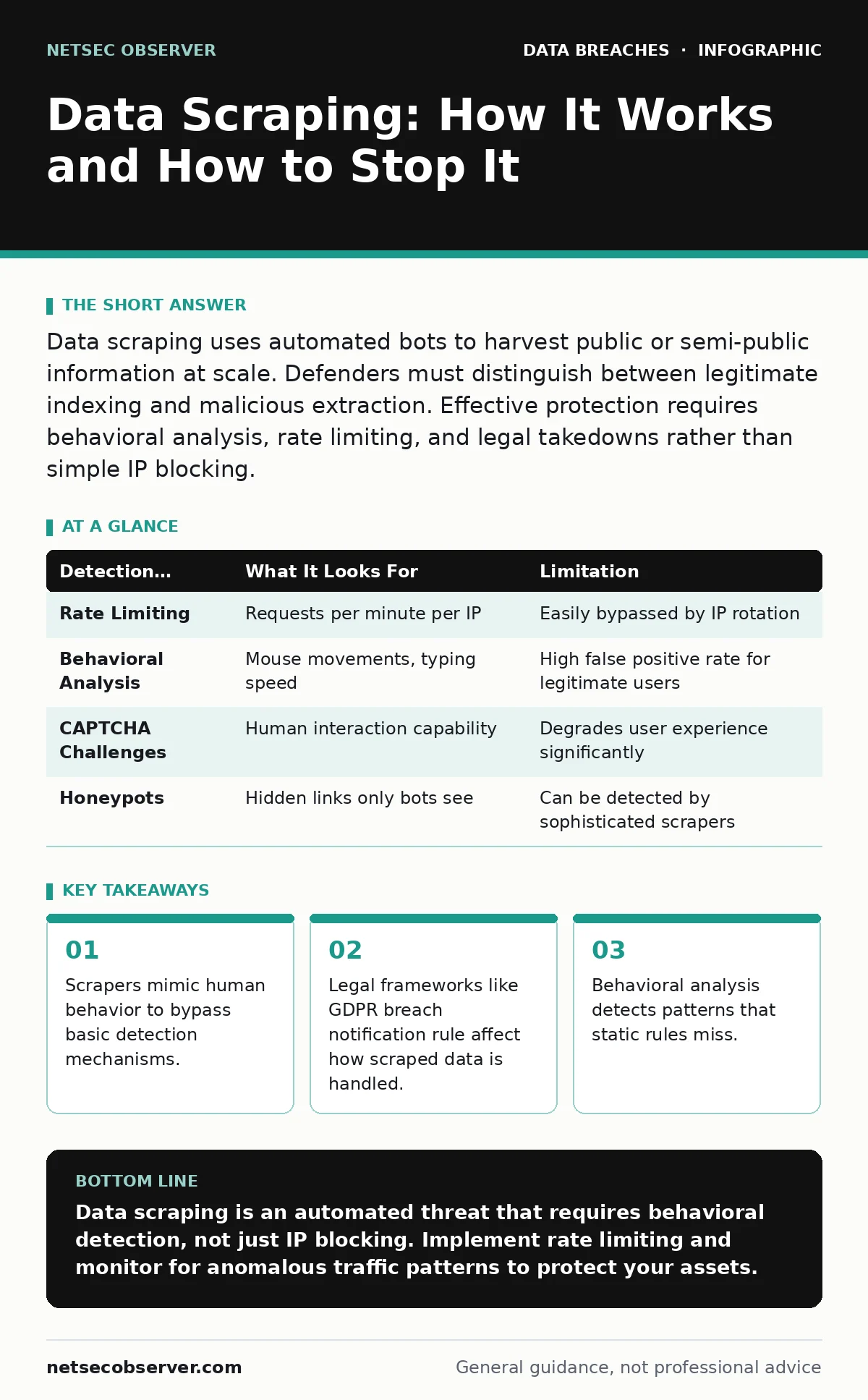
Data scraping uses automated bots to harvest public or semi-public information at scale. Defenders must distinguish between legitimate indexing and malicious extraction. Effective protection requires behavioral analysis, rate limiting, and legal takedowns rather than simple IP blocking.
What is data scraping?
Data scraping is the automated extraction of structured data from websites or applications. Scripts send requests to servers, parse the HTML or JSON responses, and store specific fields like prices, emails, or inventory levels. This process happens faster than any human could read. Attackers use this method to build competitor databases, harvest credentials for brute-force attacks, or collect personal information for identity theft. The technology itself is neutral, but the intent and volume define the threat.
How do scrapers bypass security controls?
Scrapers bypass security by distributing requests across thousands of residential IP addresses. Instead of hitting your server from one data center, the traffic appears to come from real users in different neighborhoods. This technique, known as IP rotation, defeats simple IP blacklisting. Advanced scrapers also use headless browsers that render JavaScript, making their traffic look identical to a Chrome user. They randomize mouse movements and typing speeds to fool behavioral analysis tools.
Is data scraping legal?
The legality of data scraping depends on jurisdiction, target data, and method. Scraping publicly available data for personal use is often permissible, but commercial use can violate terms of service or copyright laws. Accessing data behind a login wall constitutes unauthorized access in many regions. The Computer Fraud and Abuse Act in the United States and similar laws elsewhere penalize bypassing authentication. Companies should review their terms of service and consult legal counsel before launching or defending against scraping operations.
What are the common types of scrapers?
Scrapers fall into three main categories based on complexity. Basic HTTP scrapers send raw requests and parse text output, which is easy to block but fragile. Headless browser scrapers render full pages, handling JavaScript and dynamic content, making them harder to detect. AI-driven scrapers use machine learning to adapt to changes in website structure, automatically finding new data points without manual reconfiguration. Each type requires a different defensive approach, from simple rate limiting to advanced behavioral analysis.
How can you detect scraping activity?
Detection relies on identifying anomalies in traffic patterns. Look for high request rates from single sessions, lack of cookie persistence, or repetitive query structures. Analyze the ratio of successful to failed requests; scrapers often trigger errors when site structures change. Implement web application firewalls that inspect request headers and payloads. Monitor for unusual geographic distributions of traffic. If you see many requests for non-existent pages, it may indicate an attacker mapping your site structure before harvesting data.
| Detection Method | What It Looks For | Limitation |
|---|---|---|
| Rate Limiting | Requests per minute per IP | Easily bypassed by IP rotation |
| Behavioral Analysis | Mouse movements, typing speed | High false positive rate for legitimate users |
| CAPTCHA Challenges | Human interaction capability | Degrades user experience significantly |
| Honeypots | Hidden links only bots see | Can be detected by sophisticated scrapers |
See also: Prevent SQL Injection: Stop Database Hacks at the Source · HTTP Request Smuggling Warning Signs and Immediate Response Steps
What is the difference between scraping and crawling?
Web crawling and data scraping serve different purposes. Crawlers follow links to discover and index content for search engines, focusing on breadth. Scrapers target specific data fields, focusing on depth and structure. A crawler visits every page to map the site; a scraper visits specific pages to extract prices or emails. Defenders often allow crawlers via robots.txt but block scrapers because they consume more resources and steal proprietary data. Understanding this distinction helps configure access controls correctly.
How do you protect your data from scrapers?
Protection requires a layered approach. Start by implementing rate limiting to slow down rapid requests. Use CAPTCHAs or proof-of-work challenges for suspicious sessions to verify human intent. Obscure your data structure by using dynamic class names and rendering content via JavaScript. Employ role-based access control to ensure only authorized users see sensitive data. Regularly audit your API endpoints for excessive data exposure. Combine these technical measures with legal takedowns against persistent offenders to reduce their motivation.
What happens when scraped data is leaked?
When scraped data is leaked, the impact depends on the sensitivity of the information. If the data includes personal identifiers, you may face regulatory fines under privacy laws. If it includes proprietary business logic or pricing, you lose competitive advantage. The breach notification laws in many jurisdictions require you to inform affected users if their personal data was compromised. Even if the data was public, the aggregation and exposure can constitute a breach. Prepare incident communication plans to manage public relations and legal obligations effectively.
How does scraping relate to credential stuffing?
Scrapers often harvest email addresses and usernames from social media or public directories. Attackers then combine these with leaked passwords from other breaches to perform credential stuffing. This technique tests millions of username-password pairs against your login page. If a user reused a password, the attacker gains access. Protecting against this requires monitoring for failed login attempts from diverse IP addresses. Implementing multi-factor authentication mitigates the risk even if credentials are compromised.
What is the future of data scraping defense?
The future of defense lies in machine learning and behavioral biometrics. Static rules will fail against AI-driven scrapers that adapt to defenses. Systems will analyze keystroke dynamics, mouse trajectories, and device fingerprints to distinguish humans from bots. Zero-trust architectures will verify every request regardless of origin. Encryption key management becomes critical as attackers try to intercept data in transit. Defenders must continuously update their models and stay ahead of evolving scraping techniques.
Key takeaways
- Scrapers mimic human behavior to bypass basic detection mechanisms.
- Legal frameworks like GDPR breach notification rule affect how scraped data is handled.
- Behavioral analysis detects patterns that static rules miss.
Data scraping is an automated threat that requires behavioral detection, not just IP blocking. Implement rate limiting and monitor for anomalous traffic patterns to protect your assets.
Frequently asked questions
Can I block all scrapers?
No, blocking all scrapers is impossible without blocking legitimate search engines and users. Focus on protecting sensitive data and limiting resource consumption.
Does HTTPS stop scraping?
HTTPS encrypts data in transit but does not prevent scraping. Scrapers still receive the encrypted data and decrypt it using your server's public key.
How do I stop price scraping?
Obscure price data in JavaScript, use dynamic class names, and implement rate limiting on product pages. Monitor for unusual traffic spikes.
Is scraping my own data illegal?
Scraping your own data is generally legal, but ensure you comply with your own terms of service and do not violate third-party agreements.
How this guide was produced: written by the NetSec Observer editorial team with AI assistance, checked against the public references listed below, and reviewed when the facts change. See our editorial policy or report an error.