
Incident Communication Plans: Mechanics, Limits, and Internal Workflow
An incident communication plan controls the narrative by separating technical remediation from public messaging, preventing operational errors caused by panic or misinformation.
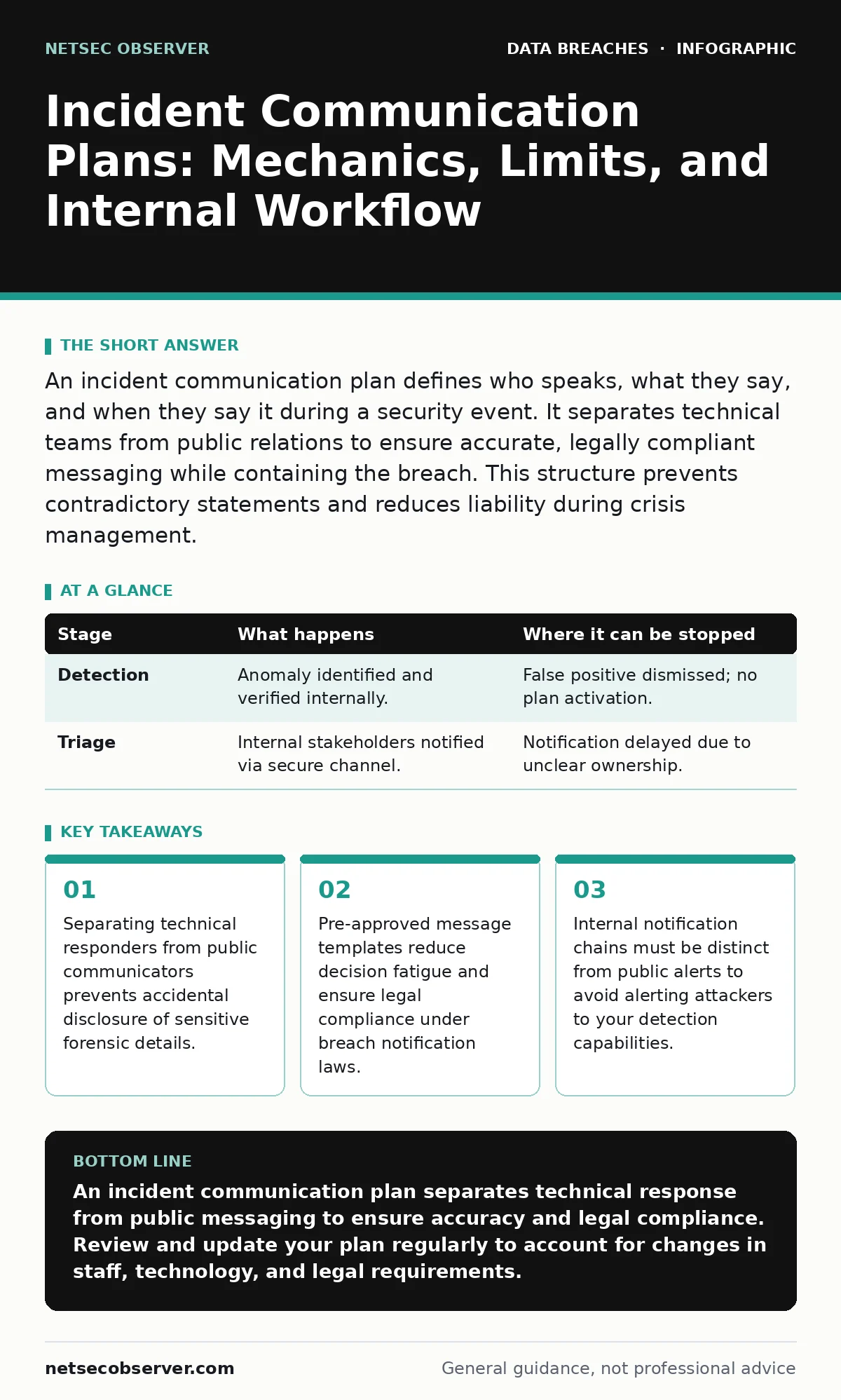
An incident communication plan defines who speaks, what they say, and when they say it during a security event. It separates technical teams from public relations to ensure accurate, legally compliant messaging while containing the breach. This structure prevents contradictory statements and reduces liability during crisis management.
The Separation of Technical and Public Roles
An incident communication plan is not a marketing document. It is a operational protocol that dictates how information flows during a security crisis. The primary mechanism is the strict separation of duties between those fixing the problem and those talking about it. Technical responders focus on containment and eradication. Communications teams focus on stakeholder management and legal requirements.
This separation exists because technical teams often lack the training to manage public perception or legal liability. Conversely, communications teams lack the context to understand the technical scope. When these roles merge, errors occur. A technician might accidentally reveal system architecture details in a press statement. A public relations officer might promise a timeline for resolution that engineering cannot meet.
The plan establishes a single source of truth. Only designated spokespersons can release external information. All internal updates flow through a secure channel that is separate from public-facing systems. This prevents attackers, who may be monitoring public channels, from gaining insight into your response strategy.
Stage 1: Detection and Internal Triage
The process begins when an anomaly is detected. The first step is not to notify the public, but to verify the incident. False positives are common. Acting on a false alarm wastes resources and damages credibility. The incident response team confirms the threat using established indicators of compromise.
Once confirmed, the team activates the incident communication plan. The first communication is internal. Key stakeholders are notified via a pre-defined channel. This channel must be out-of-band, meaning it does not use the potentially compromised systems. Email is often unsafe during an active breach. Secure messaging platforms or phone trees are preferred.
The internal notification includes only what is known. It does not include speculation. The goal is to assemble the right people without causing panic. This stage often fails when junior staff attempt to diagnose the issue publicly or on social media. The plan must explicitly forbid unauthorized external communication.
| Stage | What happens | Where it can be stopped |
|---|---|---|
| Detection | Anomaly identified and verified internally. | False positive dismissed; no plan activation. |
| Triage | Internal stakeholders notified via secure channel. | Notification delayed due to unclear ownership. |
Stage 2: Assessment and Message Drafting
With the team assembled, the next step is assessment. The technical lead determines the scope. What data was accessed? Which systems are affected? How long has the attacker been present? This information is critical for legal compliance. Many jurisdictions have specific requirements for breach notification laws.
The communications lead drafts initial messages based on the technical facts. These drafts are reviewed by legal counsel. The goal is to be accurate without being overly specific. You must inform affected parties without giving attackers more information about your defenses. This is a delicate balance. Too much detail helps the attacker evade future detection. Too little detail violates trust and regulatory requirements.
Pre-approved templates accelerate this phase. These templates cover common scenarios, such as data exfiltration or ransomware. They include placeholders for specific details. This reduces the cognitive load on responders who are already under stress. The templates ensure that the tone remains consistent and professional.
Stage 3: External Notification and Ongoing Updates
Once the messages are approved, external notifications are sent. This includes affected customers, partners, and regulators. The timing is critical. Many regulations require notification within a specific window. Missing this window can result in significant penalties. The communication plan defines the exact trigger for each type of notification.
After the initial notification, the plan shifts to ongoing updates. The situation is rarely static. New information emerges as the investigation continues. The communications team must manage expectations. They should provide regular updates, even if there is no new information. Silence breeds speculation and rumors.
The plan also addresses media inquiries. A single spokesperson handles all press questions. This ensures consistency. If multiple employees speak to the press, contradictions will emerge. These contradictions undermine trust and can be used by attackers to discredit your response.
Stage 4: Post-Incident Review and Plan Revision
The communication plan does not end when the incident is resolved. The final stage is review. The team analyzes what worked and what did not. Did the notification reach all affected parties? Were the messages clear? Did the separation of duties hold?
This review informs the revision of the plan. Communication channels may change. Legal requirements may evolve. The plan must be updated to reflect these changes. This is often overlooked. Teams focus on technical remediation and neglect to update the communication protocols. This leaves the organization vulnerable to future incidents.
The review also includes training. Staff should be trained on their roles in the communication plan. Drills simulate incidents to test the plan. These drills reveal gaps in the process. For example, a drill might reveal that the designated spokesperson is unavailable during a weekend incident. The plan must account for such contingencies.
See also: Cybersecurity Incident Response Team: How It Works and Why It Matters · WordPress Page Builder Breach: Response and Recovery Steps
Hidden Costs and Limitations
An incident communication plan has limits. It cannot prevent a breach. It can only manage the aftermath. The hidden cost is the time required to maintain the plan. Templates must be updated. Contact lists must be verified. Training must be conducted. This is a continuous effort, not a one-time project.
Another limitation is the reliance on human judgment. Under stress, people make mistakes. They may bypass the plan to act quickly. The plan must include clear escalation paths for when standard procedures fail. It must also account for the possibility that the attackers are monitoring your communications.
The plan does not replace technical security measures. It works alongside them. Strong encryption key management and regular privacy impact assessments reduce the likelihood and impact of a breach. The communication plan ensures that if a breach occurs, the organization responds effectively.
Integration with Broader Security Strategies
The incident communication plan is part of a larger security framework. It relies on accurate data classification. If you do not know what data you hold, you cannot notify the right people. Privacy impact assessments help identify sensitive data and its location.
The plan also interacts with third-party risk assessments. If a vendor is breached, your communication plan must address how to notify your customers. You may be liable for the vendor’s failure. The plan should include clauses for vendor incidents.
Finally, the plan supports credit freezes and other remediation services. If customer data is exposed, you may offer these services. The communication plan must explain these options clearly. Customers need to know what steps they can take to protect themselves. This reduces their anxiety and limits your liability.
Key takeaways
- Separating technical responders from public communicators prevents accidental disclosure of sensitive forensic details.
- Pre-approved message templates reduce decision fatigue and ensure legal compliance under breach notification laws.
- Internal notification chains must be distinct from public alerts to avoid alerting attackers to your detection capabilities.
An incident communication plan separates technical response from public messaging to ensure accuracy and legal compliance. Review and update your plan regularly to account for changes in staff, technology, and legal requirements.
Frequently asked questions
Who should be included in the incident communication team?
The team should include technical leads, legal counsel, public relations staff, and executive sponsors. Each role has specific responsibilities that must be defined in advance.
How often should the communication plan be tested?
The plan should be tested at least annually through tabletop exercises. These drills simulate incidents to identify gaps and train staff on their roles.
What if the incident involves a third-party vendor?
The plan should include specific procedures for vendor incidents. This includes coordinating with the vendor’s response team and notifying your own customers if their data was affected.
Can social media be used for incident communication?
Social media can be used for broad announcements, but it should not be the primary channel for sensitive notifications. Official statements should be posted on the company website and sent via direct communication channels.
How this guide was produced: written by the NetSec Observer editorial team with AI assistance, checked against the public references listed below, and reviewed when the facts change. See our editorial policy or report an error.