
How the CISA KEV Catalog Works and Why You Must Patch It
The CISA Known Exploited Vulnerabilities catalog forces immediate remediation by tracking real-world attacks, not just theoretical flaws in software code.
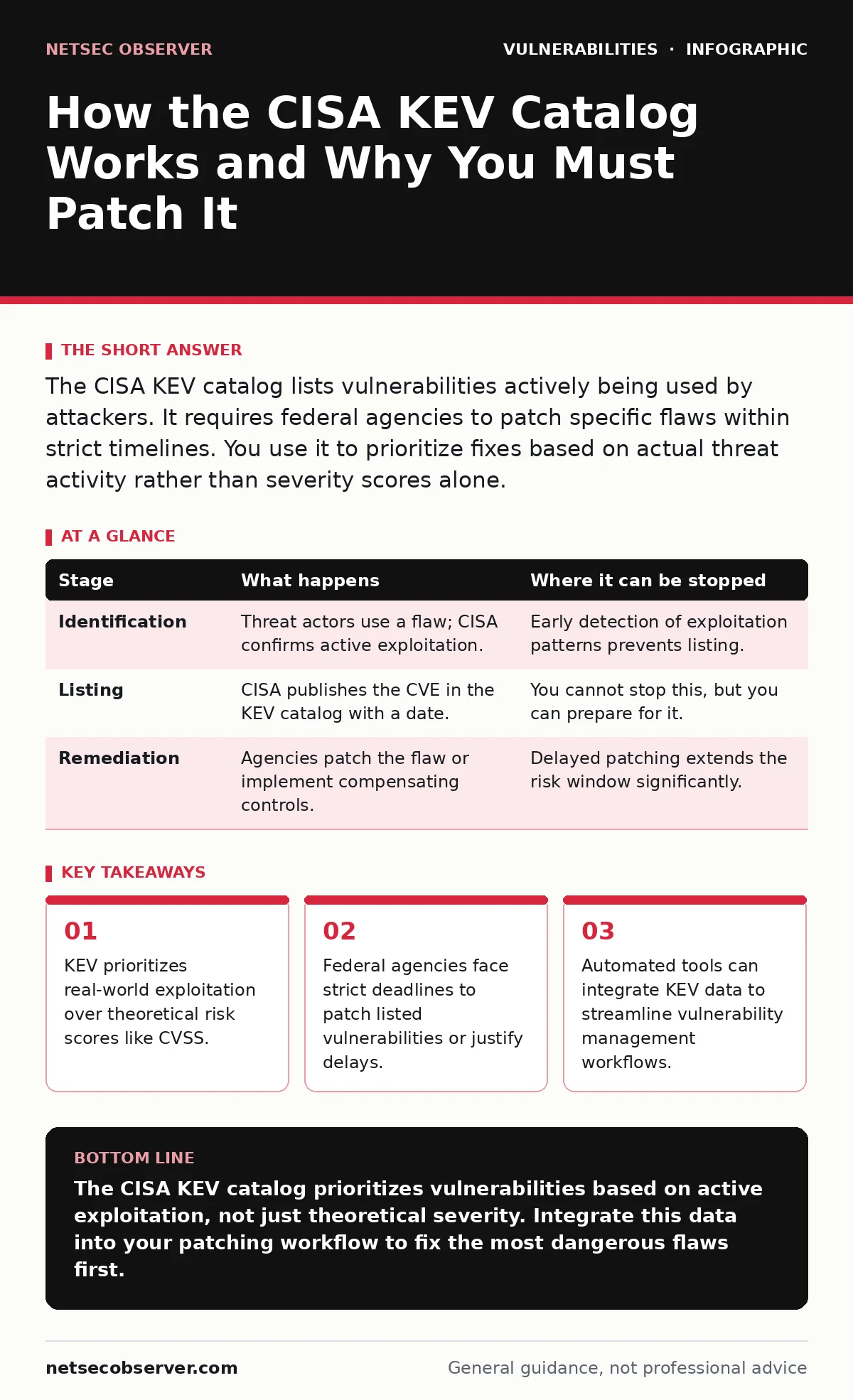
The CISA KEV catalog lists vulnerabilities actively being used by attackers. It requires federal agencies to patch specific flaws within strict timelines. You use it to prioritize fixes based on actual threat activity rather than severity scores alone.
The Shift from Theory to Practice
Most vulnerability management programs rely on severity scores to decide what to fix first. The Common Vulnerability Scoring System (CVSS) provides a numerical rating for technical flaws. A score of ten means a critical flaw, while one point means low risk. This system helps you sort thousands of alerts.
However, a high score does not mean attackers are using the flaw. Many critical vulnerabilities sit unpatched for years because no one targets them. The CISA Known Exploited Vulnerabilities (KEV) catalog changes this dynamic. It lists only those flaws that have seen active exploitation in the wild.
This shift forces you to look at threat intelligence rather than just software documentation. You stop guessing which bug an attacker might use. You start fixing the ones they are actually using. This approach reduces the window of opportunity for adversaries.
Stage 1: Identification of Active Exploitation
The process begins with threat actors using a vulnerability to breach systems. CISA monitors global threat data from various sources. They look for evidence that a specific CVE (Common Vulnerabilities and Exposures) identifier is being used in attacks.
This is not about discovering a new bug. It is about confirming that the bug is in play. Analysts verify that the exploitation is widespread and impactful. They do not list every minor flaw ever found. They list the ones causing real damage.
Imagine a developer finds a buffer overflow in a popular server software. If no one uses this flaw to hack systems, it stays off the KEV list. If attackers start using it to steal data, CISA adds it. This distinction saves you from wasting time on theoretical risks.
| Stage | What happens | Where it can be stopped |
|---|---|---|
| Identification | Threat actors use a flaw; CISA confirms active exploitation. | Early detection of exploitation patterns prevents listing. |
| Listing | CISA publishes the CVE in the KEV catalog with a date. | You cannot stop this, but you can prepare for it. |
| Remediation | Agencies patch the flaw or implement compensating controls. | Delayed patching extends the risk window significantly. |
Stage 2: Publication and Prioritization
Once confirmed, CISA adds the vulnerability to the public catalog. The entry includes the CVE ID, the product name, and the date it was added. This date is critical for compliance and prioritization.
You can download this list in machine-readable formats. This allows your security tools to ingest the data automatically. Your vulnerability scanner can now cross-reference your asset inventory with the KEV list.
This automation is key to scaling your defense. Manual checks are too slow for the speed of modern attacks. By integrating KEV data, your tools flag these specific vulnerabilities as urgent. They rise to the top of your patching queue.
Stage 3: Remediation and Compliance
For federal agencies, patching KEV items is mandatory. They must fix the flaw within a set timeframe. If a patch is not available, they must implement compensating controls. These controls might include network segmentation or access restrictions.
Private organizations do not face the same legal requirement. However, the logic still applies. If attackers are using a flaw, your organization is likely a target. Ignoring KEV items leaves you exposed to known attack paths.
You should treat KEV items as your highest priority. Fix them before you address lower-risk issues. This strategy reduces your attack surface effectively. It ensures you are defending against the threats that matter most.
Integrating with Broader Security
The KEV catalog works best when combined with other security practices. Exposure management helps you see what assets are visible to attackers. If you know your exposure, you can better understand the impact of a KEV item.
Dependency updates are also critical. Many KEV items affect libraries and frameworks. Keeping these dependencies current prevents you from inheriting known flaws. This is especially true for web applications that rely on open-source code.
Consider how broken access control might compound a KEV issue. If an attacker exploits a vulnerability to gain initial access, weak access controls allow them to move deeper. Fixing the vulnerability is the first step. Strengthening access controls is the second.
See also: Difference Between Attack Surface Management and Vulnerability Management · Dependency Updates: 8 Questions About Security Risks and Fixes
Common Pitfalls in Application
Many teams struggle with the volume of data. They try to patch everything at once. This leads to burnout and system instability. Focus on the KEV items first. They represent the highest risk.
Another pitfall is assuming a patch solves everything. Some vulnerabilities require configuration changes. Simply installing an update might not close the hole. Read the vendor guidance carefully. Test patches in a safe environment before deploying them widely.
Suppose you apply a patch for a SQL injection flaw. You might think the issue is resolved. However, if your application still allows raw SQL input, other injection types might remain. You must validate the fix, not just assume it works.
The Hidden Cost of Delay
Delaying patching for KEV items has a hidden cost. It increases the likelihood of a breach. Attackers often scan for known vulnerabilities. Your systems become easy targets.
This delay also erodes trust. If you are a service provider, your clients expect you to follow best practices. Ignoring the KEV catalog signals negligence. It can lead to lost business and reputational damage.
You must balance speed with stability. Rushing patches can break systems. But waiting too long invites attacks. Use the KEV catalog to find the right balance. Prioritize based on real-world threat data.
Moving Beyond Basic Patching
Patching is not the only solution. Sometimes, you can mitigate risk without a patch. Network segmentation can isolate vulnerable systems. This limits the damage if an attacker succeeds.
Firewall rules can block traffic to vulnerable services. This is a temporary measure but buys you time. It allows you to plan a proper fix without immediate exposure.
Command injection and server-side request forgery (SSRF) are often exploited via known vulnerabilities. Understanding these attack vectors helps you design better mitigations. You can block specific patterns that indicate an attack.
Sustaining the Effort
Security is an ongoing process. The KEV catalog updates regularly. New items are added as attackers find new ways in. Old items may be removed if patches are widespread.
You need a process to handle these changes. Automate where possible. Use tools that integrate with your existing workflow. This reduces manual effort and error.
Regularly review your patching process. Identify bottlenecks. Improve your speed and accuracy. The goal is to reduce the time between identification and remediation. This reduces your risk window.
Key takeaways
- KEV prioritizes real-world exploitation over theoretical risk scores like CVSS.
- Federal agencies face strict deadlines to patch listed vulnerabilities or justify delays.
- Automated tools can integrate KEV data to streamline vulnerability management workflows.
The CISA KEV catalog prioritizes vulnerabilities based on active exploitation, not just theoretical severity. Integrate this data into your patching workflow to fix the most dangerous flaws first.
Frequently asked questions
Is the KEV catalog mandatory for private companies?
No, it is mandatory for federal agencies. However, private companies should use it as a best practice for prioritizing security fixes.
How often does the KEV catalog update?
CISA updates the catalog regularly, often adding new entries as threat intelligence becomes available. Check for updates frequently.
What if no patch is available for a KEV item?
Implement compensating controls like network segmentation or access restrictions. Monitor the vendor for a patch and apply it immediately when released.
Can I automate KEV compliance?
Yes, many security tools support automation. You can configure them to ingest KEV data and flag relevant vulnerabilities in your environment.
How this guide was produced: written by the NetSec Observer editorial team with AI assistance, checked against the public references listed below, and reviewed when the facts change. See our editorial policy or report an error.