
What Is Third Party Risk Management: A Practical Framework
Your security posture is only as strong as the weakest vendor connection, making continuous monitoring more effective than one-time checks.
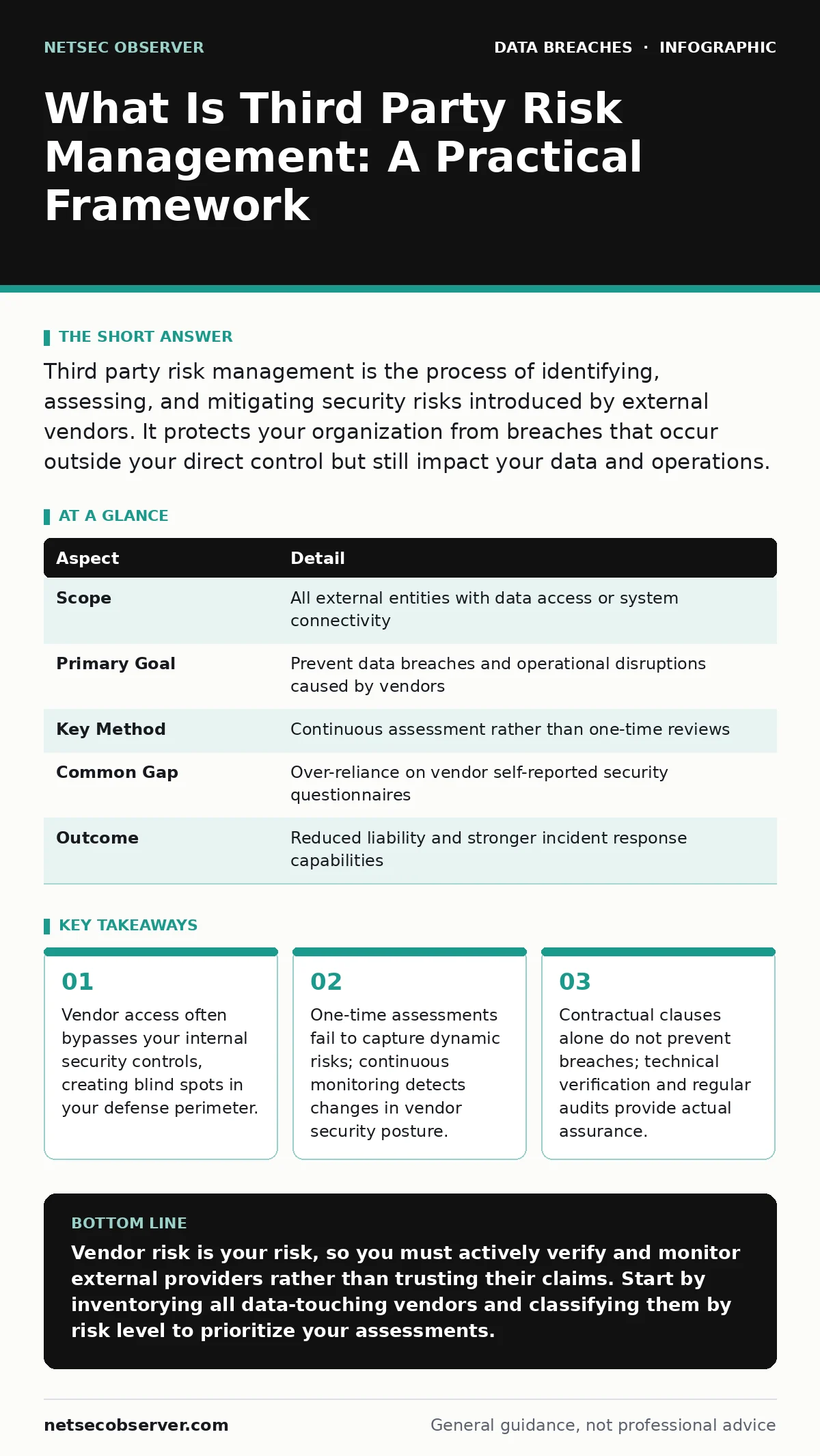
Third party risk management is the process of identifying, assessing, and mitigating security risks introduced by external vendors. It protects your organization from breaches that occur outside your direct control but still impact your data and operations.
Start With A Simple Analogy
Imagine you hire a cleaning company to maintain your office. You trust them with keys and access codes. If they lose their keys or hire unvetted sub-contractors, your security fails. You did not hire thieves, but the risk originated from a trusted partner. Third party risk management applies this logic to digital services. It ensures that the companies you rely on protect your data with the same rigor you expect internally.
What Is Third Party Risk Management
What is third party risk management? It is the systematic evaluation of security risks posed by external providers who handle your data or access your systems. This practice extends your security boundary beyond your own employees and infrastructure. It covers software vendors, cloud providers, payroll processors, and even IT support firms. The goal is not to eliminate vendors, but to understand and control the risks they introduce. You cannot secure what you do not see.
| Aspect | Detail |
|---|---|
| Scope | All external entities with data access or system connectivity |
| Primary Goal | Prevent data breaches and operational disruptions caused by vendors |
| Key Method | Continuous assessment rather than one-time reviews |
| Common Gap | Over-reliance on vendor self-reported security questionnaires |
| Outcome | Reduced liability and stronger incident response capabilities |
How The Process Works
The process begins with inventory. You must know every vendor that touches your data. Next comes classification. Not all vendors pose equal risk. After classification, you conduct third-party risk assessments. These reviews examine the vendor’s security policies, technical controls, and compliance history. Finally, you establish monitoring. Security is not static. A vendor that was secure last year may have weak controls today. Regular checks ensure they maintain their promises.
Who Is Affected By Vendor Risks
Every organization that uses external services is affected. Small businesses often assume they are too small to target, but attackers frequently exploit smaller vendors to reach larger clients. Large enterprises face complex supply chains where a single weak link can compromise thousands of downstream partners. Regulatory bodies hold you accountable for data breaches, even if the failure occurred at a vendor’s site. You remain liable for protecting customer information regardless of where the breach originates. Ignoring vendor risk shifts liability without reducing exposure.
Common Mistakes In Vendor Oversight
Many organizations treat vendor risk as a checkbox exercise. They send a questionnaire, receive a generic response, and file the document. This approach provides false confidence. Vendors often exaggerate their security posture in self-assessments. Another mistake is focusing only on initial onboarding. Risks evolve. A vendor may change its infrastructure, hire new staff, or suffer an incident months after approval. Without ongoing monitoring, you operate with outdated information. You also often neglect the exit strategy. When a contract ends, residual access and data copies remain if not properly revoked and verified.
See also: Personally Identifiable Information: Small Business Protection Strategies · Data Scraping: How It Works and How to Stop It
Technical Controls And Verification
You must verify claims with evidence. Ask for penetration test results, not just summaries. Review their incident response plans to see how they handle breaches. Check if they use encryption for data at rest and in transit. Verify their access controls to ensure only necessary personnel can view your data. If you rely on their systems for critical operations, require uptime guarantees and backup procedures. Technical verification prevents you from trusting marketing materials over actual security practices. It forces vendors to maintain rigorous standards.
Managing The Human Factor
Vendors are only as secure as their people. Social engineering attacks often target vendor employees who have access to your systems. Attackers know that vendor staff may have weaker training than your internal team. Ensure your vendors conduct regular security awareness training. Require them to report phishing attempts and suspicious activities. Include clauses in contracts that mandate immediate notification of any security incident involving their staff. Human error is a leading cause of accidental data disclosure, and vendors are no exception.
Building A Resilient Program
A resilient program integrates vendor risk into your broader security strategy. Align vendor requirements with your internal security policies. Use automated tools to monitor vendor security scores and news feeds for emerging threats. Regularly update your inventory as business needs change. Conduct tabletop exercises that include vendor scenarios. Imagine a vendor suffers a ransomware attack. How does your team respond? Do you have an incident communication plans ready? Testing these scenarios reveals gaps before real incidents occur.
Moving Beyond Basic Compliance
Compliance is the floor, not the ceiling. Meeting minimum regulatory requirements does not guarantee security. You must assess risks based on your specific business context. A healthcare provider needs stricter controls than a retail store, even if both use the same vendor. Consider the sensitivity of your data and the criticality of the service. Implement encryption key management practices that allow you to control your data regardless of the vendor. This reduces dependency on their security controls. You retain the ability to protect your data even if they fail.
The Cost Of Inaction
Ignoring vendor risk leads to reputational damage and financial loss. Customers lose trust when their data is exposed through a partner. Regulatory fines can be substantial. Operational downtime disrupts business continuity. The cost of implementing a robust vendor risk program is far less than the cost of a single breach. You invest in prevention rather than paying for remediation. Proactive management builds trust with customers and partners. It demonstrates that you take security seriously across your entire ecosystem.
Conclusion Of The Framework
Third party risk management is an ongoing discipline. It requires attention to detail, continuous verification, and clear communication. You cannot outsource your responsibility for security. Even when vendors handle your data, you remain accountable. By implementing strict assessments, continuous monitoring, and clear contractual obligations, you reduce your exposure. You create a security culture that extends beyond your walls. This approach protects your organization from the hidden risks of the modern supply chain.
Key takeaways
- Vendor access often bypasses your internal security controls, creating blind spots in your defense perimeter.
- One-time assessments fail to capture dynamic risks; continuous monitoring detects changes in vendor security posture.
- Contractual clauses alone do not prevent breaches; technical verification and regular audits provide actual assurance.
Vendor risk is your risk, so you must actively verify and monitor external providers rather than trusting their claims. Start by inventorying all data-touching vendors and classifying them by risk level to prioritize your assessments.
Frequently asked questions
How often should I reassess my vendors?
Reassess high-risk vendors annually or immediately after significant changes. Low-risk vendors can be reviewed every two to three years, but continuous monitoring should be ongoing.
Do I need to audit every vendor?
No. Focus on vendors with direct access to sensitive data or critical systems. Use questionnaires and certifications for low-risk vendors to save resources.
What if a vendor refuses to share security details?
Treat this as a major red flag. Refusal to share basic security information suggests poor practices or hidden vulnerabilities. Consider finding an alternative provider.
How does this relate to dark web monitoring?
Dark web monitoring can alert you to compromised credentials belonging to your vendors. This helps you detect breaches early, even if the vendor has not yet reported them.
How this guide was produced: written by the NetSec Observer editorial team with AI assistance, checked against the public references listed below, and reviewed when the facts change. See our editorial policy or report an error.