
Credit Freezes: How to Lock Your Identity From Unwanted Loans
Stop lenders from accessing your history, blocking new accounts in their name, and learning why this lock does not stop all financial theft.
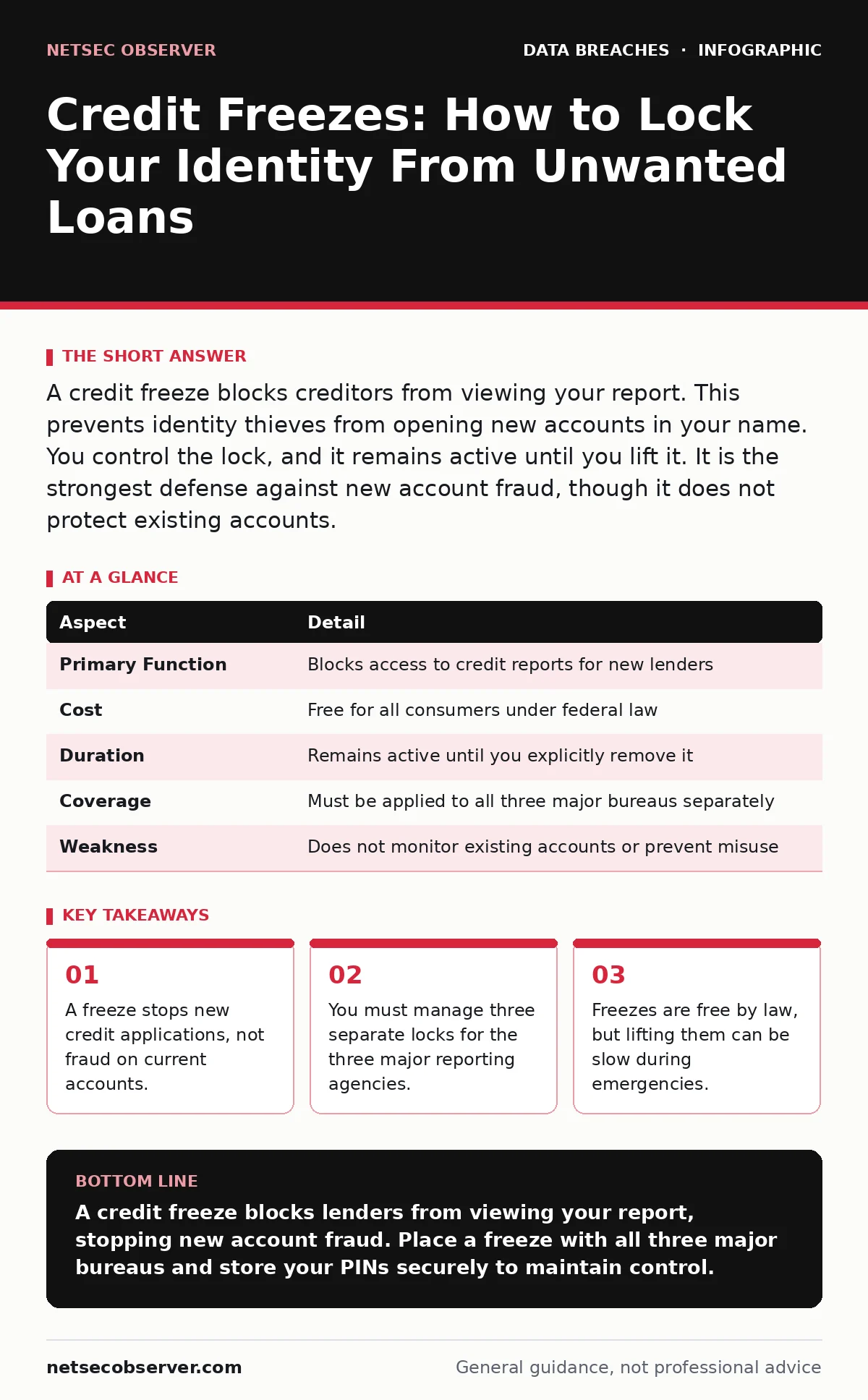
A credit freeze blocks creditors from viewing your report. This prevents identity thieves from opening new accounts in your name. You control the lock, and it remains active until you lift it. It is the strongest defense against new account fraud, though it does not protect existing accounts.
The Digital Padlock Analogy
Imagine your credit report is a detailed file sitting in a locked cabinet. Creditors need to see this file to decide if you qualify for a loan. A credit freeze puts a heavy padlock on that cabinet. The lock is keyed only to you. When a lender tries to open the cabinet, they find it shut tight. They cannot see your history, your debts, or your credit score. Because they cannot assess your risk, they deny the application.
This mechanism does not hide your data from everyone. It only stops new lenders from pulling a hard inquiry. A hard inquiry is a formal request by a creditor to view your full credit history for lending decisions. Other parties, such as existing creditors or government agencies, may still access limited information depending on local laws. The freeze is a gatekeeper, not a wall.
| Aspect | Detail |
|---|---|
| Primary Function | Blocks access to credit reports for new lenders |
| Cost | Free for all consumers under federal law |
| Duration | Remains active until you explicitly remove it |
| Coverage | Must be applied to all three major bureaus separately |
| Weakness | Does not monitor existing accounts or prevent misuse |
The Problem of New Account Fraud
The main threat a freeze addresses is application fraud. This occurs when a thief uses your personal information to apply for credit cards, loans, or utilities. They provide your name, address, and Social Security number. The lender checks your credit report. The thief then drains the credit limit or defaults on the loan.
A freeze breaks this chain at the verification step. When the lender checks the report, the system returns a "frozen" status. The lender cannot proceed. The application fails immediately. This stops the fraud before money changes hands or debt is incurred. It is a proactive block rather than a reactive alert.
How the Lock Works Technically
A credit freeze is an instruction to the consumer reporting agencies. These agencies maintain databases of your credit behavior. When you request a freeze, they place a flag on your file. This flag tells any automated system that requests a full report to reject the request. The system does not need to know who is asking. It simply denies access.
You receive a PIN or password when you set the freeze. This credential is your key. To lift the freeze, you must provide this PIN. You can lift the lock temporarily for a specific time window or permanently until you freeze it again. Some systems allow you to specify a duration, such as one hour or twenty-four hours, which helps when you are applying for a loan in person.
Managing Three Separate Systems
You do not have one credit report. You have three, one with each of the major consumer reporting agencies. A freeze with one agency does not protect you with the others. You must place a freeze with all three to be fully protected. If you only lock one, a thief can simply apply for credit through a lender that uses one of the other two.
This creates a management burden. You must track three different PINs or passwords. If you lose one, the recovery process can be slow. You may need to verify your identity through mail or phone calls. This delay can leave you vulnerable for days or weeks. Keep your credentials in a secure password manager or a physical safe, not in a wallet or an unencrypted file.
Where Freezes Fit in Your Defense Stack
A credit freeze is not a complete security solution. It works best when combined with other controls. Think of it as the front door lock. You still need to secure the windows and the back door. A freeze stops new accounts, but it does not stop thieves from using your existing cards. It does not stop them from changing your address or making purchases on open lines of credit.
For existing accounts, you need monitoring. Transaction alerts notify you when a charge occurs. This helps you catch unauthorized use quickly. You should also review your statements regularly. Look for small, unfamiliar charges that might indicate a test transaction. Combining a freeze with monitoring covers both new account fraud and existing account abuse.
See also: Data Scraping: How It Works and How to Stop It · Build an Incident Communication Plan That Prevents Panic
Common Misconceptions About Freezes
Many people believe a freeze affects their credit score. It does not. Your score is calculated from the data in your report. The freeze only blocks access to that data. It does not change the data itself. Your score remains the same, whether the file is locked or open.
Another mistake is thinking a freeze stops all identity theft. It does not. Thieves can still use your information for medical fraud, tax fraud, or criminal impersonation. These activities do not require a credit check. They rely on other government or institutional databases. A freeze only protects against financial lending fraud. Do not assume you are safe from all identity crimes just because you have a freeze in place.
The Trade-Off of Convenience
The main cost of a freeze is inconvenience. Every time you apply for credit, you must lift the lock. This adds steps to the process. You cannot simply click "apply" online and wait for an instant decision. You must contact the bureaus first. This can take minutes or hours, depending on the method you use.
This delay can be frustrating in time-sensitive situations. If you find a house you want to buy, you may need to secure financing quickly. You must plan ahead. Lift the freeze before you schedule the loan application. Some bureas offer mobile apps that allow faster lifting than phone calls. Using these tools can reduce the friction.
What to Do Next
Start by checking your credit reports. See if any freezes are already in place. If not, contact the three major bureaus to place them. Save your PINs securely. Set a reminder to review your accounts regularly. Understand that a freeze is a strong tool, but it is not the only tool. Combine it with monitoring and careful habits to build a layered defense.
Key takeaways
- A freeze stops new credit applications, not fraud on current accounts.
- You must manage three separate locks for the three major reporting agencies.
- Freezes are free by law, but lifting them can be slow during emergencies.
- A PIN is required to lift the freeze, making it a strong control.
A credit freeze blocks lenders from viewing your report, stopping new account fraud. Place a freeze with all three major bureaus and store your PINs securely to maintain control.
Frequently asked questions
Does a credit freeze lower my credit score?
No, a freeze does not change your credit score. It only restricts access to your report. Your score remains unchanged while the freeze is active.
Can I still use my existing credit cards with a freeze?
Yes, a freeze does not affect existing accounts. You can continue to use your cards and make payments as normal. The lock only stops new credit applications.
How long does it take to lift a freeze?
It varies by bureau and method.
How this guide was produced: written by the NetSec Observer editorial team with AI assistance, checked against the public references listed below, and reviewed when the facts change. See our editorial policy or report an error.