
Server-Side Request Forgery: 6 Myths Blocking Your Detection
SSRF exploits the server’s network privileges, not just its code, meaning internal services and cloud metadata are the primary targets, not external websites.
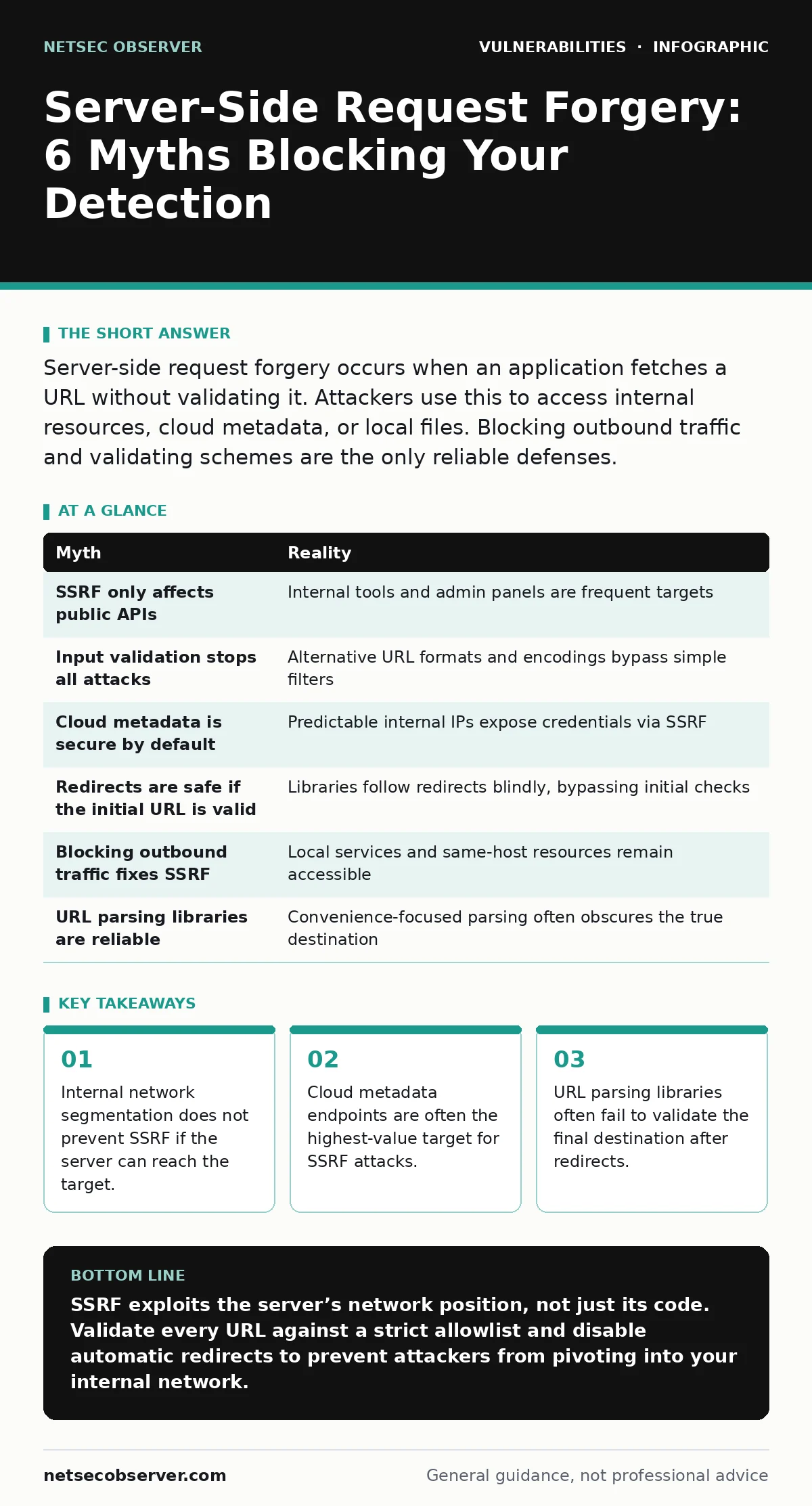
Server-side request forgery occurs when an application fetches a URL without validating it. Attackers use this to access internal resources, cloud metadata, or local files. Blocking outbound traffic and validating schemes are the only reliable defenses.
Myth: SSRF Only Affects Public-Facing APIs
Reality: Server-side request forgery (SSRF) thrives in internal tools, admin panels, and any interface that accepts user-controlled input to fetch resources. The vulnerability exists wherever the server acts as a proxy for a network request.
Attackers do not need to target the public web to exploit this flaw. They often look for internal dashboards, import wizards, or webhook configuration pages. These interfaces are less scrutinized because they sit behind authentication or are assumed to be safe. If the server can initiate a request based on user input, the attack surface exists regardless of the interface’s visibility.
Myth: Input Validation Stops All SSRF Attacks
Reality: Basic input validation fails because attackers can bypass string checks using alternative URL formats and encoding schemes. The server’s network stack interprets these formats differently than a simple regex pattern.
Imagine a filter that blocks URLs containing "127.0.0.1". An attacker can submit "localhost", "0.0.0.0", or an integer representation like 2130706433. All of these resolve to the local machine. The application sees different strings, but the operating system routes the traffic to the same destination. Relying on blacklists of known bad domains or IP ranges is ineffective because the number of valid representations for a single host is vast.
Myth: Cloud Metadata Is Secure by Default
Reality: Cloud providers place metadata services on predictable internal IP addresses, such as 169.254.169.254, to allow instances to configure themselves. These endpoints often return sensitive credentials, API keys, or temporary access tokens.
When an application runs in a cloud environment, it inherits the network permissions of its host. If an SSRF vulnerability exists, the attacker can direct the server to query this metadata endpoint. The server returns the credentials to the attacker, who then assumes control of the cloud account. This is not a flaw in the cloud provider’s security, but a consequence of the application failing to restrict where it can send requests.
Myth: Redirects Are Safe If the Initial URL Is Valid
Reality: Many URL-fetching libraries follow HTTP redirects automatically. If the initial URL passes validation, the library may blindly follow a 302 redirect to an internal address. The application never sees the final destination.
Suppose your application validates that a URL points to a public news site. An attacker hosts a page on that site that immediately redirects to an internal service. The server fetches the news page, receives the redirect instruction, and fetches the internal service. The initial validation passed, but the final request bypassed all security controls. You must disable automatic redirects or validate the final URL after every hop.
Myth: Blocking Outbound Traffic Fixes SSRF
Reality: Blocking outbound traffic from the application server is a strong control, but it is not always feasible or sufficient. Some applications require outbound access to function, such as those that integrate with third-party APIs or fetch external content.
Even when outbound traffic is blocked, SSRF can still target local services. The server may be able to reach services on the same host or the local network segment. If the application can connect to a local database, a cache service, or a microservice, an attacker can use SSRF to interact with these resources. This often leads to broken access control, where the attacker performs actions they should not be able to perform by leveraging the server’s trusted identity.
See also: Command Injection: How It Works and How to Stop It
Myth: SSRF Is Just a Network Problem
Reality: SSRF is fundamentally an application logic flaw that results in network access. It is often confused with command injection, where an attacker executes arbitrary system commands. SSRF does not execute commands; it initiates network connections.
However, the impact can be similar. By accessing internal services, an attacker can trigger actions within the application’s ecosystem. This might involve deleting records, escalating privileges, or exfiltrating data. The distinction matters for defense. You cannot patch SSRF by hardening the operating system alone. You must fix the code that handles URL input. This requires understanding how the application processes requests, similar to how you would analyze SQL injection vulnerabilities in database queries.
Myth: URL Parsing Libraries Are Reliable
Reality: Most standard URL parsing libraries are designed for convenience, not security. They often normalize URLs in ways that obscure the true destination. A library might accept a URL with a double slash or a missing scheme as valid.
Developers often trust these libraries to validate input. They assume that if the library parses the URL, it is safe. This assumption is dangerous. The authentication credentials are sent to the attacker, and the request is made to the internal service. You must implement your own validation logic that checks the scheme, host, and port against a strict allowlist.
| Myth | Reality |
|---|---|
| SSRF only affects public APIs | Internal tools and admin panels are frequent targets |
| Input validation stops all attacks | Alternative URL formats and encodings bypass simple filters |
| Cloud metadata is secure by default | Predictable internal IPs expose credentials via SSRF |
| Redirects are safe if the initial URL is valid | Libraries follow redirects blindly, bypassing initial checks |
| Blocking outbound traffic fixes SSRF | Local services and same-host resources remain accessible |
| URL parsing libraries are reliable | Convenience-focused parsing often obscures the true destination |
Key takeaways
- Internal network segmentation does not prevent SSRF if the server can reach the target.
- Cloud metadata endpoints are often the highest-value target for SSRF attacks.
- URL parsing libraries often fail to validate the final destination after redirects.
SSRF exploits the server’s network position, not just its code. Validate every URL against a strict allowlist and disable automatic redirects to prevent attackers from pivoting into your internal network.
Frequently asked questions
How do I test for SSRF in my application?
Attempt to request internal IP addresses, localhost, and cloud metadata endpoints. Observe if the server responds with data from those sources or if it returns an error indicating the request was blocked.
Can SSL/TLS prevent SSRF attacks?
No. SSL/TLS encrypts the data in transit but does not validate the destination. An attacker can still direct the encrypted request to an internal server or cloud metadata endpoint.
What is the difference between SSRF and open redirect?
An open redirect tricks the user’s browser into visiting a malicious site. SSRF tricks the server into making a request to an internal or restricted resource. SSRF is generally more dangerous because it bypasses network segmentation.
Should I use a web application firewall to stop SSRF?
A WAF can help block known patterns, but it is not a complete solution. SSRF payloads are often context-specific and can bypass generic rules. Code-level validation is required for effective protection.
How this guide was produced: written by the NetSec Observer editorial team with AI assistance, checked against the public references listed below, and reviewed when the facts change. See our editorial policy or report an error.