
Shift Left Security Testing: How to Find Flaws Before Deployment
Moving security checks earlier in the development cycle catches logic errors that automated scanning tools miss entirely.
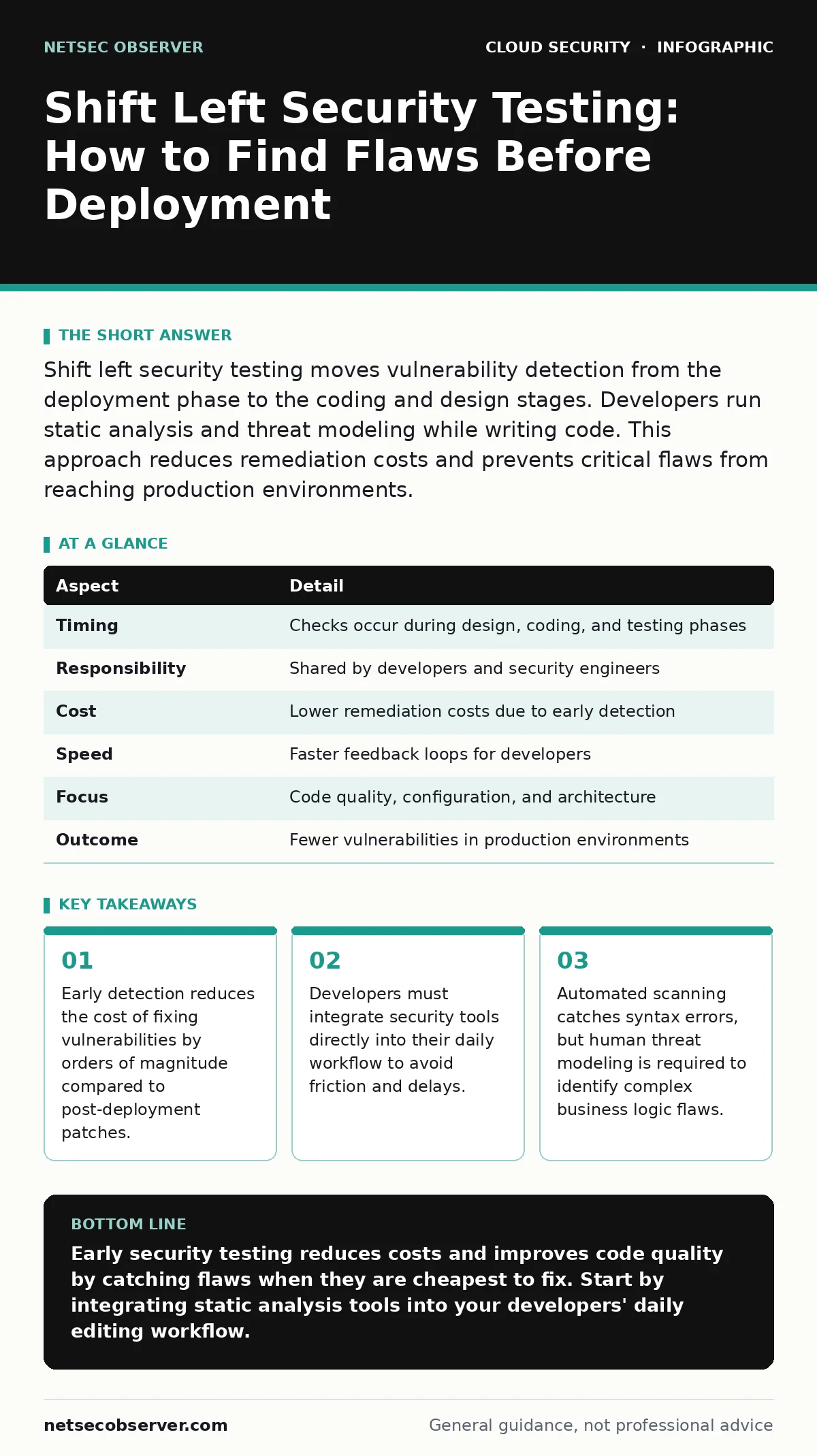
Shift left security testing moves vulnerability detection from the deployment phase to the coding and design stages. Developers run static analysis and threat modeling while writing code. This approach reduces remediation costs and prevents critical flaws from reaching production environments.
The Kitchen Analogy for Security Timing
Imagine you are baking a cake. You mix the ingredients, check the temperature, and then put the batter in the oven. If you taste the batter before baking, you can add more sugar. If you wait until the cake is fully baked and sliced to taste it, you cannot fix the flavor. You can only throw it away and start over.
Security works the same way. Traditional security checks happen after the software is built. This is like tasting the cake after it is out of the oven. Shift left security testing changes this process. It moves security checks to the mixing stage. You find the missing ingredient before you waste time and resources baking a flawed product.
What Is Shift Left Security Testing?
Shift left security testing is the practice of integrating security activities into the earliest phases of the software development lifecycle. Instead of waiting for a dedicated security team to audit the final product, developers perform security checks while they write code. This approach treats security as a continuous process rather than a final gate.
The term "shift left" refers to the visual representation of a project timeline. The start of the project is on the left. Moving security activities toward the start moves them to the left. This shift changes who is responsible for security. It moves ownership from a centralized security team to the individual developers who create the code.
| Aspect | Detail |
|---|---|
| Timing | Checks occur during design, coding, and testing phases |
| Responsibility | Shared by developers and security engineers |
| Cost | Lower remediation costs due to early detection |
| Speed | Faster feedback loops for developers |
| Focus | Code quality, configuration, and architecture |
| Outcome | Fewer vulnerabilities in production environments |
How the Process Works in Practice
The mechanism relies on automation and developer habit. You install static application security testing tools directly into your code editor. These tools scan your code for known vulnerability patterns as you type. They highlight potential issues in real time. This immediate feedback allows you to fix the problem before you even save the file.
You also integrate dynamic scanning into your continuous integration pipeline. Every time you commit code, the system builds a test version and runs automated security scans. If the scan finds a critical flaw, the build fails. The code does not move forward until you fix the issue. This creates a safety net that operates automatically.
Human review remains necessary for complex decisions. You perform threat modeling during the design phase. This involves drawing diagrams of your system and identifying where data flows. You ask questions about how an attacker might intercept or alter that data. This manual step catches logic errors that automated tools cannot see.
Who Is Affected by This Change
Developers bear the primary burden of this shift. They must learn to recognize security patterns and use new tools. This changes their daily routine. They spend less time debugging security issues in production and more time writing secure code from the start. It requires a change in mindset from "feature first" to "feature and security."
Security teams change their role from gatekeepers to enablers. They build the tools and policies that developers use. They train developers on secure coding practices. They focus on high-level architecture and policy rather than reviewing every line of code. This allows security teams to scale with the development velocity.
Project managers and product owners also feel the impact. They must allocate time for security activities in their sprint planning. They cannot treat security as an afterthought. They must accept that early security checks may slow initial development speed slightly. This trade-off saves significant time later by avoiding major rework or emergency patches.
Common Misconceptions About Early Security
Many organizations believe that automation replaces human judgment. This is incorrect. Automated tools scan for known patterns. They do not understand the unique business logic of your application. You still need human experts to review architecture and complex interactions. Relying solely on tools creates a false sense of security.
Another common mistake is treating shift left as a one-time project. Security is not a feature you add and then forget. It is a continuous discipline. Tools evolve, and new vulnerabilities emerge. You must update your scanning rules and training regularly. Neglecting maintenance leads to tool fatigue and missed vulnerabilities.
Some teams assume that shifting left eliminates the need for penetration testing. This is false. Early testing catches common coding errors. It does not replace the need for adversarial testing later in the cycle. You still need external testers to try to break your system. They provide a different perspective that internal tools cannot replicate.
See also: Orphaned Cloud Resources: Risks and Protection for Small Businesses
Integrating Security Into Daily Workflow
You start by selecting the right tools for your technology stack. Choose static analysis tools that support your programming languages. Integrate them into your integrated development environment. Configure them to run on every save or commit. This ensures that security checks are invisible to the developer's workflow.
You must also manage secrets properly. Developers often hardcode credentials into their source code. This is a major risk. Use pre-commit hooks to scan for secrets before they are pushed to the repository. This prevents accidental exposure. For more details on managing sensitive data, see our guide on secrets in source code.
Communication is key. Security teams must provide clear, actionable feedback. Do not just report a vulnerability. Explain why it is dangerous and how to fix it. Provide code examples. This reduces friction and helps developers learn. Over time, they will start to avoid these patterns naturally.
What To Do About Implementation
Begin with a pilot program. Select one development team to try the new process. Gather feedback on what works and what causes friction. Adjust your tools and policies based on their experience. Do not roll out to the entire organization at once. This allows you to refine your approach without disrupting all operations.
Measure your progress. Track the number of vulnerabilities found in development versus production. Monitor the time it takes to fix issues. Use these metrics to demonstrate the value of the approach. Share successes with other teams to build momentum.
Stay connected to broader security trends. For example, understanding how container escape vulnerabilities work helps you configure your build environments securely. Knowing about public code repository leaks helps you enforce strict access controls. These related topics influence how you implement shift left strategies.
Key takeaways
- Early detection reduces the cost of fixing vulnerabilities by orders of magnitude compared to post-deployment patches.
- Developers must integrate security tools directly into their daily workflow to avoid friction and delays.
- Automated scanning catches syntax errors, but human threat modeling is required to identify complex business logic flaws.
Early security testing reduces costs and improves code quality by catching flaws when they are cheapest to fix. Start by integrating static analysis tools into your developers' daily editing workflow.
Frequently asked questions
Does shift left security testing replace penetration testing?
No, it complements it. Shift left catches coding errors early, while penetration testing evaluates the entire system for complex, real-world attack scenarios.
How long does it take to implement shift left security?
Basic tool integration can take a few weeks. Full cultural adoption and workflow adjustment typically take several months of consistent effort and training.
Can small teams benefit from shift left security?
Yes, small teams benefit most. They have fewer resources to fix bugs later, so preventing them early is critical for maintaining velocity and stability.
What tools are needed for shift left security?
You need static application security testing tools, software composition analysis tools, and pre-commit hooks for secret detection.
How this guide was produced: written by the NetSec Observer editorial team with AI assistance, checked against the public references listed below, and reviewed when the facts change. See our editorial policy or report an error.