
Why is Identity Described as the New Security Perimeter
Network firewalls fail to stop insider threats or stolen credentials, making identity the only reliable boundary for modern cloud environments.
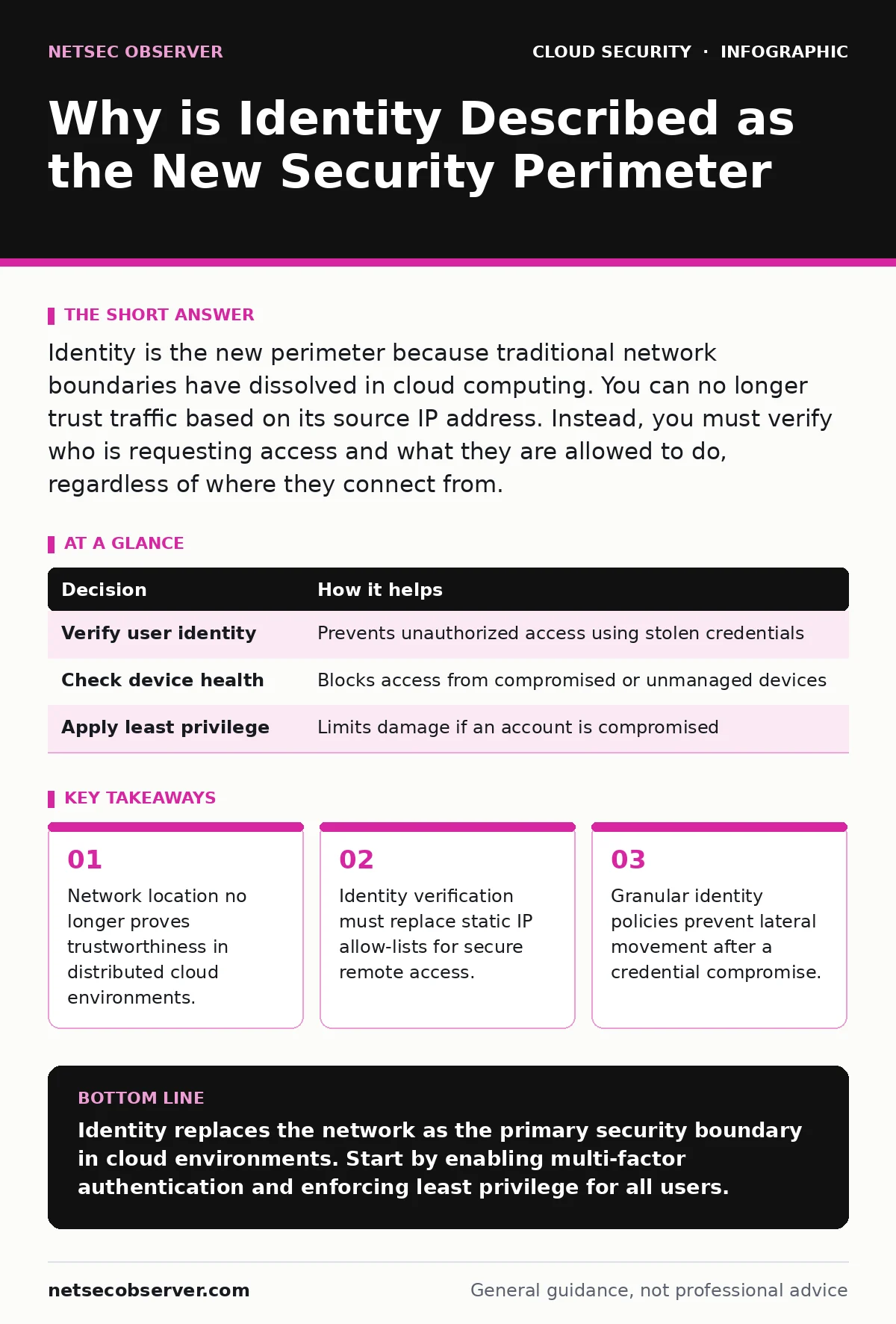
Identity is the new perimeter because traditional network boundaries have dissolved in cloud computing. You can no longer trust traffic based on its source IP address. Instead, you must verify who is requesting access and what they are allowed to do, regardless of where they connect from.
Why is identity described as the new security perimeter
The concept of the security perimeter has shifted from network boundaries to user identities. Traditional security relied on firewalls to block external threats. This model assumed that anything inside the corporate network was safe. Cloud computing and remote work have destroyed this assumption. Users access resources from anywhere. Devices are not owned by the organization.
Attackers bypass network defenses by stealing valid credentials. Identity becomes the only consistent point of control. You must verify every request, regardless of its origin. This shift forces organizations to treat identity as the primary defense layer. It replaces the false sense of security provided by internal network placement.
The failure of network-based trust
Network-based security depends on location. A firewall checks the IP address of an incoming connection. If the address is on an allow-list, traffic passes. This method fails when legitimate users work from home. It also fails when attackers compromise a server inside the network. Once an attacker is inside, they appear to be trusted. They can move laterally to other systems. Identity-based security does not care about location. It checks who is making the request. It checks if that person has permission. This approach stops attacks that originate from within the network. It also stops attacks using stolen credentials. Identity verification is continuous, not a one-time check at the edge.
Reasons for the identity shift
You prioritize identity because it offers granular control. Network rules are broad and static. Identity policies are specific and dynamic. Here are the reasons this shift matters, in order of weight. First, credential theft is the most common attack vector. Second, cloud resources are public by default. Third, remote work removes the corporate network. Fourth, third-party vendors need access. Fifth, compliance requires audit trails. Each reason reinforces the need for strong identity management. You cannot secure what you cannot identify. Identity provides the context needed to make access decisions.
| Decision | How it helps |
|---|---|
| Verify user identity | Prevents unauthorized access using stolen credentials |
| Check device health | Blocks access from compromised or unmanaged devices |
| Apply least privilege | Limits damage if an account is compromised |
What goes wrong without identity focus
Ignoring identity leads to uncontrolled access. Users share accounts to collaborate. These shared accounts lack individual audit trails. You cannot trace actions to a specific person. Attackers exploit these shared credentials. They gain access to sensitive data. Network segmentation fails to stop them. The attacker moves freely between systems. Data exfiltration occurs without detection. Insider threats are harder to catch. They already have valid credentials. Network logs show normal activity. Identity logs show unusual behavior. Without identity focus, you miss these signals. You rely on perimeter defenses that no longer exist.
Implementing identity-based controls
You implement identity controls through strict verification. Start with strong authentication methods. Multi-factor authentication adds a second layer of defense. It requires something the user has, not just knows. This stops attackers with stolen passwords. Next, enforce least privilege. Users should only access what they need. Remove excess permissions regularly. Conduct SaaS access reviews to ensure permissions match current roles. This reduces the attack surface. Monitor for anomalous behavior. Detect logins from unusual locations. Block access from known malicious networks. Identity management is not a one-time setup. It requires ongoing maintenance and review.
See also: Cloud Ransomware: How It Works and How to Stop It · Cloud Key Management Services Explained with Real Analogies
The hidden cost of weak identity
Weak identity management has hidden costs. It increases the risk of data breaches. It complicates incident response. You cannot isolate compromised accounts easily. Recovery takes longer. Reputation damage follows. Compliance violations result in fines. Operational downtime occurs during investigations. These costs are often invisible until a breach happens. Investing in identity security prevents these losses. It provides better visibility into user activity. It enables faster response to threats. The cost of implementation is lower than the cost of a breach. You must weigh the initial effort against long-term security.
Integrating identity with other defenses
Identity does not work in isolation. It must integrate with other security controls. Secure your secrets management practices. Review secrets in source code to prevent credential leaks. Ensure single sign-on is configured correctly. This reduces password fatigue and improves security. Monitor for public code repository leaks that expose API keys. Combine identity with network segmentation. Use identity to define micro-segments. Restrict traffic between services based on identity. This limits lateral movement. Identity enhances every other control. It provides the context needed for effective security.
Next steps for your organization
Start by mapping your identity landscape. Identify all users and service accounts. Determine what they have access to. Remove unnecessary permissions. Enable multi-factor authentication everywhere. Implement automated provisioning and de-provisioning. Ensure accounts are disabled when employees leave. Monitor identity logs for anomalies. Integrate identity management with your SIEM. Set up alerts for risky behavior. Continuously review and update your policies. Identity security is a journey, not a destination. Stay proactive and adapt to new threats.
Key takeaways
- Network location no longer proves trustworthiness in distributed cloud environments.
- Identity verification must replace static IP allow-lists for secure remote access.
- Granular identity policies prevent lateral movement after a credential compromise.
Identity replaces the network as the primary security boundary in cloud environments. Start by enabling multi-factor authentication and enforcing least privilege for all users.
Frequently asked questions
Does identity security replace firewalls?
No, identity security complements firewalls. Firewalls block unauthorized network traffic. Identity security verifies who is accessing resources. Both are needed for a layered defense.
How do you handle service accounts?
Treat service accounts like user accounts. Use strong credentials. Limit their permissions. Rotate secrets regularly. Monitor their activity for anomalies.
Is multi-factor authentication enough?
MFA is critical but not sufficient. You also need least privilege. You need continuous monitoring. You need strong password policies. MFA is one part of a broader strategy.
What if a user loses their MFA device?
Have a secure backup method. Use backup codes or a secondary device. Verify the user’s identity through other means before resetting. Document the process clearly.
How this guide was produced: written by the NetSec Observer editorial team with AI assistance, checked against the public references listed below, and reviewed when the facts change. See our editorial policy or report an error.