Stop Password Cracking: Prioritize These Controls First
Most cracking attacks fail not because hashes are strong, but because the attacker never gets the data they need to process offline.
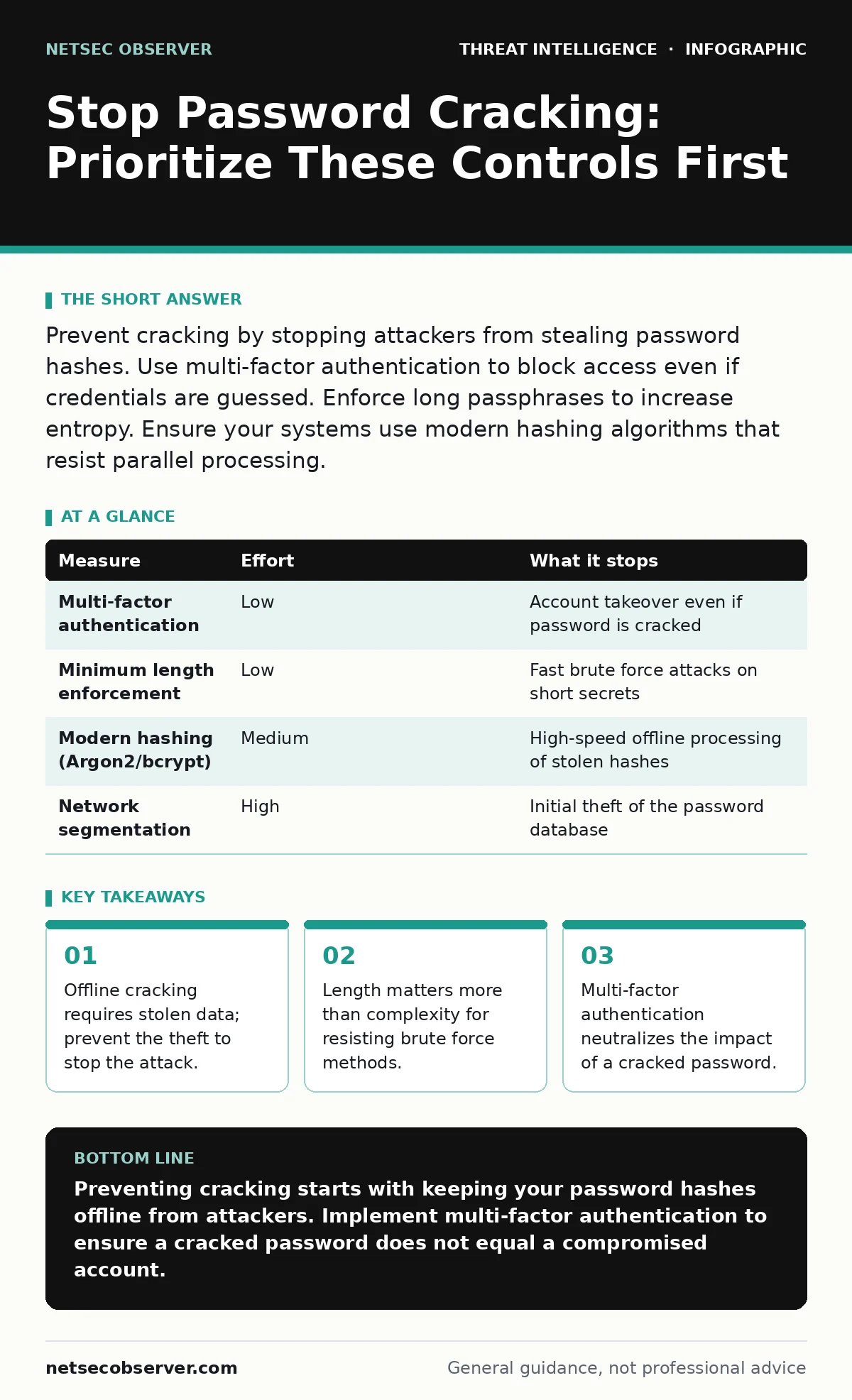
Prevent cracking by stopping attackers from stealing password hashes. Use multi-factor authentication to block access even if credentials are guessed. Enforce long passphrases to increase entropy. Ensure your systems use modern hashing algorithms that resist parallel processing.
The Mechanics of Offline Cracking
Password cracking rarely happens in real time against a login screen. Modern systems limit how many guesses you can make per minute. Attackers know this, so they avoid online guessing. Instead, they steal the password database from your server. This database contains password hashes, which are fixed-length strings created by running your password through a mathematical function. Once the attacker has these hashes, they take them home. They use powerful hardware to guess millions of passwords per second. This is called offline cracking. The attacker is no longer constrained by your server’s speed or account lockout policies. They can run their guesses as fast as their hardware allows.
Stop the Data Theft First
You cannot prevent an attacker from guessing a password if they already have the hash. The highest priority measure is preventing the initial breach. If your server is never compromised, the hashes are never stolen. This is where security telemetry becomes relevant. You need to detect unauthorized access attempts before the attacker exfiltrates the data.
Focus on protecting the integrity of your authentication systems. Use network segmentation to isolate database servers from public-facing applications. If an attacker breaches a web server, they should not have direct access to the user database. This limits the scope of what they can steal. It forces them to stay online, where your rate limiting and account lockouts work.
Enforce Length Over Complexity
Many organizations require passwords with numbers, symbols, and mixed case. This adds little defense against modern cracking tools. These tools use dictionaries of common words and rules to modify them. Adding a number to a common word is easily guessed. Length is the true defense. Each additional character increases the number of possible combinations exponentially. A twelve-character passphrase is significantly harder to crack than an eight-character complex password.
Attackers prioritize short passwords because they can be tested quickly. They move on to longer passwords only after exhausting shorter options. By enforcing a minimum length of twelve characters, you push your passwords into the range that takes years to crack with standard hardware. Do not restrict the character set. Allow users to type spaces and special characters if they wish.
Modern Hashing Algorithms
The algorithm you use to store passwords determines how fast an attacker can guess them. Simple algorithms like MD5 or SHA-1 are designed for speed. This speed helps attackers, not you. They can process billions of these hashes per second. You need algorithms designed to be slow. These algorithms introduce computational cost. They force the attacker’s hardware to work harder for each guess.
Argon2, bcrypt, and scrypt are examples of these memory-hard functions. They require significant memory and processing power. This slows down the cracking process dramatically. It turns a job that takes minutes into one that takes years. Ensure your application framework uses one of these modern standards by default. Do not roll your own cryptography. Use established libraries that have been reviewed by experts.
| Measure | Effort | What it stops |
|---|---|---|
| Multi-factor authentication | Low | Account takeover even if password is cracked |
| Minimum length enforcement | Low | Fast brute force attacks on short secrets |
| Modern hashing (Argon2/bcrypt) | Medium | High-speed offline processing of stolen hashes |
| Network segmentation | High | Initial theft of the password database |
The Role of Multi-Factor Authentication
Even if an attacker cracks a password, they should not gain access. Multi-factor authentication requires a second form of verification. This second factor is something you have, like a phone, or something you are, like a fingerprint. It is not something you know, like a password. If the attacker only has the password, they cannot complete the login. This renders the cracked password useless.
It breaks the chain of the attack. Implement this for all administrative accounts first. Then roll it out to all users. Use phishing-resistant methods where possible. SMS codes are vulnerable to SIM swapping attacks. Hardware security keys or authenticator apps are more secure. This measure provides the highest return on investment for risk reduction.
See also: OSINT tools for investigators map digital footprints · Dark Web Search Engines: Spotting the Hidden Warning Signs
What Does Not Work
Complexity requirements alone are ineffective. Forcing users to use symbols and numbers leads to predictable patterns. Users write passwords down or reuse them across sites. This increases risk rather than reducing it. Password expiration policies are also harmful. They force users to change strong passwords to weaker ones. This encourages incremental changes that attackers can predict. For example, changing "Summer2023" to "Summer2024" is easy for cracking software.
These policies create friction for users without adding security. They also encourage bad habits. Focus on detection and response instead. Monitor for signs of compromise. Use user and entity behavior analytics to spot unusual login patterns. If an account logs in from a new country at an odd hour, investigate. This helps you catch the breach early, before the attacker does significant damage.
Closing Checklist
You need to act on these three items immediately. They provide the most significant reduction in risk. Start with the controls that are easiest to implement but have the highest impact.
- Enable multi-factor authentication for all privileged accounts.
- Update password policy to require a minimum of twelve characters.
- Verify your application uses a modern hashing algorithm like Argon2 or bcrypt.
Key takeaways
- Offline cracking requires stolen data; prevent the theft to stop the attack.
- Length matters more than complexity for resisting brute force methods.
- Multi-factor authentication neutralizes the impact of a cracked password.
Preventing cracking starts with keeping your password hashes offline from attackers. Implement multi-factor authentication to ensure a cracked password does not equal a compromised account.
Frequently asked questions
Does using a password manager prevent cracking?
A password manager helps you create unique, long passwords for every site. This prevents one cracked password from compromising other accounts. It does not stop the cracking of the password itself, but it limits the damage.
How do I know if my passwords have been cracked?
You usually cannot know until the attacker uses them. Monitor for unauthorized access attempts. Check public breach databases to see if your email addresses appear in known leaks. This is part of open-source intelligence (OSINT) practices for security teams.
Are passphrases better than passwords?
Yes, passphrases are easier to remember and longer. Length is the primary defense against brute force attacks. A sentence of random words is harder to guess than a short string of complex characters.
What if I already suspect a breach?
Assume the hashes are stolen. Force a password reset for all users immediately. Enable multi-factor authentication if it is not already on. Review logs for signs of attacker reconnaissance or beaconing to detect ongoing activity.
How this guide was produced: written by the NetSec Observer editorial team with AI assistance, checked against the public references listed below, and reviewed when the facts change. See our editorial policy or report an error.