
Stop Island Hopping: Cut Lateral Movement Paths
Most defenses fail because they assume the perimeter is the only entry point, leaving internal trust relationships wide open to abuse.
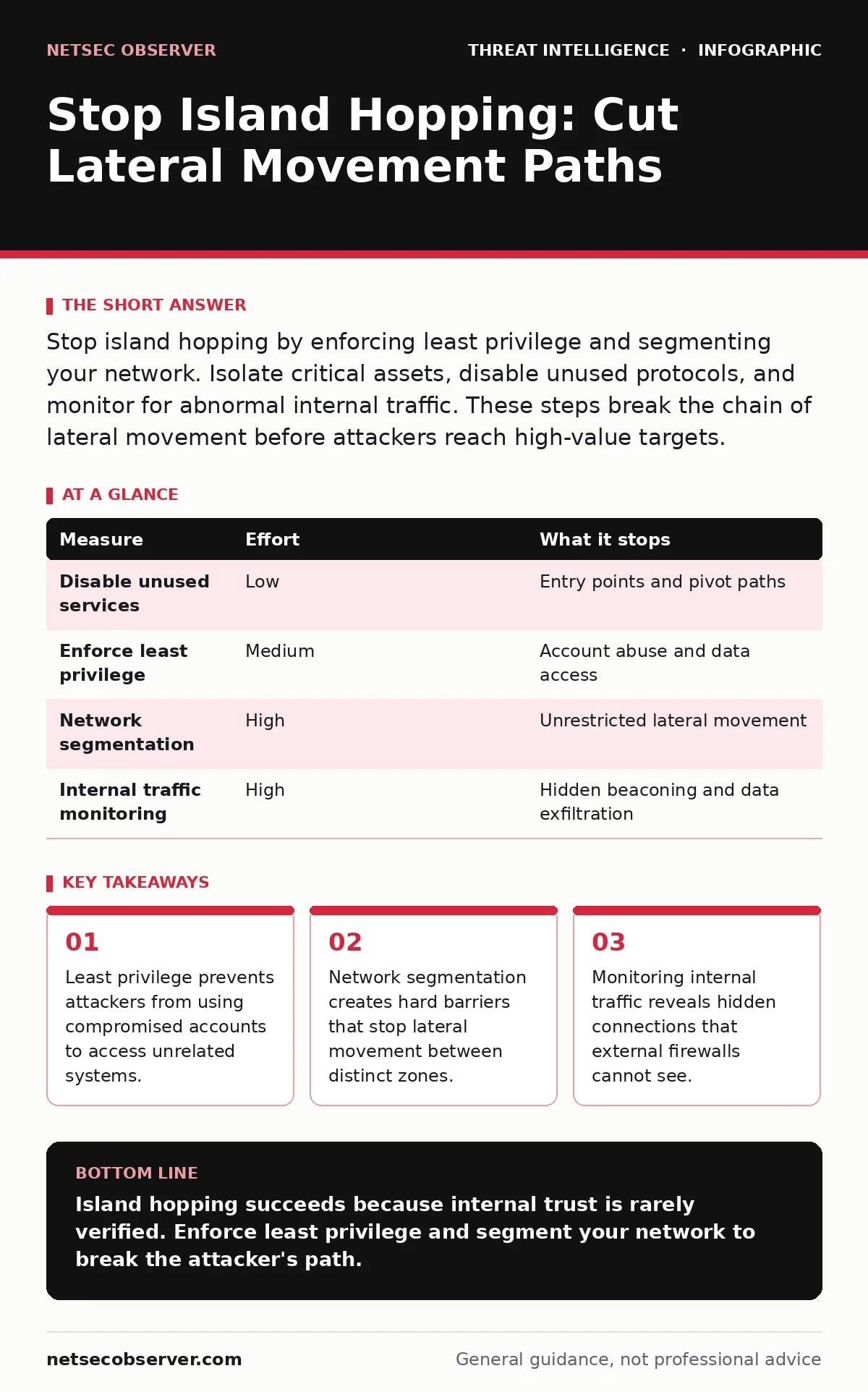
Stop island hopping by enforcing least privilege and segmenting your network. Isolate critical assets, disable unused protocols, and monitor for abnormal internal traffic. These steps break the chain of lateral movement before attackers reach high-value targets.
The Myth of the Secure Perimeter
You likely spend most of your energy securing the edges of your network. Firewalls, intrusion detection systems, and web application firewalls form a shield around your assets. This approach assumes that if you keep the bad actors out, you are safe. Island hopping attacks prove this assumption wrong.
Attackers do not always target your crown jewels directly. Instead, they look for poorly secured systems on the periphery. These might be public-facing servers, partner portals, or Internet of Things devices. Once inside one of these low-security islands, they move laterally toward higher-value targets.
This movement relies on trust. Many networks allow free flow of data between internal systems. An attacker who gains a foothold on a vulnerable web server can use that trust to pivot to a database server. They hop from one island to the next until they reach their objective.
Prioritizing Risk Reduction
Not all prevention measures are equal. Some offer quick wins with high impact. Others require significant effort but provide deeper protection. You should rank your actions by how much risk they remove relative to the effort required.
The following table outlines measures by their effectiveness in stopping lateral movement.
| Measure | Effort | What it stops |
|---|---|---|
| Disable unused services | Low | Entry points and pivot paths |
| Enforce least privilege | Medium | Account abuse and data access |
| Network segmentation | High | Unrestricted lateral movement |
| Internal traffic monitoring | High | Hidden beaconing and data exfiltration |
Quick Wins: Removing Attack Surface
Start by reducing the number of doors an attacker can open. Many systems run services that are not needed for their primary function. Each running service is a potential vulnerability. If a service is not essential, disable it.
This includes remote administration protocols that are not in use. It also includes file sharing services that expose directories to the wider network. By turning these off, you remove the initial foothold. You also remove the paths attackers use to move between systems.
Imagine a web server that also runs a database service. If the web server is compromised, the attacker has direct access to the database. Disabling the database service on that specific host forces the attacker to find another way in. This breaks the first hop in the chain.
The Core Defense: Least Privilege
The most effective way to stop lateral movement is to limit what each account can do. The principle of least privilege means giving users and processes only the permissions they need to perform their specific tasks. Nothing more.
Default accounts often have broad access. Administrators frequently leave these defaults in place because they are convenient. This convenience becomes a liability. An attacker who compromises a default admin account gains immediate access to many systems.
You must audit permissions regularly. Remove access for employees who have left or changed roles. Ensure that service accounts do not have interactive login rights. If a process does not need to write to a specific folder, it should not have that permission. This containment stops the spread of compromise.
Building Internal Barriers
Network segmentation divides your network into smaller zones. Each zone has its own security controls. Traffic between zones is restricted and monitored. This prevents an attacker from moving freely across your entire infrastructure.
Flat networks are dangerous. In a flat network, any device can talk to any other device. Once an attacker is in, they have full visibility and access. Segmentation creates choke points. These choke points allow you to inspect traffic and block unauthorized connections.
You should segment based on function. Separate development systems from production systems. Isolate guest Wi-Fi from corporate devices. Place critical databases in a restricted zone that only accepts connections from specific application servers. This structure makes island hopping significantly harder.
See also: 7 SSRF Mistakes That Expose Internal Networks to Attack · Respond to Attacker Reconnaissance: Stop the Scan Before Breach
The Hidden Cost of Trust
Many organizations rely on mutual trust between internal systems. They assume that because traffic originates inside the firewall, it is safe. This is a dangerous assumption. Attackers exploit this trust to move laterally without triggering external alarms.
This is where user and entity behavior analytics becomes valuable. Traditional tools look for known bad signatures. They often miss legitimate-looking traffic that is actually malicious. Behavioral analytics looks for anomalies. It flags a server that suddenly starts talking to a database it never contacted before.
You must also consider attacker reconnaissance. Attackers scan internal networks to map their environment. They look for open ports and shared resources. If you do not monitor internal scanning activity, you remain unaware of their presence until they strike.
What Does Not Work
Many teams believe that strong perimeter defenses are enough. They invest heavily in external firewalls and ignore internal controls. This is a mistake. Once an attacker is inside, the perimeter is irrelevant.
Another common failure is relying solely on endpoint protection. Antivirus software can detect known malware. It cannot stop an attacker from using legitimate tools like PowerShell or remote desktop protocol to move laterally. These tools are designed for administration, not attack.
Monitoring and Detection
You will not prevent every breach. You must detect lateral movement quickly. This requires visibility into internal traffic. You need to see who is talking to whom and what data is moving.
Look for unusual patterns. A workstation connecting to a domain controller at 3 AM is suspicious. A server sending large amounts of data to an external IP address is suspicious. These behaviors indicate beaconing or data exfiltration.
Integrate your logs into a central system. Correlate events from different sources. This helps you spot the chain of events that constitutes an island hopping attack. Without this visibility, you are flying blind.
Checklist for Today
Do not wait for a major overhaul. Start with these three steps today. They provide immediate risk reduction with minimal effort.
- Audit and disable unused remote access services on public-facing systems.
- Review permissions for shared administrative accounts and remove unnecessary access.
- Identify your most critical assets and verify they are not directly accessible from less secure zones.
Final Thoughts on Defense
Island hopping attacks exploit the gaps between your systems. They rely on your trust in internal traffic. By enforcing least privilege and segmenting your network, you break the path attackers need to succeed.
You must also monitor for abnormal behavior. Detection is your last line of defense. Combine these technical controls with a culture of security awareness. Every employee and system plays a role in stopping lateral movement.
Key takeaways
- Least privilege prevents attackers from using compromised accounts to access unrelated systems.
- Network segmentation creates hard barriers that stop lateral movement between distinct zones.
- Monitoring internal traffic reveals hidden connections that external firewalls cannot see.
Island hopping succeeds because internal trust is rarely verified. Enforce least privilege and segment your network to break the attacker's path.
Frequently asked questions
How do I know if I am being island hopped?
Look for unusual internal connections, such as workstations contacting servers they never normally access, or unexpected data transfers between departments.
Is network segmentation expensive to implement?
It requires planning and configuration, but modern software-defined networking tools make it easier to create logical boundaries without new hardware.
Does zero trust prevent island hopping?
Yes, zero trust assumes no user or device is trusted by default, requiring verification for every access request, which stops lateral movement.
Can endpoint detection and response stop lateral movement?
It can detect some malicious activities on endpoints, but it cannot stop network-level pivoting if internal traffic is not monitored and restricted.
How this guide was produced: written by the NetSec Observer editorial team with AI assistance, checked against the public references listed below, and reviewed when the facts change. See our editorial policy or report an error.