
Encryption vs Hashing: How to Choose the Right Data Protection
Hashing destroys data to verify integrity, while encryption hides data to preserve it, creating two distinct security paths for different threats.
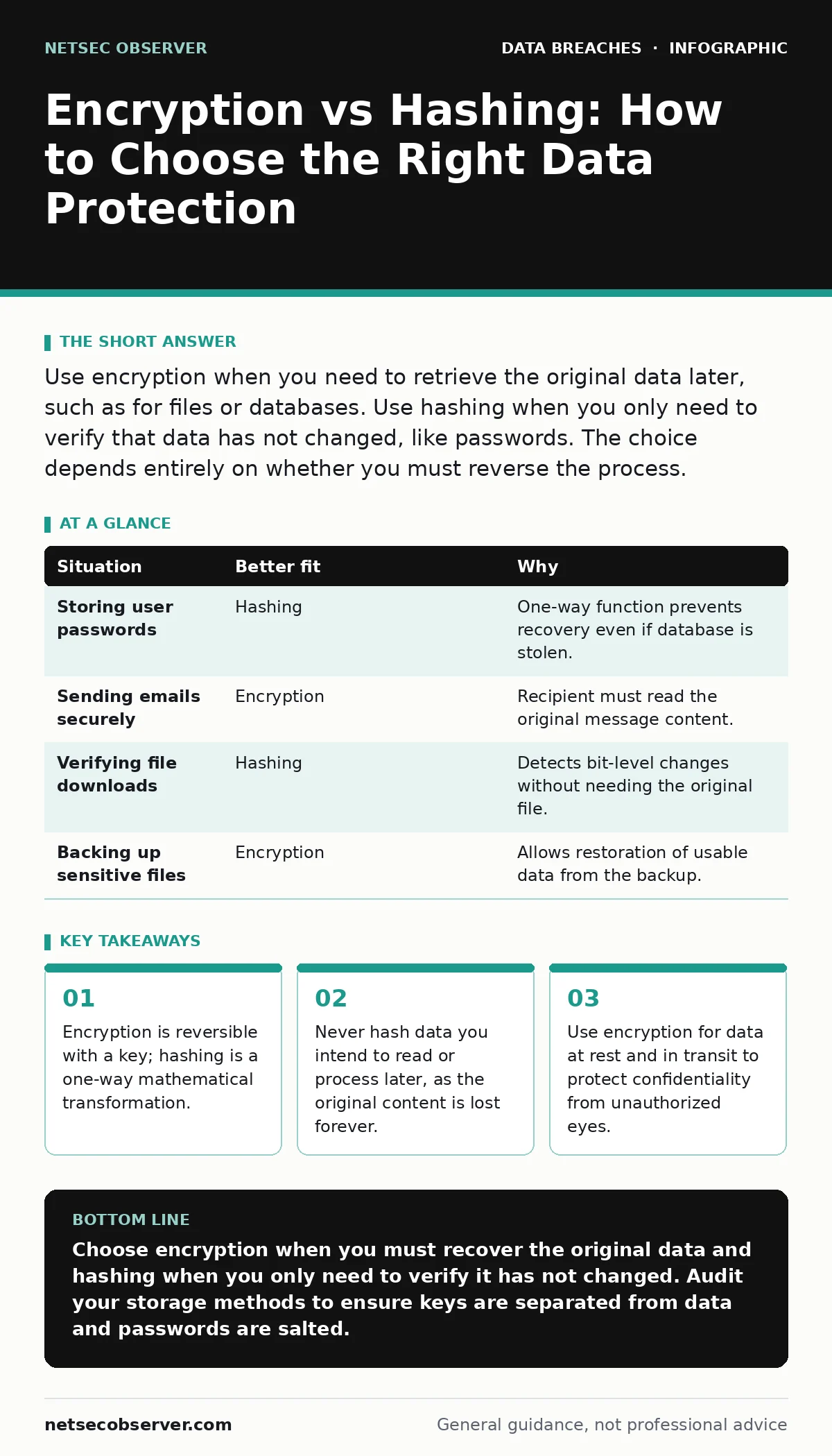
Use encryption when you need to retrieve the original data later, such as for files or databases. Use hashing when you only need to verify that data has not changed, like passwords. The choice depends entirely on whether you must reverse the process.
Do You Need to Read the Data Later?
The first question determines your entire architecture. If you need to retrieve the original information, you must use encryption. Encryption transforms plaintext into ciphertext using an algorithm and a key. The same key, or a related one, reverses the process. This preserves the data’s utility while hiding its contents from anyone without the key.
Hashing works differently. It takes input of any size and produces a fixed-size string of characters, known as a digest. This process is one-way. You cannot derive the original input from the hash. If you hash a document, you cannot read the document again. You can only check if a new hash matches the old one to prove the file has not changed.
Imagine you store customer addresses. You need to mail invoices. Encryption allows you to decrypt the address when needed. Hashing would leave you with a string of random characters, useless for printing a label.
Is the Goal Confidentiality or Integrity?
Confidentiality means keeping information secret. Integrity means ensuring information has not been altered. These are different security goals requiring different tools. Encryption provides confidentiality. It stops an attacker from reading sensitive data even if they steal the storage device.
Hashing provides integrity. It acts as a digital fingerprint. If a single bit changes in the original data, the hash changes completely. This makes it easy to detect tampering. You use hashing to verify software downloads or to ensure database records remain unchanged since their creation.
How Will You Handle the Keys?
Encryption introduces a critical dependency: key management. You must store the decryption key securely. If you lose the key, the data is gone forever. If an attacker finds the key, the encryption is useless. This creates a continuous operational burden. You must rotate keys, back them up, and restrict access strictly.
Hashing has no keys to manage for basic verification. However, for passwords, you must add a "salt". A salt is random data added to the password before hashing. This prevents attackers from using precomputed tables, called rainbow tables, to reverse common passwords. You must store the salt alongside the hash. Losing the salt makes verification impossible, but it is less risky than losing an encryption key.
When to Use Both Together
Complex systems often require both mechanisms. You might encrypt a database to protect confidentiality at rest. Simultaneously, you hash the primary keys or checksums to detect if the database structure was tampered with. This layered approach protects against both eavesdropping and modification.
Consider password storage. You never encrypt passwords. You hash them. If you encrypt passwords, an attacker who steals the database and the key can read every password. If you hash them, the attacker only gets the hashes. They must guess passwords to match the hashes, which is computationally difficult.
| Situation | Better fit | Why |
|---|---|---|
| Storing user passwords | Hashing | One-way function prevents recovery even if database is stolen. |
| Sending emails securely | Encryption | Recipient must read the original message content. |
| Verifying file downloads | Hashing | Detects bit-level changes without needing the original file. |
| Backing up sensitive files | Encryption | Allows restoration of usable data from the backup. |
Poor choices in this area lead to database exposure. If you encrypt data but store the key in the same configuration file, you have failed. Proper encryption key management separates the key from the data, often using hardware security modules or dedicated key vaults.
You must also consider third-party risk assessments. If you send hashed data to a vendor, they cannot re-identify the source. If you send encrypted data, they can decrypt it. The choice affects your compliance with privacy impact assessments.
The Hidden Cost of Reversibility
Encryption allows recovery, which is a feature and a vulnerability. In a breach, encrypted data is useless without the key. But if your system decrypts data for processing in memory, that memory can be dumped by an attacker. Hashing avoids this entirely. The original data never exists in memory during verification.
This distinction matters for accidental data disclosure. If a developer accidentally logs encrypted data, it is safe if the key is not in the log. If they log a hash, it is also safe. But if they log plaintext because they forgot to encrypt, the damage is done. The decision to hash or encrypt dictates how you handle data in logs and temporary storage.
See also: Personally Identifiable Information: Small Business Protection Strategies · Data Scraping: How It Works and How to Stop It
Final Verification Steps
Before implementing, ask who needs to read the data. If the answer is "nobody, except to check if it matches," use hashing. If the answer is "users or applications," use encryption. Never mix them up. Encrypting a password field is a common error that wastes resources and creates false confidence. Hashing a credit card number is a fatal error that renders the data useless for transactions.
Review your breach notification laws. Some regulations require encryption of personal data. They rarely require hashing, except for specific identifiers. Using the wrong tool can lead to non-compliance. Ensure your architecture supports the legal and operational needs of your data.
Key takeaways
- Encryption is reversible with a key; hashing is a one-way mathematical transformation.
- Never hash data you intend to read or process later, as the original content is lost forever.
- Use encryption for data at rest and in transit to protect confidentiality from unauthorized eyes.
Choose encryption when you must recover the original data and hashing when you only need to verify it has not changed. Audit your storage methods to ensure keys are separated from data and passwords are salted.
Frequently asked questions
Can I decrypt a hash if I lose the original file?
No. Hashing is a one-way mathematical process. Once the data is hashed, the original input is mathematically destroyed and cannot be reconstructed.
Is hashing safer than encryption for passwords?
Yes. Hashing ensures that even if the database is stolen, the actual passwords cannot be retrieved. Encryption allows recovery, which means an attacker with the key can read all passwords.
Do I need a salt for every hash?
Yes. A salt is unique random data added to each input before hashing. It ensures that identical inputs produce different hashes, preventing attackers from using precomputed tables to reverse them.
Can I use the same key for encryption and hashing?
No. Encryption keys and hashing salts serve different purposes. Mixing them can weaken security. Use distinct, strong random values for each function to maintain proper isolation.
How this guide was produced: written by the NetSec Observer editorial team with AI assistance, checked against the public references listed below, and reviewed when the facts change. See our editorial policy or report an error.