
GDPR Breach Notification Rules for Small Businesses: What You Must Do
Small companies face the same strict 72-hour reporting deadline for data breaches as global corporations, regardless of their size or budget constraints.
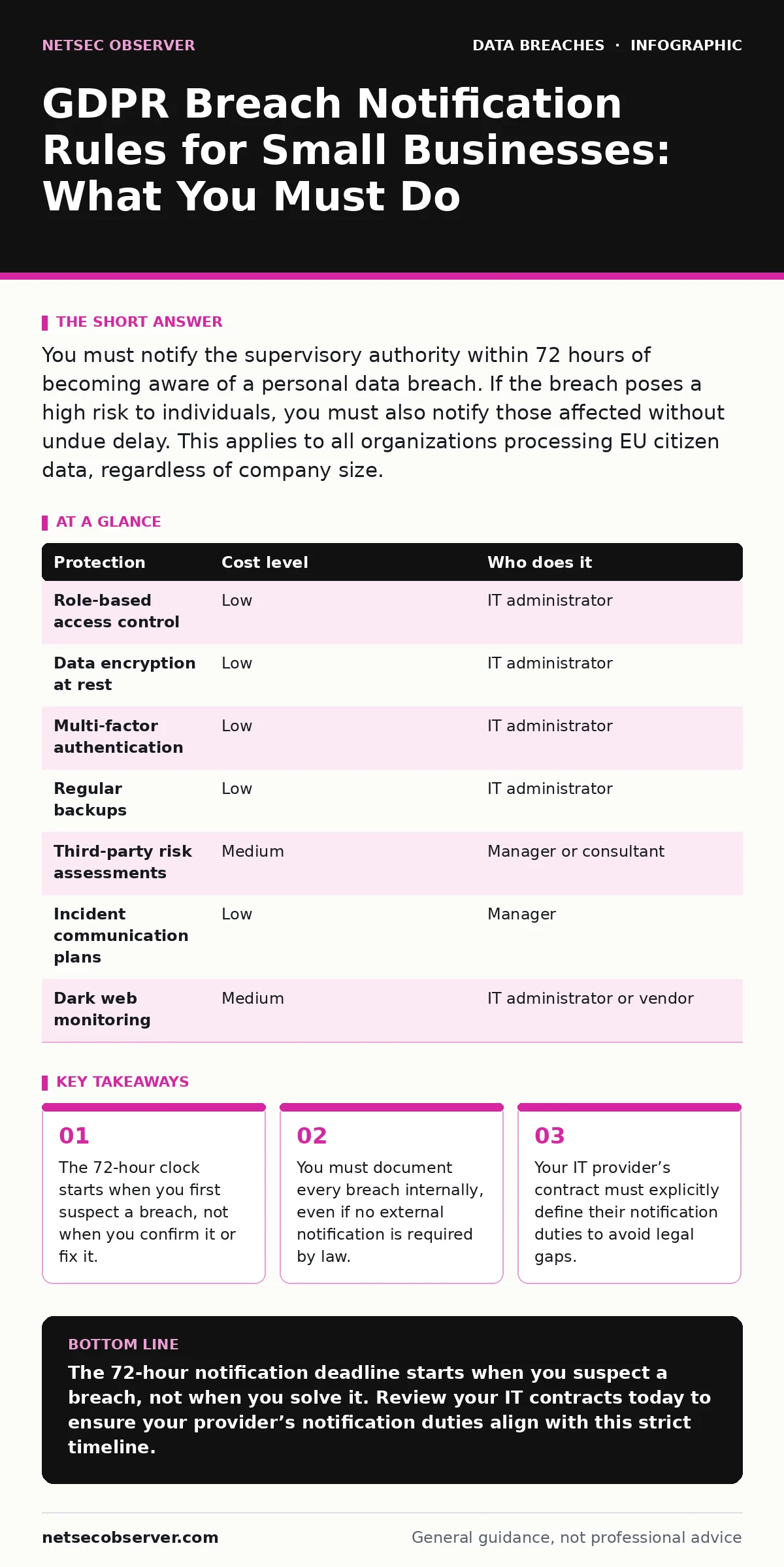
You must notify the supervisory authority within 72 hours of becoming aware of a personal data breach. If the breach poses a high risk to individuals, you must also notify those affected without undue delay. This applies to all organizations processing EU citizen data, regardless of company size.
The 72-Hour Clock Starts Earlier Than You Think
The General Data Protection Regulation requires organizations to report personal data breaches to the relevant supervisory authority within 72 hours of becoming aware of the incident. Many small business owners misunderstand this deadline. They believe the clock starts when they have fully investigated the cause or when they have restored systems. The law does not work that way. The timer begins the moment you have reasonable grounds to suspect a breach has occurred.
This distinction creates a significant operational challenge. You must report based on incomplete information. You will likely not know the exact number of affected records or the full scope of the damage at the 72-hour mark. The regulation allows for this uncertainty. You can submit an initial notification with known facts and provide further details as soon as they become available. This mechanism prevents delays caused by perfectionism. It forces you to prioritize speed over completeness in the initial alert.
Delaying the report to gather more data increases your legal risk. Supervisory authorities view late notifications as a failure of governance, regardless of the technical complexity of the breach. You must have a process that triggers the reporting sequence immediately upon detection. This process must bypass normal approval chains. Speed is the primary compliance requirement.
Why Scale Does Not Protect You
Small businesses often assume they are invisible to regulators. They believe that limited resources or low revenue exempt them from strict compliance standards. The GDPR does not include a small business exemption. If you process the personal data of individuals in the European Economic Area, the rules apply to you. The definition of personal data is broad. It includes names, email addresses, IP addresses, and even cookie identifiers.
Processing this data creates liability. A breach at a small scale can still cause significant harm to individuals. Identity theft, financial fraud, and reputational damage do not discriminate based on company size. Regulators assess the risk to the rights and freedoms of data subjects. They do not assess your annual revenue before enforcing penalties. Fines can reach significant percentages of global turnover or fixed monetary amounts, whichever is higher. For a small business, even the lower fixed amounts can be catastrophic.
You must treat your data with the same rigor as a large corporation. The expectations for security and transparency are identical. Your lack of a dedicated security team does not excuse non-compliance. It may, however, influence how you structure your defenses. You must implement measures appropriate to your risk profile. This means focusing on high-impact, low-cost controls rather than expensive, complex systems.
Documenting Breaches You Never Report
Not every security incident requires external notification. You do not need to report a breach if it is unlikely to result in a risk to the rights and freedoms of natural persons. Examples include encrypted data that cannot be decrypted, or data that was immediately recovered without exposure. However, you must still document every breach internally. This internal record-keeping is a mandatory requirement.
The documentation must include the facts relating to the breach. You must record the categories and approximate number of data subjects concerned. You must describe the likely consequences of the breach. You must detail the measures taken to address the breach and mitigate its possible adverse effects. This internal log serves two purposes. It demonstrates accountability to regulators. It provides a history of incidents that helps you identify patterns and improve security.
Failing to maintain these records is a violation in itself. Regulators may request these logs during audits or investigations. Without them, you cannot prove that you assessed the risk correctly. You cannot prove that you decided not to notify based on sound reasoning. The documentation must be thorough and contemporaneous. Retrospective entries are viewed with suspicion.
Protecting Data Without Breaking the Bank
Implementing security controls requires balancing protection with cost. Small businesses cannot replicate the security infrastructure of large enterprises. They must select controls that provide the highest return on investment. The following table outlines common protections and their relative costs.
| Protection | Cost level | Who does it |
|---|---|---|
| Role-based access control | Low | IT administrator |
| Data encryption at rest | Low | IT administrator |
| Multi-factor authentication | Low | IT administrator |
| Regular backups | Low | IT administrator |
| Third-party risk assessments | Medium | Manager or consultant |
| Incident communication plans | Low | Manager |
| Dark web monitoring | Medium | IT administrator or vendor |
Role-based access control ensures that employees only access data necessary for their jobs. This limits the damage if credentials are compromised. Data encryption at rest renders stolen data useless without the decryption key. Multi-factor authentication adds a layer of security beyond passwords. These three controls form the foundation of small business security. They are widely available and often included in standard software suites.
Regular backups allow you to restore data after a ransomware attack. You must test these backups regularly. Unverified backups are useless during a crisis. Incident communication plans ensure that you know who to call and what to say when a breach occurs. This reduces panic and speeds up response times. Dark web monitoring can alert you if your credentials appear in leaked databases. This is a proactive measure that helps you detect breaches early.
What to Ask Your IT Provider
Many small businesses outsource their IT functions. This creates a dependency that must be managed carefully. Your IT provider is a processor of your data. They have legal obligations under the GDPR. You must ensure that their contract reflects these obligations. You must ask specific questions to verify their compliance.
- Does your contract explicitly state that you will notify us of any breach within a specified timeframe?
- Do you perform third-party risk assessments on your own suppliers and subcontractors?
- How do you handle personally identifiable information in your development and testing environments?
- What is your process for detecting database exposure or unauthorized access?
- Do you provide logs and evidence of security monitoring for our review?
These questions help you understand the provider’s security posture. They also clarify their responsibilities during an incident. If your provider fails to notify you promptly, you may miss the 72-hour deadline. This makes you liable. You must ensure that the contract includes a clause that allows you to terminate the agreement if they fail to meet security standards. You must also ensure that they return or destroy your data upon termination.
See also: Log Tampering Risks and Protection for Small Businesses · Personally Identifiable Information: Small Business Protection Strategies
The Hidden Cost of Vendor Risk
Your security is only as strong as your weakest partner. Small businesses often rely on a few key vendors. These vendors may have less rigorous security practices. A breach at a vendor can expose your data and trigger your notification obligations. You are responsible for the data you share with them. This is known as vendor risk management.
You must assess the security practices of your vendors. This does not require a full audit. It requires a basic review of their security policies and certifications. You should ask for their security whitepapers or compliance reports. You should verify that they use encryption and access controls. You should ensure that they have a process for handling breaches.
Ignoring vendor risk is a common mistake. Small businesses often assume that reputable vendors are secure. This assumption is dangerous. A breach at a small vendor can still expose your data. You must treat vendor risk as part of your own risk profile. You must monitor their security posture over time. You must have a plan for replacing vendors that fail to meet your standards.
Preparing for the Inevitable Incident
No security measure guarantees complete protection. You will experience security incidents. The goal is to minimize their impact and meet your legal obligations. An incident communication plan is critical. This plan defines who speaks to the media, who contacts regulators, and who informs customers. It ensures that messages are consistent and accurate.
You must practice this plan. Run tabletop exercises with your team. Simulate a breach and walk through the notification process. Identify gaps in your knowledge or resources. Update the plan based on the exercise. This preparation reduces stress and errors during a real incident. It ensures that you can meet the 72-hour deadline.
You must also consider data scraping as a threat. Attackers often scrape public websites for employee information. This information can be used in phishing attacks. You should limit the amount of personal data published on your website. You should monitor for unauthorized use of your data. This proactive approach reduces the likelihood of successful attacks.
Key takeaways
- The 72-hour clock starts when you first suspect a breach, not when you confirm it or fix it.
- You must document every breach internally, even if no external notification is required by law.
- Your IT provider’s contract must explicitly define their notification duties to avoid legal gaps.
The 72-hour notification deadline starts when you suspect a breach, not when you solve it. Review your IT contracts today to ensure your provider’s notification duties align with this strict timeline.
Frequently asked questions
Do I need to notify customers if the data was encrypted?
You generally do not need to notify customers if the encrypted data is unreadable and the encryption key was not compromised. You must still document the breach internally.
What if I am not sure if a breach occurred?
If you have reasonable grounds to suspect a breach, you must start the investigation immediately. The 72-hour clock begins at the moment of suspicion, not confirmation.
Can I use a third-party service to handle notifications?
Yes, you can use a third-party service for legal or communication support. However, you remain legally responsible for the accuracy and timeliness of the notification.
How long must I keep breach records?
You must keep internal records of breaches for as long as required by your national supervisory authority. This is often several years. Check your local regulations.
How this guide was produced: written by the NetSec Observer editorial team with AI assistance, checked against the public references listed below, and reviewed when the facts change. See our editorial policy or report an error.