
Ransomware Payment Debate: The Hidden Economics of Extortion
Paying ransomware operators often funds further attacks while leaving no guarantee of decryption, making non-payment the primary defense strategy.
The ransomware payment debate centers on whether paying extorts operators or ensures recovery. Evidence suggests payment rarely guarantees data return and often encourages repeat attacks. Organizations must focus on immutable backups and detection rather than financial negotiations to survive these incidents effectively.
The Economic Engine of Extortion
Ransomware operates as a service economy. Operators develop code, sell access to infected networks, and negotiate payments through encrypted channels. You are not just fighting a piece of software; you are engaging with a business model that relies on speed and fear. Understanding this model helps you predict operator behavior during an incident.
The debate over payment often assumes that paying restores normalcy. This assumption is flawed. Operators frequently fail to provide working decryption keys. Even when they do, the organization remains vulnerable because the initial entry point remains open. The financial transaction does not fix the security gap that allowed the intrusion.
The Mechanics of Infection
The attack begins with initial access. This might occur through a phishing email that exploits weak macro security settings or through a vulnerability in a public-facing service. Once inside, the operator moves laterally to find high-value data. They prioritize databases and file servers.
Imagine a scenario where an attacker compromises a single workstation. They do not immediately encrypt files. Instead, they map the network to identify backup systems. If you rely on real-time protection solely for prevention, you may miss this quiet phase. The operator is preparing for maximum impact, not immediate destruction.
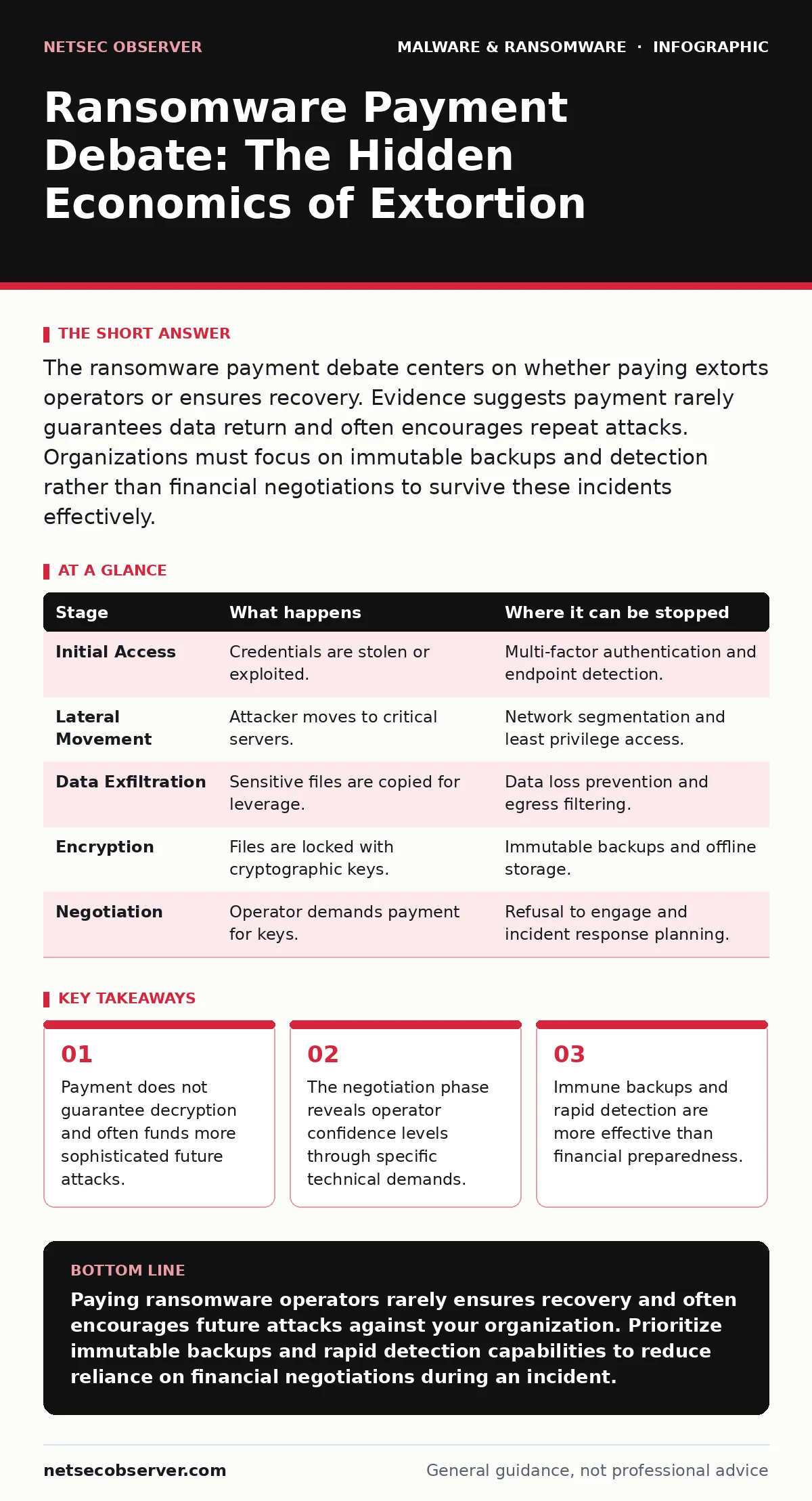
| Stage | What happens | Where it can be stopped |
|---|---|---|
| Initial Access | Credentials are stolen or exploited. | Multi-factor authentication and endpoint detection. |
| Lateral Movement | Attacker moves to critical servers. | Network segmentation and least privilege access. |
| Data Exfiltration | Sensitive files are copied for leverage. | Data loss prevention and egress filtering. |
| Encryption | Files are locked with cryptographic keys. | Immutable backups and offline storage. |
| Negotiation | Operator demands payment for keys. | Refusal to engage and incident response planning. |
The Negotiation Phase
When encryption occurs, the operator presents a ransom note. This note is a template, but the subsequent communication reveals their strategy. They will claim to have exfiltrated data. This is double extortion. They threaten to publish sensitive information if you do not pay.
You must verify these claims. Operators often bluff. They may claim to have terabytes of data when they only have gigabytes. Malware analysis can help determine if the ransomware variant actually includes exfiltration capabilities. Some older variants only encrypt local files. Knowing this distinction prevents unnecessary panic and financial loss.
The Decision to Pay or Refuse
The decision to pay is rarely about the cost of the ransom. It is about the perceived cost of downtime and reputational damage. However, paying has hidden costs. You provide the operator with proof of concept. They know your organization is likely to pay. This makes you a target for repeat attacks.
Suppose you pay the ransom. The operator provides a decryption tool. You restore your files. However, the operator still has your exfiltrated data. They may sell it on dark web forums months later. You have paid once, but the threat persists. Non-payment forces the operator to move on to easier targets.
The Role of Backups
Backups are the primary countermeasure to ransomware. However, not all backups are equal. If your backups are connected to the same network as your production systems, the ransomware may encrypt them too. You need immutable backups. These are backups that cannot be changed or deleted for a set period.
Imagine your backups are stored on a cloud service with versioning enabled. The ransomware encrypts the latest version. You can roll back to a previous, clean version. This capability is more valuable than any decryption key. Regular testing of backup restoration is critical. A backup that cannot be restored is no backup at all.
See also: Malware Analysis FAQ: Answers to Common Questions · Build an Incident Communication Plan That Prevents Panic
The Aftermath and Recovery
Recovery involves more than decrypting files. You must identify the root cause. If you do not find the initial entry point, the operator can return. This requires thorough forensic analysis. You may need to rebuild systems from scratch to ensure no backdoors remain.
The financial cost of recovery often exceeds the ransom amount. Downtime, forensic investigations, and legal fees add up. By refusing to pay, you avoid the direct financial loss but incur these operational costs. These costs are predictable and manageable. The cost of paying is unpredictable and ongoing.
The Broader Security Context
Ransomware does not exist in isolation. It is part of a larger ecosystem of cybercrime. Operators may use malvertising to distribute their malware. They may exploit SEO poisoning to trick users into visiting malicious sites. Understanding these distribution methods helps you strengthen your perimeter.
You should also consider the impact on different operating systems. Linux malware is becoming more common as organizations adopt cloud infrastructure. Ransomware targeting Linux servers can disrupt critical services. Your defense strategy must cover all platforms, not just Windows endpoints.
The Future of Ransomware Defense
The debate over payment will continue. However, the technical reality is clear. Payment is a high-risk strategy with low reward. The industry is shifting toward resilience. This means accepting that breaches will happen and focusing on rapid detection and recovery.
Dynamic malware analysis can help detect new ransomware variants before they encrypt files. By monitoring behavior rather than signatures, you can stop attacks in the early stages. This proactive approach reduces the likelihood of needing to make the payment decision.
Practical Steps for Organizations
Start by auditing your backup infrastructure. Ensure backups are immutable and offline. Test restoration procedures regularly. Next, implement network segmentation to limit lateral movement. Use multi-factor authentication to protect against credential theft.
Train your staff to recognize phishing attempts. Human error is often the first step in a ransomware attack. Finally, develop an incident response plan that includes a clear policy on ransom payments. Decide in advance that you will not pay. This removes the emotional pressure during a crisis.
Key takeaways
- Payment does not guarantee decryption and often funds more sophisticated future attacks.
- The negotiation phase reveals operator confidence levels through specific technical demands.
- Immune backups and rapid detection are more effective than financial preparedness.
Paying ransomware operators rarely ensures recovery and often encourages future attacks against your organization. Prioritize immutable backups and rapid detection capabilities to reduce reliance on financial negotiations during an incident.
Frequently asked questions
Is it legal to pay a ransomware ransom?
Laws vary by jurisdiction. Some countries prohibit payments to designated criminal entities or sanctioned groups. Consult legal counsel before making any payment.
How do I know if the operator has actually stolen my data?
You often cannot know for certain. Operators may bluff. Forensic analysis can determine if the ransomware variant has exfiltration capabilities, but it cannot confirm what specific data was taken.
What is double extortion?
Double extortion is when attackers encrypt your files and also steal sensitive data. They threaten to publish the stolen data if you do not pay the ransom.
Can I recover files without paying?
In some cases, decryption tools are available for older ransomware variants. However, for new variants, recovery usually depends on clean backups.
How this guide was produced: written by the NetSec Observer editorial team with AI assistance, checked against the public references listed below, and reviewed when the facts change. See our editorial policy or report an error.